


Audio By Carbonatix
The management of the Asunafo North Municipal Assembly in the Ahafo Region, as part of measures to curb habitual waste dumping and littering, has processed several sanitation offenders for court next week in Goaso.
The intervention follows the failure of multiple public education campaigns to address the municipality's deep-seated environmental challenges.
Speaking on Thursday during a town hall meeting in Goaso, the Municipal Environmental Health Officer, Rejoice Ntiamoah, revealed that both formal and informal educational efforts to change residents' behaviours regarding uncleanliness had hit a wall.
Mrs Ntiamoah stated that all the documentation is complete and that the offenders, especially shop owners and residents who deliberately ignored the municipality’s monthly cleanup exercise, are set to be arraigned.

She emphasised that triggering the assembly’s by-laws to punish offenders has become urgent to serve as a strong deterrent to others. She further urged closer collaboration among stakeholders to salvage the area's failing sanitation system and avert potential disease outbreaks.
The upcoming prosecutions come at a time when the Asunafo North Municipality is battling a severe Water, Sanitation, and Hygiene (WASH) crisis.
The area is currently grappling with a severe drinking water shortage in Goaso, rampant open defecation, indiscriminate littering, air and water pollution, and heavily blocked waterways.
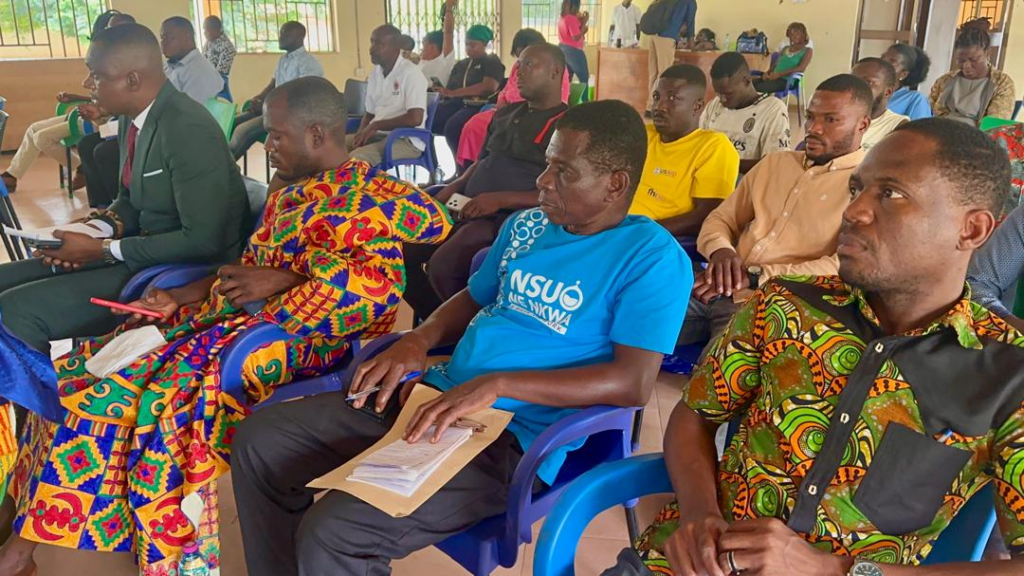
During the town hall, local residents, including persons living with disabilities (PWDs), voiced frustrations over these deteriorating WASH standards. They explicitly entreated structural engineers to ensure that public water and sanitation facilities are designed to be disability-friendly.
Providing hope on the utility front, water service providers assured the community that contractors would soon return to the site of the stalled Goaso Water System project to restore a reliable water supply.
The face-to-face accountability meeting was organised by IRC-Ghana, the Ahafo Regional Coordinating Council, and the Asunafo North Municipal Assembly.
Driven by a recent water user satisfaction survey, the engagement allowed authorities, service providers, and residents to directly confront delivery gaps.
Afua Pomaa Anguah Dei, a Programs Officer with IRC-Ghana, noted that the forum successfully achieved its purpose by identifying a critical communication gap between service providers and consumers.

She remarked that improved water and sanitation systems are not a one-person show but a united collaboration between stakeholders, adding that the meeting established concrete timelines to address the discovered shortfalls.
In Ghana, the mandate for Metropolitan, Municipal, and District Assemblies (MMDAs) to arrest and prosecute sanitation violators is firmly anchored in national legislation.
Backed by Section 181 of the Local Governance Act, 2016, the Public Health Act, 2012, and the Criminal Offences Act, 1960, authorities maintain they have the full statutory power to prosecute anyone compromising public health.
By testing these prosecutorial powers in court next week, the Asunafo North Municipal Assembly aims to reinforce institutional respect, safeguard public health, and send a clear message that environmental lawlessness will no longer be tolerated.
Latest Stories
-
Total expenditure as of July 2026 amounted to GH¢147.07bn, 16% below target – BoG
2 hours -
Total revenue & grants stood at GH¢144.5bn in July 2026, slightly below target – BoG
2 hours -
Ghana Sports Fund urges sports federations to submit credible proposals and measurable targets
2 hours -
Sally Rooney books withdrawn in UK over Palestine Action support
2 hours -
Musk says US government may be behind slowdown of Ukraine drone speeds
2 hours -
Picking Chief Justices nearing retirement could give Mahama immense power – Bentil
2 hours -
Netflix to shed 1,000 jobs in steepest cuts since 2022
3 hours -
Burnham had two hospitality dinners with Man City chairman, deleted records show
3 hours -
Semenyo ‘froze’ after alleged racist abuse, court told
3 hours -
‘Shameless’ – Mourinho critical of Vinicius Jr ban timing
3 hours -
Loyalty can outweigh competence in Chief Justice selection – Bentil
3 hours -
Man City suffer as PSG masterclass sets up Champions League win
4 hours -
Customer Service Africa CEO urges business leaders to observe staff and customer interactions
4 hours -
On night of mayhem for Liverpool, Barcola arrives in style
4 hours -
Muzic Mensah finds healing and renewed love in new single ‘WayƐ Late’
4 hours