

Audio By Carbonatix
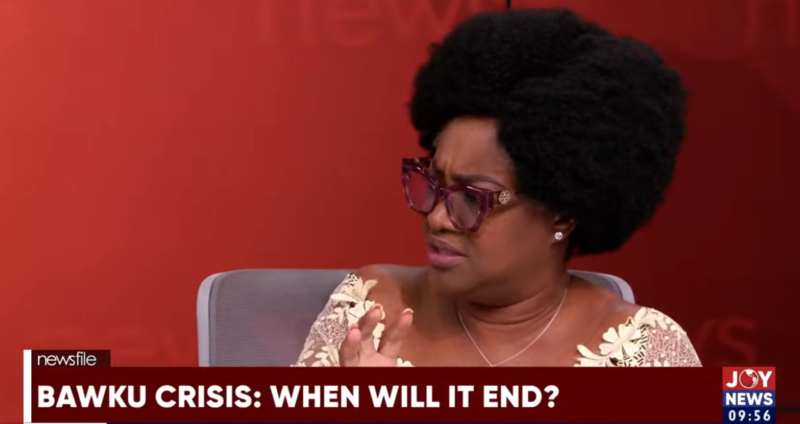
The Executive Secretary of the National Interest Movement, Susan Adu-Amankwah, has said that military enforcement cannot bring lasting peace to the troubled town of Bawku.
Speaking on JoyNews’ Newsfile on Saturday, April 12, she urged for a more thoughtful and inclusive approach to resolving the long-standing conflict.
“Peace is not a sudden event, it is not a destination, it is a journey, it takes time, it takes effort and it takes commitment. Both sides have to feel that there is something to gain by peace,” she explained.
Referring to the ethnic tensions between the Kusasis and Mamprusis in Bawku, she expressed hope that the two groups would eventually recognise the mutual benefit of peaceful coexistence.
“Bawku has not grown, and at a point, both the Kusasis and the Mamprusis will see that there is something to gain by peace,” she said.
She criticised recent attempts to force integration in the area, saying that such actions have only worsened the situation. “My understanding was that peace by force was trying to happen,” she said. “Apparently the police said they were going to force integration, so they bussed Mamprusi women to the market. It was in that scuffle that a policeman shot the youth leader, and that sparked this present situation.”
Adu-Amankwah warned that trying to impose peace through military means would not address the underlying issues.
“You cannot enforce peace, you cannot push the peace,” she said. “Peace is not the absence of conflict, it is a state of harmony, justice, and calmness. Getting the military to go there and enforce it does not necessarily mean there is peace. We need to go to the root of the matter.”
She expressed support for the Asantehene’s involvement in efforts to resolve the crisis, noting his deep understanding of the issue and the respect he commands.
“The Asantehene is going there because he knows the root,” she said. “We shouldn’t expect him to wave a magic wand. He has to work for that peace.”
Adu-Amankwah also appealed to the youth of Bawku to remain calm. “We would want the young people to tone down, because they are the ones going to be the victims if they don’t.”
She made a reflection on the cost of the crisis, not only in terms of security operations, but also in lost potential.
“It is expensive to send the police and military there. It is expensive to have a part of our nation not growing,” she said. “We have to look at the pros and cons of what is more expensive and what is more long term."
Latest Stories
-
Gov’t to establish Prison Industrial Hub to equip inmates with income-generating skills – Prison Service boss
8 minutes -
Alhassan Tampuli donates cement, roofing sheets to support storm victims in Gushegu
8 minutes -
Alhassan Tampuli appeals for urgent support for storm victims in Gushegu
11 minutes -
The hypocrisy must stop; pass Anti-LGBTQ+ Bill now – Alhassan Tampuli to Mahama
15 minutes -
Imprisonment should be rehabilitative, not punitive – Ghana Prisons boss at UNGA
37 minutes -
Ga Adangbe traditional priests petition Mahama over McDan aviation licence revocation
48 minutes -
Anti-LGBTQ Bill: NDC’s arrogance is worrying – Hassan Tampuli
59 minutes -
Let’s give OSP time to mature, not to scrap it – Hassan Tampuli
1 hour -
Nigeria convicts 386 Islamist militants in mass trials
1 hour -
Djibouti president wins election with 97.8% of vote, state media says
1 hour -
We don’t have mandate to deduct tax from rent allowance of security services personnel – Interior Ministry clarifies
1 hour -
Ablakwa receives Presidential Special Envoy on Reparations to advance global agenda
2 hours -
Christina Koch becomes first woman to travel around the moon on Artemis II
2 hours -
Epstein survivors’ calls to meet King Charles and Queen harder to ignore as US visit approaches
2 hours -
UN Secretary-General names Ghana’s Anita Kiki Gbeho as South Sudan envoy
2 hours