


Audio By Carbonatix
Bitcoin uses more electricity annually than the whole of Argentina, analysis by Cambridge University suggests.
"Mining" for the cryptocurrency is power-hungry, involving heavy computer calculations to verify transactions.
Cambridge researchers say it consumes around 121.36 terawatt-hours (TWh) a year - and is unlikely to fall unless the value of the currency slumps.
Critics say electric-car firm Tesla's decision to invest heavily in Bitcoin undermines its environmental image.
The currency's value hit a record $48,000 (£34,820) this week. following Tesla's announcement that it had bought about $1.5bn bitcoin and planned to accept it as payment in future.
But the rising price offers even more incentive to Bitcoin miners to run more and more machines.
And as the price increases, so does the energy consumption, according to Michel Rauchs, researcher at The Cambridge Centre for Alternative Finance, who co-created the online tool that generates these estimates.
“It is really by design that Bitcoin consumes that much electricity,” Mr Rauchs told BBC’s Tech Tent podcast. “This is not something that will change in the future unless the Bitcoin price is going to significantly go down."
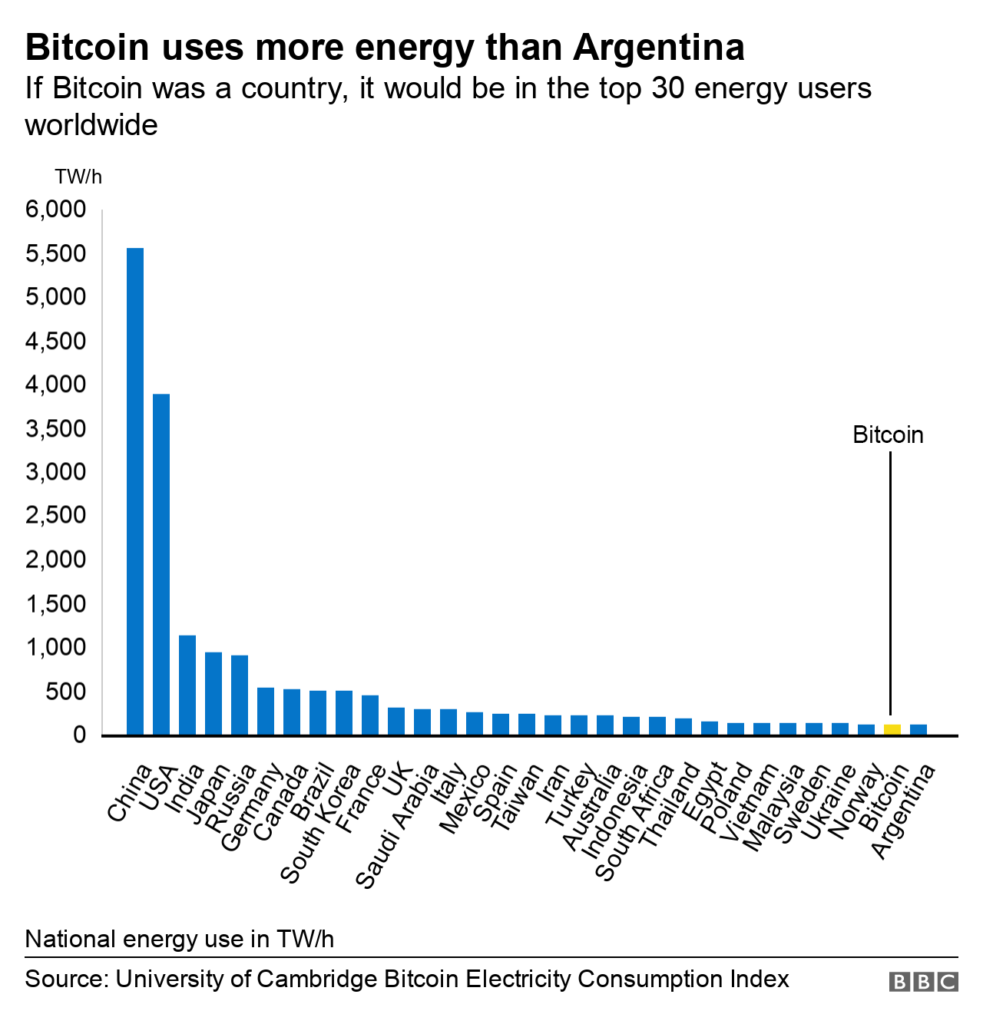
The online tool has ranked Bitcoin’s electricity consumption above Argentina (121 TWh), the Netherlands (108.8 TWh) and the United Arab Emirates (113.20 TWh) - and it is gradually creeping up on Norway (122.20 TWh).
The energy it uses could power all kettles used in the UK for 27 years, it said.
However, it also suggests the amount of electricity consumed every year by always-on but inactive home devices in the US alone could power the entire Bitcoin network for a year.
Mining Bitcoin
In order to "mine" Bitcoin, computers - often specialised ones - are connected to the cryptocurrency network.
They have the job of verifying transactions made by people who send or receive Bitcoin.
This process involves solving puzzles, which, while not integral to verifying movements of the currency, provide a hurdle to ensure no-one fraudulently edits the global record of all transactions.
As a reward, miners occasionally receive small amounts of Bitcoin in what is often likened to a lottery.
To increase profits, people often connect large numbers of miners to the network - even entire warehouses full of them.
That uses lots of electricity because the computers are more or less constantly working to complete the puzzles.
The University of Cambridge tool models the economic lifetime of the world's Bitcoin miners and assumes that all the Bitcoin mining machines worldwide are working with various efficiencies.
Using an average electricity price per kilowatt hour ($0.05) and the energy demands of the Bitcoin network, it is then possible to estimate how much electricity is being consumed at any one time.
Environmental conundrum
“Bitcoin is literally anti-efficient,” David Gerard, author of Attack of the 50 Foot Blockchain, explained. “So more efficient mining hardware won't help - it'll just be competing against other efficient mining hardware.
“This means that Bitcoin's energy use, and hence its CO2 production, only spirals outwards.
“It’s very bad that all this energy is being literally wasted in a lottery.”
The price of Bitcoin rose rapidly on Monday after Tesla announced its investment.
But commentators say the investment clashes with the electric car firm's previous environmental stance.
“Elon Musk has thrown away a lot of Tesla's good work promoting energy transition,” Mr Gerard said. “This is very bad... I don't know how he can walk this back effectively.
"Tesla got $1.5bn in environmental subsidies in 2020, funded by the taxpayer.
"It turned around and spent $1.5bn on Bitcoin, which is mostly mined with electricity from coal. Their subsidy needs to be examined."
A carbon tax on cryptocurrencies could be introduced to balance out some of the negative consumption, Mr Gerard suggested.
Latest Stories
-
Queendalyn Yurglee releases debut album ‘Clouds of Glory’
11 minutes -
UDS moves to clear MPhil student wrongly linked to robbery case
32 minutes -
Vodza Regatta 2026: Prof Audrey Gadzekpo rallies investors for coastal tourism growth
34 minutes -
Introduction of 100 new Metro Mass buses won’t affect transport unions – GPRTU
37 minutes -
Deputy Transport Minister backs Yellow Line traffic initiative
41 minutes -
MTN Ashanti-Fest music concert set to hit Kumasi on Saturday
58 minutes -
Authorities probe discovery of dead fish at Tema shipyard
1 hour -
Minority welcomes fuel tax cuts, demands accountability for GH¢1 levy
1 hour -
It remains a priority — Sam George on Anti-LGBTQ bill
1 hour -
Police arrest Nigerian national seen in viral videos wearing police uniforms
1 hour -
Free golf training empowers underprivileged girls in Accra
2 hours -
Why SIGA’s reset is not a market sin, but a national necessity
2 hours -
SIGA Directive: Beyond the theatre of institutional displacement
2 hours -
Boso Odweegyi Festival 2026 launched with call for unity, cultural preservation
2 hours -
YEA clears majority of beneficiary arrears, assures completion of outstanding payments
2 hours