


Audio By Carbonatix
The Ghana Chamber of Clean Energy (GCCE), in partnership with the International Perspective for Policy & Governance (IPPG), has urged Government to reduce import duties and taxes on electric vehicles (EVs) and related components to accelerate Ghana’s clean transport transition and stimulate local industrial growth.
According to a press statement issued on February 25, the call forms part of the newly launched Ghana Clean Transportation Outlook 2026, a first-of-its-kind publication assessing how Ghana’s electric mobility market is evolving and where policy and investment could deliver the greatest impact.
The report provides one of the clearest pictures yet of Ghana’s emerging e-mobility landscape, concluding that while the private sector has demonstrated innovation and resilience, stronger and more targeted government intervention will be essential to unlock scale.
Three Segments, Two in Focus
According to the Outlook, Ghana’s clean transport transition is unfolding across three distinct vehicle segments: passenger EVs, electric motorbikes and tricycles, and electric public transport such as trotros and buses.
However, this edition of the report concentrates on passenger EVs and electric two- and three-wheelers, where commercial activity is already visible and business models are taking shape.
Of the two, electric motorbikes and tricycles are identified as the most advanced segment.
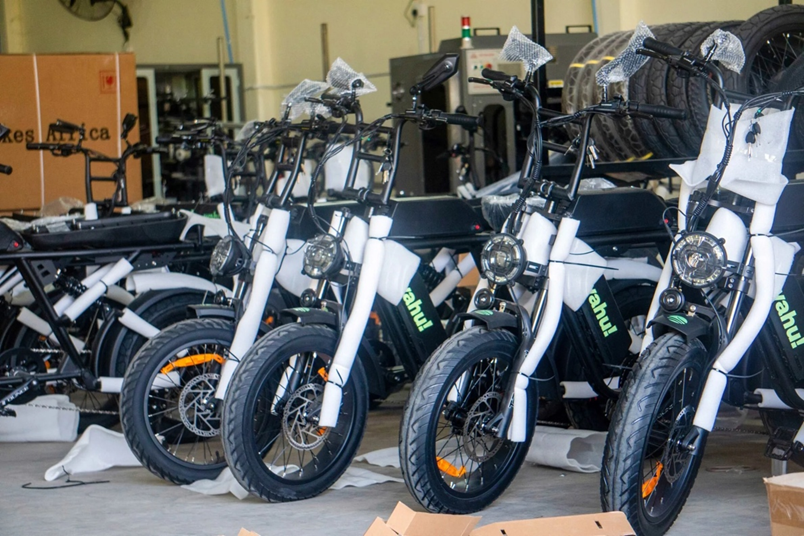
The report notes that these vehicles align naturally with the rapid expansion of delivery services and the so-called “okada” economy, in which motorbikes serve as income-generating assets across ride-hailing, courier services, and informal logistics.
In this segment, companies are already assembling and in some cases manufacturing electric motorbikes and batteries locally in Ghana.
Crucially, firms are deploying battery-swapping systems and service-based business models that reduce upfront purchase costs and keep vehicles in near-constant commercial use. This approach lowers entry barriers for riders and delivery operators, while creating domestic value chains in assembly, servicing and battery management.
As a result, the Outlook describes electric motorbikes and tricycles as the clearest near-term pathway for scaling up e-mobility-related industrial development in Ghana.
Passenger EVs Lag Behind
By contrast, the passenger EV market remains comparatively small and is dominated by imports of both new and used vehicles.
The report finds that local industrial activity in this segment is limited, and adoption continues to face strong competition from internal combustion engine (ICE) vehicles, particularly used imports.
These petrol and diesel vehicles benefit from well-established supply chains, readily available spare parts, extensive networks of mechanics and repair shops, and significantly lower upfront costs.
Together, these factors have slowed market formation for passenger EVs and constrained the development of domestic value chains.
Although both segments are growing, the Outlook concludes that progress has been driven largely by private-sector initiative rather than public policy support.
Companies are investing in vehicle imports, local assembly, charging stations, battery-swapping infrastructure and innovative service models, often in the face of high capital costs and policy uncertainty.
A Call for Immediate Fiscal Reform
Against this backdrop, the GCCE is calling for more deliberate and targeted government action to support market formation.
In the short term, the Chamber recommends reducing import duties and taxes on electric vehicles and on components used for the local assembly of motorbikes and tricycles. Such measures, it argues, would lower costs, improve competitiveness against ICE vehicles, and accelerate domestic assembly.
The report also calls for clearer and more predictable implementation of existing incentives, alongside preferential electricity tariffs for EV charging and battery-swapping stations. These measures would help address operational cost challenges and encourage infrastructure deployment.
Financing and Industrial Policy in the Medium Term
Looking beyond immediate fiscal reforms, the Outlook highlights the importance of expanding EV-specific financing and risk-sharing mechanisms. Partnerships with local financial institutions, it suggests, could help address affordability constraints that continue to limit consumer adoption.
The report further emphasises the need to strengthen support for local assembly and manufacturing, positioning e-mobility as part of Ghana’s broader industrialisation agenda.
It recommends adopting segment-specific implementation frameworks under the National Electric Vehicle Policy, recognising that passenger EVs, electric two- and three-wheelers, and public transport each operate under different economic dynamics.
Aligning policy interventions with these distinct market realities, the Chamber argues, will be critical to unlocking industrial development, crowding in private investment, and building a competitive and durable clean transportation ecosystem.
Jobs, Air Quality and Energy Security
Beyond industrial opportunity, the report underscores the wider national benefits of accelerating electric mobility.
These include job creation across assembly, maintenance, battery management and charging infrastructure; reduced urban air pollution; lower dependence on imported fuels; and long-term environmental and public health gains.
The Ghana Clean Transportation Outlook 2026 ultimately frames Ghana’s clean transport transition not merely as an environmental ambition, but as an economic strategy.
With the right fiscal incentives, regulatory clarity and financing support, the GCCE argues that Ghana could convert early private-sector momentum into a scalable industry capable of transforming urban mobility and strengthening national energy resilience.
Download full report here: https://cleanenergyghana.org/publications/
Latest Stories
-
Credit Risk Management Directive: BoG to begin implementation for banks, others from July 1, 2027
5 minutes -
Ghana Brands Awards 2026: Leading brands, business trailblazers to shine on November 20
21 minutes -
T-bills auction: Demand improves as government exceeds target by about 76%; interest rates soften
27 minutes -
Ziope undertakes initiative to build a technologically inclined community, commissions self-help ICT lab
52 minutes -
ECG announces power outage in parts of Tema, Central Region due to network fault, maintenance
1 hour -
When the Gospel Becomes a Weapon: The church, blackmail and the abuse of faith
2 hours -
JoyNews’ Jacqueline Ansomah Yeboah selected for UK Media Excellence for Emerging Technology Fellowship
2 hours -
Mental Health Alliance urges government to operationalise Mental Health Fund
2 hours -
Ghana–Holy See agreement heads to Parliament after Cabinet approval
2 hours -
Luv FM Corporate Games 2026: Kumasi Central Prisons, Amanfiman Bank win big amid fun
3 hours -
WAFU B U17: Ghana top Group A after win over Togo
3 hours -
Ho Central Mosque reopens amid unresolved leadership dispute that led to closure
4 hours -
Minority caucus questions GH¢16.4m in Ablakwa’s SA evacuation spending, demands independent audit
4 hours -
Gender Ministry meets Nana Akua Addo’s husband over domestic violence after hospital discharge
5 hours -
UG Vice-Chancellor urges swift operationalisation of National Research Fund
6 hours