

Audio By Carbonatix
A few years ago, I sat in a solemn hall as the nation mourned Ghanaian peacekeepers who had fallen in the line of duty — men and women who died far from home, wearing their country’s colours with quiet pride.
Their coffins were draped in the flag, their names read with honour. They had served in South Sudan, Lebanon, and the Congo — standing between conflict and peace. Their sacrifice had meaning.
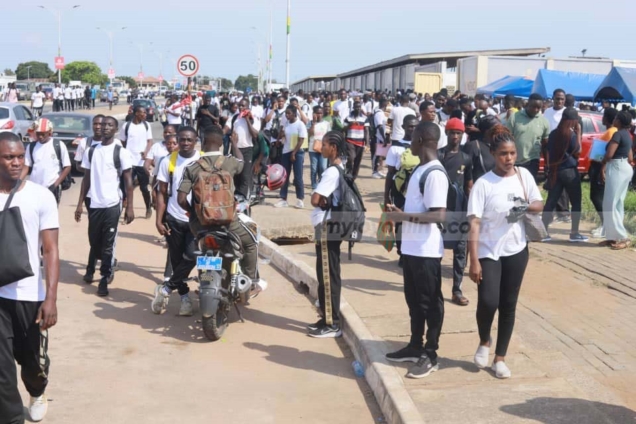
Next week, in another church, tributes will be read again. This time, for young Ghanaians who never even got the chance to serve.
The irony is painful. Those who wore blue berets went abroad to keep peace and died with honour.
These ones, who never made it past the gate, died waiting for the chance to earn that same uniform.
Under the Armed Forces Act, 1962 (Act 105), recruitment into the Ghana Armed Forces must be conducted under regulations made by the President on the advice of the Armed Forces Council.
The 1992 Constitution (Article 212) reinforces that the composition and administration of the Forces must be guided by fairness, legality, and order.
Even the Public Services Commission Act, 1994 (Act 482) demands transparency and merit in public recruitment. Nowhere do these laws authorise open, uncontrolled mass gatherings that endanger lives.
Across the world, armed forces recruit with precision and respect. In the UK, candidates apply online and attend scheduled assessments. In the US, they report by appointment to Military Entrance Processing Stations. In Kenya, clear regional timetables, smaller batches, and anti-bribery hotlines protect both the process and the people.
Ghana must urgently digitise and decentralise recruitment under the Armed Forces Act framework. Applications should begin through a secure online or USSD portal, pre-screened by qualification and region.
Candidates must be invited in small, carefully controlled batches, not open stadium gatherings with canes in hand.
Venues must have trained marshals, medical teams, water points, and evacuation routes in compliance with NADMO standards.
We need entrepreneurial and business mentorship clubs from Senior High Schools to universities — spaces where students learn to build, not just apply for jobs. Let’s teach them how to create value, start enterprises, manage resources, and innovate.
If we build their capacity early, the pressure on the Armed Forces and security services will ease naturally. Many countries struggle to convince their young people to join the army. In Ghana, young people are rushing to join — because they need work.
A nation where every young person’s hope depends on “being recruited” is a nation still learning to build ladders of its own.
Latest Stories
-
Germany commissions border Sheds to boost Ghana’s immigration operations at Aflao
5 minutes -
Sam Jonah’s concerns fuel IMANI’s petition to Mahama over political interference in insurance sector
5 minutes -
Absa SME Business Clinic equips entrepreneurs with practical financial management strategies
18 minutes -
Franklin Cudjoe hails ‘productive’ civil society meeting with Mahama; backs inquiry into ‘Big Push’ procurement
19 minutes -
Telecel Foundation supports safer pregnancies with ultrasound outreach in Naaha
1 hour -
AU’s 10-year reparations agenda is essential to address historic injustices – Spio-Garbrah
1 hour -
Ghana can’t remain vulnerable to global economic disruptions— Dr Tutu-Boahene
2 hours -
‘No nepotism’ – Former NSA Board Chairman demands world-class coach after Otto Addo exit
2 hours -
Volta Region seen as top choice for luxury weekend breaks — V. L. K. Djokoto
2 hours -
Halt small-scale mining for one year to fight galamsey – Hopeson Adorye
2 hours -
Sammy Gyamfi marks 37th birthday with donations to Special School and Korle Bu
2 hours -
President Mahama orders full probe into ‘Big Push’ procurement exposé
2 hours -
Weija-Gbawe MP calls for commissioning of Weija paediatric hospital
3 hours -
Ghanaians dying in Russia–Ukraine war: The danger is real
3 hours -
Player ratings: Oppong earns high marks as Sibo and Adjetey draw low scores in Germany defeat
3 hours