

Audio By Carbonatix
The Bank of Ghana (BoG) has defended its decision to maintain the Monetary Policy Rate (MPR) at 14 per cent, saying easing global oil prices, a favourable inflation outlook and strong external reserves have given policymakers confidence to keep borrowing costs unchanged while monitoring evolving economic risks.
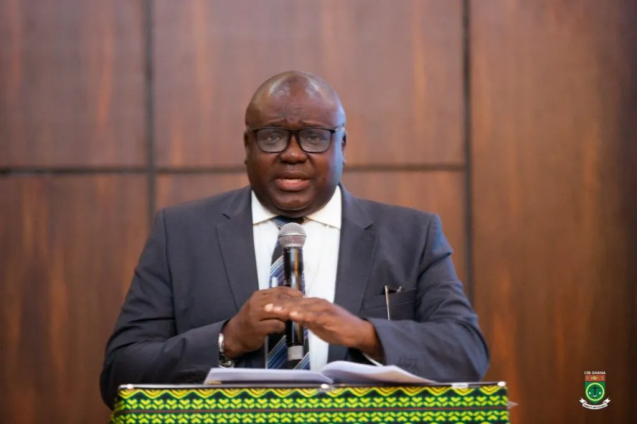
Speaking on Joy FM's Super Morning Show on Thursday, July 23, the Bank of Ghana Director of Research, Dr Philip Abradu-Otoo, explained that the decision by the Monetary Policy Committee (MPC) at its 131st meeting was guided by a cautious assessment of both domestic and global economic conditions.
He said the committee considered it prudent to leave the benchmark interest rate unchanged, arguing that while uncertainty remains in the global economy, Ghana's macroeconomic fundamentals have strengthened sufficiently to withstand potential external shocks.
Dr Abradu-Otoo noted that concerns about developments in the international oil market had played a central role in the committee's previous policy decision.
He recalled that when the MPC last met in May, crude oil prices had surged to more than US$100 per barrel, raising fears that higher fuel costs could spill over into domestic prices and reverse the country's progress in reducing inflation.
"The uncertainty in the global oil market and the level to which crude oil prices had risen were among the main reasons the committee maintained its policy stance," he explained.
According to him, policymakers were particularly concerned that sustained increases in global energy prices could feed into inflation through higher transport costs, production expenses and imported goods.
However, Dr Abradu-Otoo said the latest assessment showed that conditions had improved since the previous meeting.
Although global uncertainties persist, he observed that crude oil prices have retreated from their earlier highs, reducing the immediate risk of imported inflation.
"In fact, if you look at where crude oil prices were during our previous meeting, they have declined somewhat from those levels," he said.
He added that the bank's latest economic projections indicate that inflation is likely to remain on a stable path rather than accelerate sharply.
"When I say the outlook is benign, I mean our forecasts do not suggest inflation will rise significantly above where we expect it to be," he explained.
The committee therefore concluded that there was little evidence to suggest recent developments in global commodity markets would substantially alter Ghana's inflation trajectory.
Dr Abradu-Otoo also pointed to the Bank of Ghana's improved external reserves as an important safeguard against global economic shocks.
He said the country's reserve position provides policymakers with sufficient room to respond to unexpected developments without resorting to drastic monetary policy adjustments.
"The economy has enough buffers, and the central bank is in a very good position as far as reserves are concerned," he stated.
"When you build buffers, you build them for difficult times. What we are doing now is deploying those buffers strategically to ensure inflation remains contained."
According to him, these reserves strengthen the Bank's ability to preserve exchange rate stability and cushion the economy against external pressures.
The Director of Research stressed that the committee deliberately chose a cautious approach in order to protect the credibility the central bank has established through its recent disinflation efforts.
He argued that changing policy too quickly could undermine confidence in the bank's commitment to price stability.
"Due to the prevailing uncertainty and the need for monetary policy to remain cautious, the committee decided to maintain the policy rate at 14 per cent," he said.
Holding the benchmark rate steady, he explained, enables policymakers to avoid unnecessary policy mistakes while assessing whether current global developments prove temporary or become more persistent.
"The central bank is in an observatory mode right now. We are closely watching how these uncertainties unfold before taking further action."
Dr Abradu-Otoo explained that the policy rate serves primarily as a signalling instrument for financial markets.
Consequently, the decision to maintain the benchmark rate is expected to support stability in treasury bill yields, government securities and commercial bank lending rates.
"The policy rate is a signalling tool. By maintaining it at its current level, we expect treasury bill rates, yields and bank lending rates to broadly remain where they are," he noted.
The decision, he said, provides certainty for financial institutions, businesses and investors while allowing the central bank additional time to evaluate incoming economic data.
Looking ahead, Dr Abradu-Otoo said the Monetary Policy Committee would review the economic outlook again at its next scheduled meeting in September.
The MPC, which meets every two months, will examine the latest data on inflation, exchange rate movements, global commodity prices, domestic economic activity and other macroeconomic indicators before determining whether changes to monetary policy are necessary.
"Over the next two months, we will assess the conditions again, review the available data and, where necessary, retune the stance of monetary policy," he said.
Latest Stories
-
Imagination Africa, Mentors Chess Academy to host second African Genius Chess Championship at Ghud Park
47 minutes -
Nana B passport claims a diversionary tactic — Abu Jinapor
2 hours -
Pope Leo diagnosed with cancer as doctors remove lobe of lung, Vatican says
2 hours -
Legal Aid Commission takes free legal services to Techiman main lorry terminal
2 hours -
Nana B denies seeking passport favour, accuses Ablakwa of failing to account for GH¢16.4m
2 hours -
Young girls demand climate action, stronger protection against child marriage
2 hours -
Ex-gang boss sentenced to 40 years for orchestrating Tupac Shakur’s murder
2 hours -
From near-deferral to three awards: UMaT graduate’s academic journey
2 hours -
Atta Akyea denies seeking presidential pardon for Wontumi in galamsey case
3 hours -
Photos: Mahama commissions 85-bed Police Hospital ward, donates two ambulances
3 hours -
GTEC directs Ghana’s public universities to reopen by October 16 and begin lectures on October 19
3 hours -
Star Oil donates GH¢1million towards construction of new CID facility
3 hours -
Court hands Adjetey Sowah, two others lifetime bans after Amputee Football legal dispute
3 hours -
NDC appoints Julius Kwame Anthony as a Deputy Communications Director
3 hours -
Ghana repatriates 120 Nigerians rescued from suspected cybercrime centres
3 hours