

Audio By Carbonatix
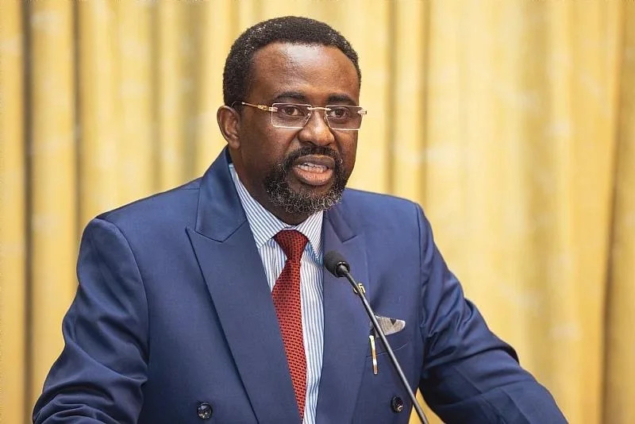
The Governor of the Bank of Ghana (BoG), Dr. Johnson Pandit Asiama, has told Parliament that Ghana’s economy is stabilising after a period of severe macroeconomic stress, with inflation falling sharply, the cedi recovering, and the banking sector strengthening.
Addressing the Parliamentary Committee on Economy and Development at Parliament House on Monday, March 9, Dr. Asiama said the country entered 2025 in a fragile state, but decisive policy measures have begun to deliver results.
“When I assumed office as Governor in February 2025, the Ghanaian economy was emerging from one of the most challenging periods in recent history,” he said.
According to Dr. Asiama, the country had been grappling with high inflation, a weakening currency, and the impact of the Domestic Debt Exchange Programme on the financial sector.
He explained that inflation stood at 23.8 percent at the end of 2024, far above the central bank’s target band of 8 ± 2 percent, while the Ghana cedi had depreciated by about 24.8 percent during the same period.
“Persistent inflation had eroded household purchasing power, complicated business planning, and weakened confidence in the macroeconomic environment,” he said.
To restore stability, the central bank adopted a tight monetary policy stance, intensified open market operations to absorb excess liquidity, and introduced measures to strengthen Ghana’s foreign exchange reserves.
Among the steps taken was the expansion of the Domestic Gold Purchase Programme, which increased Ghana’s gold reserves from about 8.7 tonnes in 2021 to more than 40 tonnes by October 2025.
However, Dr. Asiama noted that the Bank later rebalanced part of the gold holdings to reduce concentration risk.
“Ghana’s gold reserves remain part of our national reserves; what changed as part of this measure was the composition of those reserves,” he clarified.
“In light of these considerations, the Bank undertook a measured portfolio rebalancing, converting a portion of its gold holdings into foreign exchange assets to restore a more balanced reserve composition.”
He stressed that the move did not amount to a loss of national assets but rather a diversification strategy to ensure the reserves remain liquid and resilient.
The Governor told the Committee that the policy measures have produced significant macroeconomic improvements.
Inflation declined from 23.8 percent in December 2024 to 5.4 percent by December 2025, and further to 3.3 percent in February 2026.
“The results of these efforts are now evident in the macroeconomic data,” Dr. Asiama said.
He added that Ghana’s external buffers have strengthened, with gross international reserves rising to about $13.8 billion by the end of 2025, providing roughly 5.7 months of import cover.
Interest rates have also begun to ease, with the Monetary Policy Rate reduced by 900 basis points in 2025 to 18 percent.
Dr. Asiama further noted that Ghana’s banking sector has shown signs of recovery after the impact of the debt exchange programme.
Capital adequacy in the banking sector improved to 17.5 percent, well above the 13 percent regulatory requirement, while the non-performing loan ratio declined from 21.8 percent to 18.9 percent.
Total banking sector assets increased from GH₵368 billion to GH₵447 billion, with deposits rising to GH₵325 billion.
“Taken together, these indicators show that the banking system today is liquid, solvent, and profitable, and increasingly positioned to support Ghana’s economic recovery,” he said.
Dr. Asiama acknowledged that the stabilisation measures have had financial implications for the central bank, including higher costs associated with liquidity management and the restructuring of government securities.
However, he assured lawmakers that these outcomes do not affect the central bank’s ability to carry out its mandate.
“Lower inflation, exchange rate stability, and improved macroeconomic confidence have delivered significant benefits to households, businesses, and government,” he stated.
Looking ahead, the Bank of Ghana Governor expressed optimism about the country’s economic outlook but cautioned that global uncertainties remain.
“Lower inflation, stronger external buffers, and improving financial sector conditions provide a solid foundation for sustained economic recovery,” he said.
“The Bank of Ghana will therefore continue to pursue a prudent, disciplined, and data-driven approach to monetary policy.”
Latest Stories
-
Be careful with cross-border lending, foreign currency exposures – BoG to financial institutions
2 hours -
GPL 2026/27: Medeama go three clear as Hearts of Oak recover and Bechem stage stunning comeback
2 hours -
Ntiamoah Foundation launches “BEYOND 20” anniversary campaign
2 hours -
Credit Risk Management Directive: BoG to begin implementation for banks, others from July 1, 2027
2 hours -
Ghana Brands Awards 2026: Leading brands, business trailblazers to shine on November 20
3 hours -
T-bills auction: Demand improves as government exceeds target by about 76%; interest rates soften
3 hours -
Ziope undertakes initiative to build a technologically inclined community, commissions self-help ICT lab
3 hours -
ECG announces power outage in parts of Tema, Central Region due to network fault, maintenance
4 hours -
When the Gospel Becomes a Weapon: The church, blackmail and the abuse of faith
4 hours -
JoyNews’ Jacqueline Ansomah Yeboah selected for UK Media Excellence for Emerging Technologies Fellowship
4 hours -
Mental Health Alliance urges government to operationalise Mental Health Fund
5 hours -
Ghana–Holy See agreement heads to Parliament after Cabinet approval
5 hours -
Luv FM Corporate Games 2026: Kumasi Central Prisons, Amanfiman Bank win big amid fun
5 hours -
WAFU B U17: Ghana top Group A after win over Togo
5 hours -
Ho Central Mosque reopens amid unresolved leadership dispute that led to closure
7 hours