


Audio By Carbonatix
Bahison Ravindran says he always believed he was Indian.
Born to Sri Lankan refugee parents in the southern Indian Tamil Nadu state, the 34-year-old web developer had studied and worked there, and held several government-issued identity documents, including an Indian passport.
But a rude shock awaited him in April when police arrested him, saying his passport was invalid.
Authorities said he was not an Indian "citizen by birth" since both his parents were Sri Lankans who had fled to India in 1990 amid the civil war there.
For long, anyone born in India qualified for Indian citizenship, but a 1987 amendment to the law required at least one parent to be an Indian citizen for a child born after 1 July of that year to qualify.
Mr Ravindran, who was born in 1991 within months of his parents' arrival in India, told the Madras High Court in Chennai last week that he was unaware of the rule and had never hidden his ancestry from authorities.
He also told the court that as soon as he was informed that "citizenship by birth" was not automatic in India, he immediately applied for "citizenship through naturalisation".
But for now, he has become "stateless".
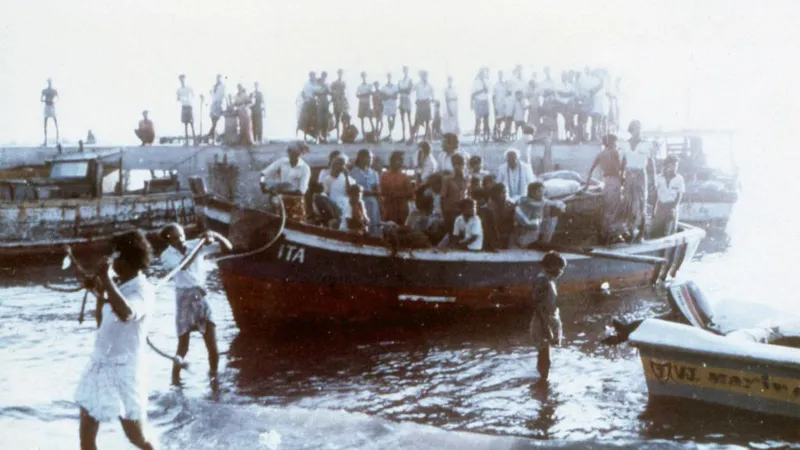
His unique situation spotlights the plight of thousands of Sri Lanka's Tamil refugees in India who fled the island nation during its decades-long conflict in the 1980s.
More than 90,000 of them live in the southern state, both in refugee camps and outside, according to the Tamil Nadu government.
Many chose the state as a sanctuary because of historical ties, linguistic and cultural similarities and geographical proximity to Sri Lanka.
And now there are more than 22,000 individuals like Mr Ravindran, who were born in India after 1987 to Sri Lankan Tamil parents.
But decades later, their citizenship status remains in limbo.
Part of the reason is that India is not a signatory to the 1951 UN Refugee Convention or its 1967 protocol and considers Sri Lankan refugees as illegal migrants.
The 2019 Citizenship Amendment Act (CAA), which fast-tracks applications from persecuted non-Muslim minorities from India's neighbouring countries, also excludes Tamils from Sri Lanka.
The status of Sri Lankan Tamils is an emotive subject in the state, with different political parties promising to help resolve their citizenship concerns. But for most, it remains a distant dream.
India only granted citizenship to the first Sri Lankan Tamil in 2022 - K Nalini was born a year before the 1987 law that mandated Indian citizenship of at least one parent. At least 13 more Tamils have been granted citizenship since.
Mr Ravindran hopes his case will be taken up soon. He pledges allegiance to India and says he never intends to return to Sri Lanka.
He recently told the BBC that he has travelled to the island nation just once in his life – in September 2024 to marry a Sri Lankan woman.
He says his troubles began after he applied for a fresh passport to include the name of his spouse this year.
Lawyer Sandesh Saravanan, who is representing Mr Ravindran in court, told the BBC that he was given a fresh passport after verification by the police, who were aware of his Sri Lankan parentage.
But the Foreigners Regional Registration Office (FRRO), which oversees the registration of foreigners in India, later flagged his parents' origin to the police, he said.
Mr Ravindran was arrested last month on charges of cheating, forgery and illegally holding an Indian passport and held in custody for 15 days, before being freed on bail.
Fearing further punitive action, he approached the Madras High Court last week, which ordered authorities to not take any coercive action until the next hearing on 8 October.
"In all these years, no-one ever told me I was not Indian," Mr Ravindran told the BBC.
"When I was told for the first time that I am a 'stateless person', I could not accept it."
And now, Mr Ravindran is pinning his hopes on the court to agree with him.
Latest Stories
-
Germany commissions border Sheds to boost Ghana’s immigration operations at Aflao
5 minutes -
Sam Jonah’s concerns fuel IMANI’s petition to Mahama over political interference in insurance sector
6 minutes -
Absa SME Business Clinic equips entrepreneurs with practical financial management strategies
19 minutes -
Franklin Cudjoe hails ‘productive’ civil society meeting with Mahama; backs inquiry into ‘Big Push’ procurement
20 minutes -
Telecel Foundation supports safer pregnancies with ultrasound outreach in Naaha
1 hour -
AU’s 10-year reparations agenda is essential to address historic injustices – Spio-Garbrah
1 hour -
Ghana can’t remain vulnerable to global economic disruptions— Dr Tutu-Boahene
2 hours -
‘No nepotism’ – Former NSA Board Chairman demands world-class coach after Otto Addo exit
2 hours -
Volta Region seen as top choice for luxury weekend breaks — V. L. K. Djokoto
2 hours -
Halt small-scale mining for one year to fight galamsey – Hopeson Adorye
2 hours -
Sammy Gyamfi marks 37th birthday with donations to Special School and Korle Bu
2 hours -
President Mahama orders full probe into ‘Big Push’ procurement exposé
2 hours -
Weija-Gbawe MP calls for commissioning of Weija paediatric hospital
3 hours -
Ghanaians dying in Russia–Ukraine war: The danger is real
3 hours -
Player ratings: Oppong earns high marks as Sibo and Adjetey draw low scores in Germany defeat
3 hours