

Audio By Carbonatix
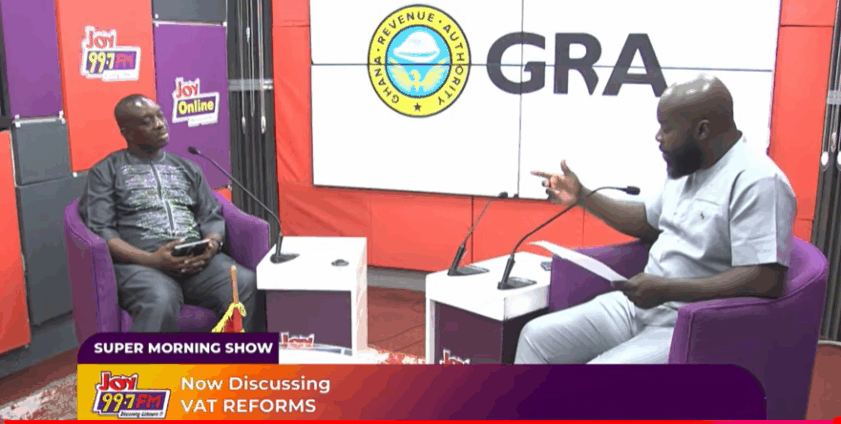
Chief Revenue Officer at the Domestic Tax Revenue Division Free Zones Unit of the Ghana Revenue Authority (GRA), Dominic Adamnor Nartey, says Ghana’s new standard VAT system allows businesses to deduct input taxes and should not automatically lead to higher prices for consumers.
He explained that under the revised VAT Act 2025 (Act 1151), businesses can recover taxes paid on purchases before selling their goods, a change he says corrects misconceptions that the shift to a 20% VAT rate will increase the cost of goods and services.
Speaking on JoyFM’s Super Morning Show on Thursday, February 19, Mr Nartey broke down how the pricing structure works under the new tax regime, contrasting it with the previous 4% flat rate system.
According to him, under the former flat rate scheme, traders were not allowed to deduct input tax from the VAT paid when purchasing goods, forcing them to treat the tax as part of their production cost.
“If you were a flat rate trader before this amendment, you were not entitled to deduct input taxes,” he said. “When you buy from others, you pay VAT, and that VAT becomes part of your cost before you add your margin and charge the 4%.”
He illustrated the process using a hypothetical example, explaining that a trader who buys an item for GH¢100 and pays GH¢15 VAT would add the GH¢15 to the cost before calculating profit and applying the flat rate tax.
However, he said the new standard VAT system changes this approach by allowing businesses to deduct the input tax, preventing it from increasing the final cost of goods.
“Now that you are a standard rate taxpayer, the law allows you to deduct all inputs that you incur in the form of VAT,” he explained. “You don’t add the input tax to your cost. You add your margin to the original cost and then charge the 20%.”
Mr Nartey further clarified that even after charging the 20% VAT, businesses do not pay the full amount to the tax authority but rather remit the net value after deducting the input tax already paid.
“You are not going to pay the entire 20% to GRA. You deduct the input tax you paid and pay the difference,” he stated.
The explanation comes amid public debate following the passage of the VAT Act 2025, which replaced the 4% flat rate with a 20% standard VAT system. The reform has generated concerns among traders and consumers who fear the new rate could increase prices and affect business operations.
But Mr Nartey maintained that when properly applied, the new system removes tax distortions and improves efficiency in Ghana’s tax framework without necessarily raising prices.
Latest Stories
-
Classic ‘I Told You So’ to be remade in 2027 for Ghana at 70
40 seconds -
533 admitted to Ghana Armed Forces College of Nursing and Midwifery
6 minutes -
Manhyia North MP, Akwasi Konadu questions speed of Damang mine tender process
9 minutes -
Accra hosts 24th EBID AGM as Finance Minister calls for bold action
12 minutes -
The Insurance Paradox: Of state capture, greedy monopolies, and the SIC reset
14 minutes -
AU welcomes US-Iran ceasefire, urges sustained dialogue for lasting peace
15 minutes -
Ato Forson praises EBID’s resilience and strategic impact at 24th AGM in Accra
16 minutes -
Ghana welcomes ECOWAS leaders to Accra for EBID high-level meeting
19 minutes -
Ato Forson urges ECOWAS states to honour EBID capital commitments
21 minutes -
Why Ghana’s Mobile Money security is a house of cards
24 minutes -
EBID records strong financial growth amid global economic uncertainty – Ato Forson
25 minutes -
PSG vs Liverpool: Date, time and everything you need to know about the Champions League quarterfinal
42 minutes -
Education Minister orders probe into illegal SHS online class fees
44 minutes -
Barcelona vs Atlético Madrid: Date, time and everything you need to know about the Champions League quarterfinal
48 minutes -
Monthly Indicator of Economic Growth slows to 7.5% in January 2026
50 minutes