


Audio By Carbonatix
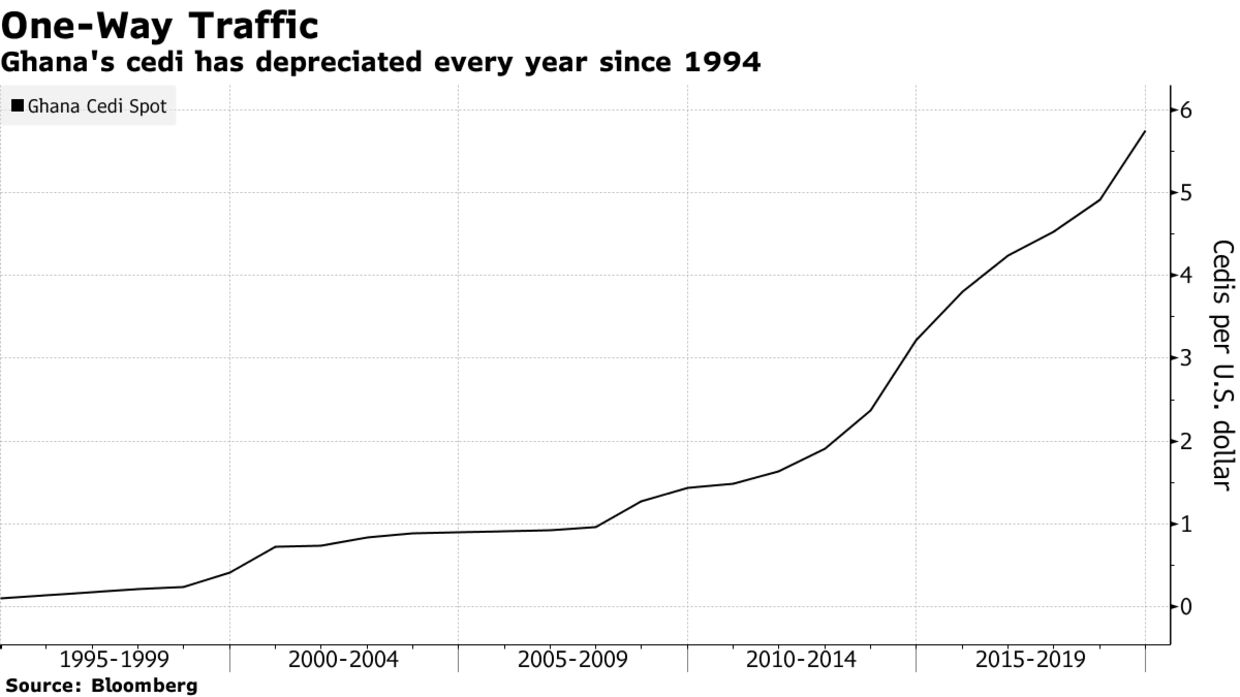
The cedi is headed for its 25th straight year of depreciation against the dollar as government’s fiscal challenges erode investor confidence in the currency of the world’s second-biggest cocoa producer.
The cedi is down 13% so far in 2019, according to data compiled by Bloomberg, poised for the worst decline since 2015, when it slumped 18%. It has declined every year since Bloomberg started keeping records in 1994.
Investors are concerned the government won’t stick to spending targets as it gets closer to an election next year, according to Cobus de Hart, chief economist for the west, central and north Africa at NKC African Economics in Paarl, South Africa.
The cedi slipped 0.1% on Thursday to 5.67 per dollar, bringing its decline this quarter to 5%.
 “The overshooting fiscal deficit and debt from arrears is putting pressure on the cedi,” De Hart said by phone. “We have an election coming up next year and portfolio investors are concerned that the plan outlined in the 2020 budget will not be met because revenue continues to underperform.”
Ghana’s budget deficit is forecast to widen to 4.9% of gross domestic product this year, from 4.1% in 2018, according to the median estimate in a Bloomberg survey of economists. The shortfall is rising as the government increases spending to pay for financial-sector bailouts and liabilities in the energy sector.
The central bank’s inability to quickly build foreign reserves due to a deficit in the current account is another source of cedi weakness, De Hart said.
“Even though the trade account is in surplus, the current account is in deficit, impeding the accumulation of foreign reserves,” he said. “Gross reserves have hovered around $8 billion for some time now, which suggests that the central bank has not aggressively intervened to support the currency.”
Ghana adopted the cedi in 1965 to replace the Ghanaian pound, which was equal in value to the British pound and its currency since independence in 1957.
The “new cedi,” worth 1.2 original cedis and about half a British pound, was introduced in 1967. Decades of high inflation led to a redenomination in 2007, when the new cedi was phased out and replaced by the current currency at a ratio of one to 10,000. It has since lost about 80% of its value.
“The overshooting fiscal deficit and debt from arrears is putting pressure on the cedi,” De Hart said by phone. “We have an election coming up next year and portfolio investors are concerned that the plan outlined in the 2020 budget will not be met because revenue continues to underperform.”
Ghana’s budget deficit is forecast to widen to 4.9% of gross domestic product this year, from 4.1% in 2018, according to the median estimate in a Bloomberg survey of economists. The shortfall is rising as the government increases spending to pay for financial-sector bailouts and liabilities in the energy sector.
The central bank’s inability to quickly build foreign reserves due to a deficit in the current account is another source of cedi weakness, De Hart said.
“Even though the trade account is in surplus, the current account is in deficit, impeding the accumulation of foreign reserves,” he said. “Gross reserves have hovered around $8 billion for some time now, which suggests that the central bank has not aggressively intervened to support the currency.”
Ghana adopted the cedi in 1965 to replace the Ghanaian pound, which was equal in value to the British pound and its currency since independence in 1957.
The “new cedi,” worth 1.2 original cedis and about half a British pound, was introduced in 1967. Decades of high inflation led to a redenomination in 2007, when the new cedi was phased out and replaced by the current currency at a ratio of one to 10,000. It has since lost about 80% of its value.
“The overshooting fiscal deficit and debt from arrears is putting pressure on the cedi,” De Hart said by phone. “We have an election coming up next year and portfolio investors are concerned that the plan outlined in the 2020 budget will not be met because revenue continues to underperform.”
Ghana’s budget deficit is forecast to widen to 4.9% of gross domestic product this year, from 4.1% in 2018, according to the median estimate in a Bloomberg survey of economists. The shortfall is rising as the government increases spending to pay for financial-sector bailouts and liabilities in the energy sector.
The central bank’s inability to quickly build foreign reserves due to a deficit in the current account is another source of cedi weakness, De Hart said.
“Even though the trade account is in surplus, the current account is in deficit, impeding the accumulation of foreign reserves,” he said. “Gross reserves have hovered around $8 billion for some time now, which suggests that the central bank has not aggressively intervened to support the currency.”
Ghana adopted the cedi in 1965 to replace the Ghanaian pound, which was equal in value to the British pound and its currency since independence in 1957.
The “new cedi,” worth 1.2 original cedis and about half a British pound, was introduced in 1967. Decades of high inflation led to a redenomination in 2007, when the new cedi was phased out and replaced by the current currency at a ratio of one to 10,000. It has since lost about 80% of its value.DISCLAIMER: The Views, Comments, Opinions, Contributions and Statements made by Readers and Contributors on this platform do not necessarily represent the views or policy of Multimedia Group Limited.
DISCLAIMER: The Views, Comments, Opinions, Contributions and Statements made by Readers and Contributors on this platform do not necessarily represent the views or policy of Multimedia Group Limited.
Latest Stories
-
‘At the age of 12, I was teaching people and collecting money from them’ – Forty Under 40 Awards
59 minutes -
I broke my virginity at the age of 26 after university – Richard Abbey Jnr.
2 hours -
Sacked for fees, saved by faith: The untold story of Forty Under 40 Awards founder Richard Abbey Jnr
3 hours -
GCB Bank surges GH¢0.45, ETI gains GH¢0.06 as GSE ends week higher
3 hours -
Two teens jailed 55 years for robbery
3 hours -
UDS demands apology for MPhil student wrongly branded as Tamale robber
4 hours -
“We don’t sell fish!” – Tema Shipyard CEO hits back over dead fish discovery
5 hours -
Sam George defends anti-LGBTQ+ Bill as ‘national priority’ amid debate over gov’t focus
5 hours -
Artemis II astronauts safely back on Earth after trip around moon
6 hours -
Sam George unveils massive 1,150-cell site rollout to end network woes
6 hours -
This Saturday on Prime Insight: Fuel levy suspension, LGBTQ+ legislation, and Damang Mine controversy
6 hours -
Struggling Real suffer title blow with Girona draw
7 hours -
Mahama nominates Pamela Graham as Auditor-General
7 hours -
The five big sticking points in US-Iran talks
8 hours -
Melania Trump’s speech propels Epstein crisis back to forefront
9 hours