

Audio By Carbonatix
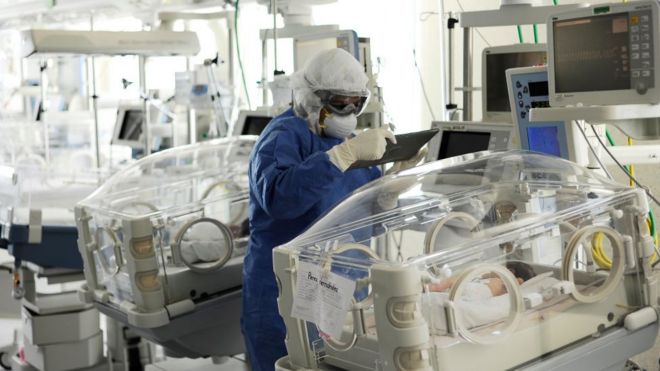
Newborn triplets in Mexico have tested positive for coronavirus in an "unprecedented" case, according to local health authorities.
Medical experts are investigating whether the disease could have been passed on through the mother's placenta during pregnancy.
Two of the babies, one boy and one girl, are in a stable condition in a hospital in San Luis Potosí state.
But the second boy is receiving treatment for a respiratory condition.
A spokesperson for the state's Health Safety Committee said contagion in multiple births had not been detected anywhere globally and so the case would be investigated.
A very small number of newborn babies have been known to pick up the virus after birth, but health officials say they do not believe this is what happened in this case.
State Health Secretary Mónica Liliana Rangel Martínez said: "It would be impossible for them to have been infected at the moment of birth."
However, the parents are currently being tested, with authorities saying they may have been asymptomatic.
Mexico has recorded more than 185,000 coronavirus cases and 22,584 deaths since the country's first case on 28 February.
Coronavirus in newborns
The triplets - born prematurely on 17 June in Mexico - all tested positive for coronavirus on the day of their birth.
Coronavirus in newborns is unusual, but not unheard of. Babies can catch the virus after birth if they have close contact with anyone who is already infected. Coronavirus might also be passed on in the womb from mother to baby via the placenta.
US researchers from Yale School of Medicine recently reported the first known case of placental infection with coronavirus. When infection does occur, the risk to mother and baby is often low - although some reports suggest it might increase the likelihood of babies being born early.
There is no evidence that the virus causes miscarriage or affects how your baby develops in pregnancy, but, as a precaution, pregnant women are advised to be strict about avoiding close social contact to reduce their chance of getting coronavirus. If they do become infected, most mums-to-be will have mild or moderate symptoms and recover. Babies may show no signs of the illness at all. If you are caring for a baby, you can reduce their risk of getting the virus by keeping your hands clean with regular hand washing.
Latest Stories
-
Prudential Life settles GH¢100,000 medical bills under its PRUCares Valentine Experience Initiative
1 hour -
Wa West Picnic: Peter Lanchene Toobu champions peace, health and unity in landmark celebration
1 hour -
Dr Mensah Market flooded after downpour in Kumasi
2 hours -
Armed men reportedly storm Adjen Kotoku Onion Market amid tensions
2 hours -
Tecco Mensah writes: Why football fans must look beyond statistics
3 hours -
Police recover stolen Honda CR-V in Kumasi within 48 hours
4 hours -
Apetorku Gbodzi 2026 Festival opens in Dagbamete with development focus
4 hours -
President Mahama arrives in Lyon to co-chair One Health Summit
4 hours -
Beverly View Plus Hotel draws crowds amid coastal Easter rush in Volta
4 hours -
Maiden Zongo Festival held in Wa amid calls to tackle drug abuse among the youth
5 hours -
FDA warns of fake HIV test kits on Ghanaian market
5 hours -
Africa urged to build resilient health systems as donor support tightens
5 hours -
Easter gesture: Ablakwa settles medical bills for 85 North Tongu constituents
7 hours -
Africa must harness its population strength—Titus-Glover
7 hours -
Visa-free access doesn’t mean unlimited stay – Lom Ahlijah
7 hours