

Audio By Carbonatix
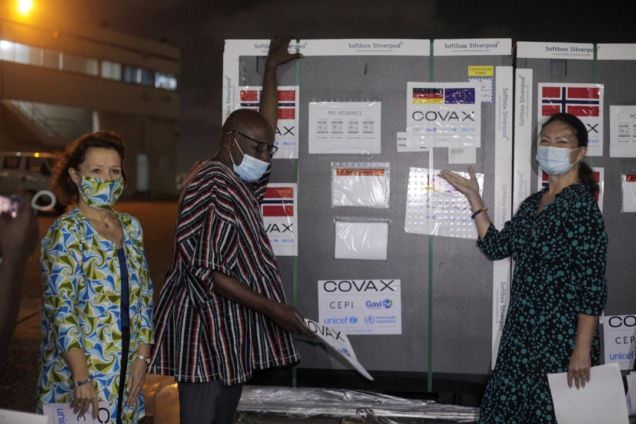
Ghana today received 98,400 doses of Covid-19 Vaccine AstraZeneca that were donated by Norway through the COVAX facility.
COVAX is a global initiative co-led by the Coalition for Epidemic Preparedness Innovations (CEPI), Gavi (the Vaccines Alliance) and the World Health Organization, which works with governments and manufacturers to accelerate the development, production and equitable access to Covid-19 vaccines around the world.
Country President for Africa, AstraZeneca, Barbara Nel, said: "I was delighted to see the arrival of 98,400 doses of the COVID-19 Vaccine AstraZeneca at Kotoka International Airport today.
"This donation from Norway will bolster Ghana’s vaccination programme and is wonderful news for the Ghanaian people.”
“Today’s arrival demonstrates the value of governments, industry and others working together to address our continent’s urgent needs to access vaccines.
"We will continue to advocate for equitable vaccine distribution and for more vaccines to get to Africa this year and into 2022. In this regard, AstraZeneca’s commitment to Africa remains steadfast,” she stated.
AstraZeneca was the first global pharmaceutical company to join COVAX in June 2020, and more than 113 million doses of the Company’s vaccine have been delivered through COVAX to date.
AstraZeneca is committed to supplying the vaccine broadly and equitably worldwide at no profit during the pandemic period.
To date, more than 1 billion doses of Covid-19 Vaccine AstraZeneca have been released for supply to over 170 countries around the world, and approximately two-thirds have gone to low- and lower-middle-income countries.
AstraZeneca is the third biggest supplier of Covid-19 vaccine doses in the world. Since the first international launch in early 2021, the vaccine has helped prevent hundreds of thousands of hospitalisations and helped save tens of thousands of lives.
Covid-19 Vaccine AstraZeneca
The Covid-19 Vaccine AstraZeneca (ChAdOx1-S [Recombinant]), formerly AZD1222, was co-invented by the University of Oxford and its spin-out company, Vaccitech.
It uses a replication-deficient chimpanzee viral vector based on a weakened version of a common cold virus (adenovirus) that causes infections in chimpanzees and contains the genetic material of the SARS-CoV-2 virus spike protein.
After vaccination, the surface spike protein is produced, priming the immune system to attack the SARS-CoV-2 virus if it later infects the body.
Latest Stories
-
Gold edges lower with focus on Fed minutes, rate path clues
50 minutes -
Oil prices rise as storms and air strikes threaten supply
59 minutes -
Nigeria nears 2,000 repatriations from South Africa after latest evacuation flight
1 hour -
World Bank maintains Ghana’s growth rate forecast at 4.8% in 2026
2 hours -
Cedi was worst African currency in quarter 2, 2026 – World Bank
2 hours -
US death row inmate Christa Pike awake and speaking after failed execution, lawyers say
2 hours -
AI gains can lift three times as many people out of poverty in Ghana – World Bank
3 hours -
Scammers target ECG customers with fake meter sales and MoMo payment calls
4 hours -
Abanga Fusani credits hard work and consistency for NPP Youth Organiser victory
4 hours -
We did not take security issues seriously – Abanga Fusani reflects on NPP’s 2024 election loss
5 hours -
Nigeria’s Dangote refinery aims to draw more retail investors than Aramco IPO, CEO says
5 hours -
Banker in court for allegedly stealing GH¢1 million
5 hours -
Police arrest suspect over jewellery theft during fire outbreak
5 hours -
EOCO returns Hanan’s £6,700, GH¢2,750 and devices after defence challenge
5 hours -
Opplift Youth Entrepreneurs Summit 2026 equips entrepreneurs with skills, mentorship and support
5 hours