

Audio By Carbonatix
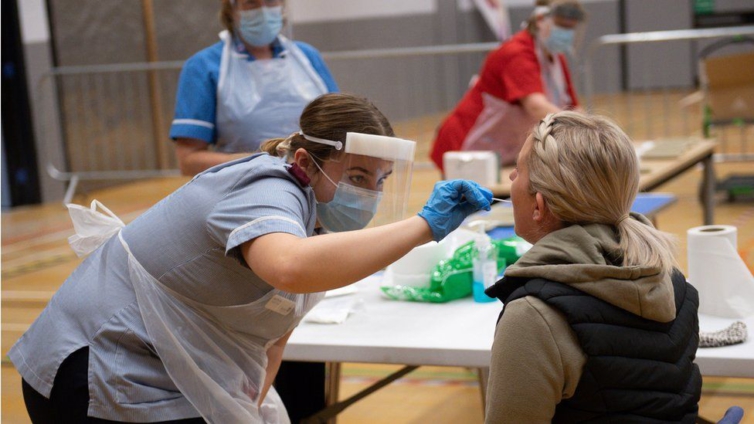
The mass use of rapid Covid tests has been defended by a senior NHS adviser, amid concerns over their accuracy.
Dr Susan Hopkins, chief medical adviser to NHS Test and Trace, said the lateral flow tests could identify many cases of infection in people without symptoms.
Speaking to BBC Radio 4's Today programme, she acknowledged there had been "false negatives" but stressed the policy was a "game-changer".
Mass testing is being introduced in England's tier-three "high-risk" areas.
It is also starting in one of the areas hardest-hit by Covid-19 in Wales.
And more than million rapid tests are being sent to care homes in England over the next month to allow safe indoor visits.
However, an article in the BMJ medical journal has raised concerns about the effects of rapid testing in Liverpool, where a pilot scheme was carried out. The lateral flow tests were reported to have missed half of all cases and a third of those with a high viral load who were likely to be the most infectious.
Dr Hopkins said the tests had "limitations" but stressed they were helping diagnose asymptomatic cases that would otherwise have gone undetected, adding: "What we are doing here is case detection. We are not saying people do not have the disease if their test is negative.
"We are trying to say [to people who test positive] 'You do have the disease and now we want you to go and isolate for 10 days.' That is a whole different game-changer."
Asked about concerns people who were declared negative could have a misplaced sense of reassurance, Dr Hopkins stressed mass-testing did not end the need for social distancing.
"We are also very clear that until we get a much lower prevalence of disease in this country that we shouldn't be changing our behaviours," she said.
Her comments came as the UK's chief medical officers warned the winter could be "especially hard" for the health service because of coronavirus.
Officials are preparing to begin using the Pfizer/BioNTech Covid-19 vaccine from as early as Tuesday.
But in a letter to colleagues, the chief medical officers of England (Prof Chris Whitty), Scotland (Dr Gregor Smith), Wales (Dr Frank Atherton) and Northern Ireland (Dr Michael McBride) said: "Although the very welcome news about vaccines means that we can look forward to 2021 with greater optimism, vaccine deployment will have only a marginal impact in reducing numbers coming into the health service with Covid over the next three months."
Latest Stories
-
After more than 14 years at Atletico Madrid, what next for Simeone?
2 hours -
Conquering the World – Building on the foundations laid by Otto Addo
2 hours -
[Watch Live] Obrafour, Kwaw Kese, Tinny, Keche and others thrill fans at Gomoa Easter Carnival
2 hours -
Gomoa Easter Carnival: Experts charge indigenes to own festival to ensure sustainability
3 hours -
Gomoa Easter Carnival: Edem Agbana and Joy Prime fans shower festival with huge endorsements
4 hours -
Gov’t to overhaul free zones into manufacturing hubs for local production – Trade Minister
5 hours -
Ghana losing $2.5bn yearly from raw exports – Trade Minister reveals
6 hours -
Mahama unveils plans for Kwahu Airport, Convention Centre
6 hours -
World’s oldest leader, Paul Biya to get a deputy for first time in 43-year rule
6 hours -
Search for missing US airman continues as Trump threatens ‘hell’ if Iran does not reach deal
6 hours -
US says it has arrested relatives of late Iranian general Qasem Soleimani
6 hours -
La Liga: Real Madrid’s title hopes hang in the balance as Mallorca snatch stoppage-time winner
6 hours -
FA Cup: Haaland hat-trick powers Man City past Liverpool into semi-finals
6 hours -
FA Cup: Chelsea thrash Port Vale to reach Wembley semi-final
6 hours -
Gov’t to boost tourism in coastal communities through infrastructure, sanitation – Vice President
7 hours