

Audio By Carbonatix
The Constitution Review Committee has proposed significant changes to the tenure and removal processes of the Chief Justice and other Justices of the Superior Courts.
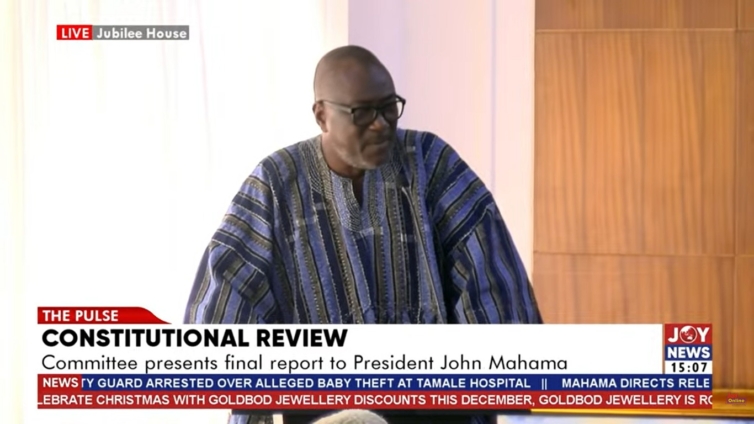
The proposals form part of a huge volume of recommendations by the Constitutional Review Committee (CRC), which was presented to President John Mahama on Monday, December 22.
At the centre of the proposals is a new tenure regime for the Chief Justice. The Committee recommends that the Chief Justice should serve a single, non-renewable term of 10 years or retire upon attaining the age of 70, whichever comes first.
Under the proposal, a Chief Justice would retire with full entitlements attached to the office. However, where the 10-year term ends before the age of 70, the individual may opt to continue serving as a Justice of the Supreme Court.
Justices of the Superior Courts
For other Justices of the Superior Courts, the Committee proposes that tenure should continue until retirement, death or resignation.
The mandatory retirement age would remain 70 years for Justices of the Supreme Court and the Court of Appeal, while High Court judges would retire at 65.
Beyond tenure, the Committee has outlined a uniform and clearly defined process for the removal of Justices of the Superior Courts, including the Chief Justice.
It recommends that the grounds for removal should be the same across the judiciary and include mental or physical incapacity, incompetence, gross misconduct, violation of the judicial code of conduct, or bankruptcy.
With specific regard to the Chief Justice, the Committee proposes a multi-layered and confidential removal process. An aggrieved person may submit a petition to the Council of State seeking the removal of the Chief Justice.
Within seven days of receiving the petition, the Council is required to refer it to its judicial committee to determine whether it discloses a prima facie case.
Where the committee finds the petition lacks merit, it would be dismissed. If sufficient grounds are established, the Council would notify the President and the Speaker of Parliament.
Upon notification, the President may suspend the Chief Justice pending investigations. The Council of State would then constitute a five-member tribunal to inquire into the matter.
The proposed tribunal would include a non-lawyer appointed by the President, a former Member of Parliament appointed by the Speaker, a representative of the Public Service Commission, a nominee of the National House of Chiefs, and a former Justice of the Supreme Court appointed by the Judicial Council. The tribunal would be chaired by the former Supreme Court Justice.
Hearings would be conducted in camera, and the tribunal would be required to submit its findings within 60 days.
The Committee says the proposed reforms are intended to strengthen judicial independence, enhance accountability, and bring clarity and predictability to the governance of the judiciary.
Latest Stories
-
Mahama’s push for visa-free Africa reflects Nkrumah’s Pan-African vision – Rashid Tanko-Computer
9 minutes -
Redefining sweetness: Why our celebrations must heal, not harm
10 minutes -
IMANI urges Mahama to reaffirm his 2014 directive on competitive state insurance placements
11 minutes -
Maiden Katon Praise comes off at Accra Sports Stadium on April 17
23 minutes -
Families flock to Luv FM Easter party at Rattray park in Kumasi
39 minutes -
Rural health worker laments overwhelming burden at CHPS compounds
59 minutes -
Katon Meet to stream Accra stadium Katon Praise Concert worldwide
1 hour -
Gov’t considers exploring local raw materials to stabilise production costs of sachet water prices
1 hour -
Mahama in Paris: Turning Diplomacy into Delivery
2 hours -
Middle East crisis shows Ghana needs to diversify energy sources – Energy expert
2 hours -
Government of Ghana Internal Revenue Generation cannot fund Big Push in Four Years
2 hours -
EPCG Moderator urges leaders to serve with courage and humility in Easter message
3 hours -
The Cobra at the gate: When good intentions overrun the system
3 hours -
Easter service disrupted in Nyanyano as suspected land guards storm church event
3 hours -
Price surge exposing NDC gov’ts dishonesty -Titus Glover
3 hours