

Audio By Carbonatix
Health workers in Agona East and West districts are sounding the alarm over what they describe as a looming outbreak of waterborne diseases, including typhoid and cholera.
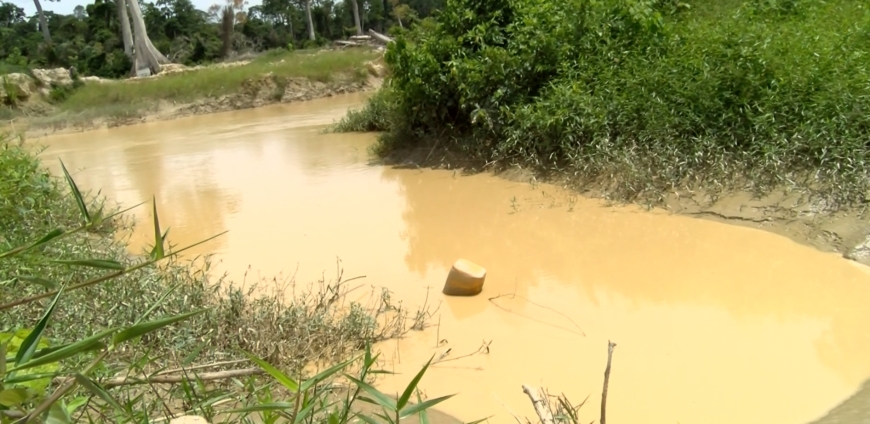
The warning follows the shutdown of the Kwanyaku Headworks two months ago due to illegal mining (galamsey), which has polluted the main water source for several communities.
With taps running dry, residents now depend on stagnant, contaminated water from ponds shared with livestock, and health workers say the consequences are already showing.
At the Kwesitwikrom CHPS Compound, the situation has become desperate. Nurse in charge, Maureen Adjei Dansoa, says the clinic now buys sachet water to treat patients.
“It’s been very difficult,” she said. “At times, we have to let patients take their start doses at home instead of starting treatment here because there’s no water.”
Aresident also said: “There is no water at our CHPs compound. Patients who visit the facility are sometimes treated with satchet water.”
The facility’s borehole broke down months ago, and with no government support, Maureen uses her own salary to buy water from nearby towns.
“Yes, from my own pocket. Nobody is paying,” she admitted quietly, her voice heavy with fatigue.
Outside the clinic, the community of Kwesitwikrom relies on a dark, smelly pool of water for drinking and cooking. Maureen fears that the same water, polluted and breeding insects, could soon spark a full-blown public health crisis.
“Definitely, there is going to be an outbreak of cholera. It has even started — just last week we had diarrhea cases here,” she revealed.
In the nearby Nyakrom Township in Agona West, the story is no different. The once-clear river that supplied households now flows in thick, tea-coloured currents, tainted by illegal mining upstream.
At the Nyakrom Health Centre, Senior Physician Assistant and head of the facility, Florence Mavis Odoom, says cases of typhoid and other waterborne infections are rising fast.
“In a month, we can record about 10 to 20 cases, sometimes more. It’s not easy,” she said. “We had the problem far away, but today it’s right next to us. Look at what we’re facing now.”
She says the government must act decisively if Ghana is to escape an even greater catastrophe.
“It still boils down to the government. If there are ways of getting rid of galamsey totally, we need to do it — else Ghana will be in a great mess.”
Latest Stories
-
Fire destroys 3-bedroom house at Bogyawe
8 minutes -
Why the Supreme Court is a “policy court” – Justice Richard Adjei-Frimpong breaks it down
12 minutes -
Playback: The Law discussed Supreme Court @150
1 hour -
MTN Momo staff walk to promote wellness and fitness
2 hours -
Assafuah: Sedina Attionu’s return from Nevada will test government’s commitment to accountability
2 hours -
How GRA’s Modified Taxation Scheme is boosting revenue compliance & SMEs competitiveness
2 hours -
Stonebwoy Can Do It: A call to unite behind 2026 BHIM Fest
2 hours -
World Shea Expo returns to Tamale for 2026 edition
2 hours -
Prioritise cocoa sector with better prices, timely payments-Annoh-Dompreh urges NDC
3 hours -
Lands and Mines Watch Ghana endorses Heath Goldfields’ mining capacity
3 hours -
Gbintiri residents protest alleged diversion of 24-hour market project
4 hours -
Justin Bieber headlines Coachella with nostalgia-fuelled set
4 hours -
Ukraine and Russia accuse each other of hundreds of ceasefire violations
4 hours -
Asha Bhosle: The sound of Bollywood dies aged 92
4 hours -
Fire destroys section of 4-bedroom apartment at Tantra Hill
4 hours