

Audio By Carbonatix
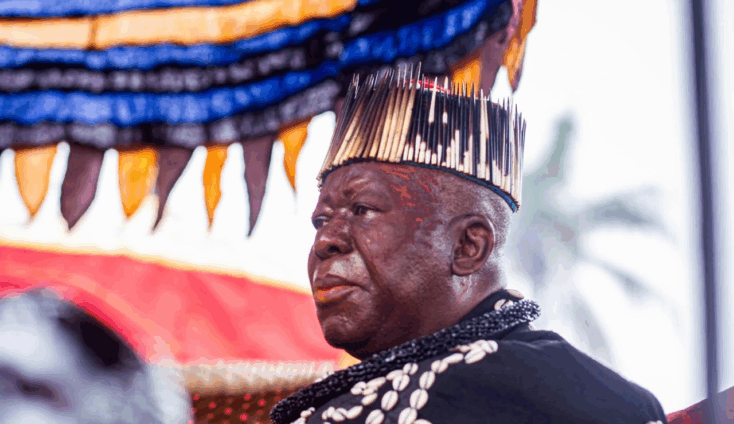
The royal hat of the Asantehene, Otumfuo Osei Tutu II, worn on the second day of the burial rites of Asantehemaa, Nana Konadu Yiadom III, is not born out of the ordinary.
The hat is made of original porcupine quills carefully arranged in vertical order, pointing to the sky.
It takes only those vested in the Asante tradition and culture to break down the meaning and message it carries.
It is one that depicts the power and supremacy and also sends a strong warning to enemies of the kingdom.

Otumfuo Osei Tutu II, like all Ashanti kings, has maintained the porcupine as one of their important emblems. It was adopted in 1701 and has since remained so.
The porcupine is seen displaying its quills in a warning manner.
The emblem also explains the might, dexterity, and power of the Asante people.
The "Wo kum apem a, apem beba," to wit, "When you kill a thousand, a thousand fold will come forward," is the slogan of the Asante Kingdom a kingdom that derived its powers and supremacy from its people united for wars.
The porcupine, by nature, fights from all angles, an indication of the Asante Kingdom’s readiness to fight with its enemies at all times. The porcupine warriors, as the people of Asante are called, stand united and ready to defend themselves, especially their king, at all material times.
This explains why chiefs and their subjects, in defiance of rain, paid homage to the Asantehene at the Manhyia Palace on day two of the ‘Dote Yie’ of Asantehemaa, Nana Konadu Yiadom III.
The Asante Kingdom in the early 18th century expanded its territory to as far as Bondoukou in present-day Ivory Coast and has since kept ties with the same. It has several paramountcies that cut across politically administered regions and districts of Ghana.
Such paramountcies can be found in the Ashanti, Ahafo, Bono, and Bono East; Western and Western North; and Eastern and Oti regions of Ghana.

The kingdom has, over the years, maintained close ties and alliances with paramountcies in areas where it has no permanent paramountcies. These could be found in the Volta, Savannah, Northeast, and Northern regions.
In the olden days, the Asante army was not only dreaded but also fearful, as it wielded gunpower and numerical advantage after trading in the coastal towns with the whites.
The Asantehene’s hat has a handwoven fabric-like red cloth, which is decorated underneath with dark green Kente cloth stitched with cowries to match.
These are the official colors of the Asante Kingdom, which resonate with its old-age customs and traditions.
While the red color signifies war and sacrifice, an integral part of the Asante Kingdom, the green color is a reminder of the natural resources, such as the land, the kingdom is endowed with.
Latest Stories
-
4 Killed in Buipe–Tamale Highway crash as Fire Service rescues survivors
24 minutes -
Tunisian journalist sentenced to two years, union denounces systemic attack on media
35 minutes -
Nigerian lawmakers approve increased $49.4bn 2026 budget
45 minutes -
Nigeria allocates more crude cargoes to Dangote refinery for May, sources say
55 minutes -
Senegal president backs new anti-LGBT law banning ‘promotion’
1 hour -
Nigeria warns its citizens in South Africa to be cautious after march turns violent
1 hour -
EOCO declares Dr Kwamigah-Atokple wanted in gold fraud probe
1 hour -
Police arrest suspects in cybercrime, violent cases
2 hours -
Adenta Court fines students for assault on teacher
2 hours -
Accra Circuit Court probes alleged online fraudsters
2 hours -
Global refinery giant eyes Ghana as gold processing hub – Sammy Gyamfi tells Joy News
2 hours -
By 2030, no raw gold leaves Ghana – Sammy Gyamfi reveals Mahama’s bold directive
3 hours -
Raw gold exports declining as Ghana shifts to refining agenda – Sammy Gyamfi
3 hours -
It has already started – Sammy Gyamfi says shift from raw gold to bullion is underway
5 hours -
Czech Republic deny Denmark in shootout to reach World Cup
5 hours