

Audio By Carbonatix
Facebook has banned users trading in historical artefacts on the site.
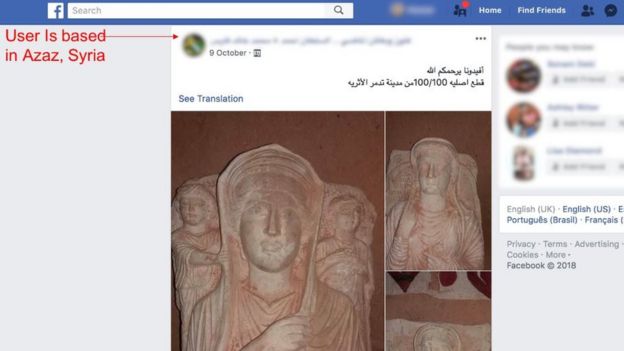
It follows a campaign by academic researchers and an investigation by BBC News, exposing how items looted from Iraq and Syria were sold on Facebook.
One expert welcomed the move but said for anything to change, Facebook should invest in "teams of experts to identify and remove networks rather than playing whack-a-mole with individual posts".
Facebook says all trade in ancient artefacts is banned on its platforms.
The changes are included in a new set of Facebook Community Standards published on Tuesday.
They ban content that "encourages or attempts to buy, sell or trade historical artefacts" or "attempts to solicit historical artefacts".
Items sold in this way can include ancient scrolls, manuscripts, mummified body parts and ancient coins.
Facebook public policy manager Greg Mandel explained: "Historical artefacts hold significant personal and cultural value for communities across the globe, but their sale often results in harmful behaviour.
"That's why we've long had rules preventing the sale of stolen artefacts.
"To keep these artefacts and our users safe, we've been working to expand our rules, and starting today we now prohibit the exchange, sale or purchase of all historical artefacts on Facebook and Instagram."
Prof Amr al-Azm, from Shawnee State University in Ohio, hailed the move as an important shift in Facebook's position but said he feared the new standards would prove worthless without adequate efforts to enforce them.
The social media giant is developing automated systems based on images and keywords to identify content which violates the new policy but Prof Al-Azm told the BBC: "Relying on user reports and Artificial Intelligence is simply not enough."
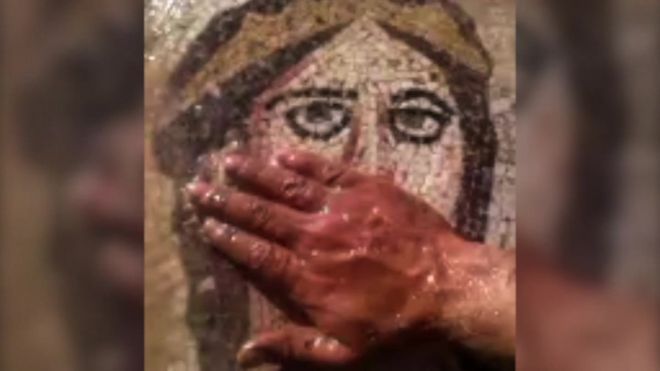
A BBC News investigation in 2019 found evidence that Roman mosaics still in the ground in Syria were being offered for sale on Facebook.
We saw groups exchange ideas on how to dig up sites and evidence of "loot-to-order" requests. In one case, administrators asked for Islamic-era manuscripts to be made available for purchase in Turkey.
Following our investigation, Facebook said it had removed 49 groups - but researchers continue to unearth evidence that trade is still ongoing.
"Illicit antiquities trade on Facebook appears to have the greatest reach in the Middle East and North Africa where we are currently monitoring over 120 Facebook groups developed solely for looting and trafficking activity," said Prof Amr Al-Azm
"The largest group we identified had roughly 150,000 members this time last year - now it has more than 437,000. "
Part of the recent increase may be attributable to the effects of the economic crisis caused by the coronavirus pandemic.
But this was not just a case of the impoverished selling antiquities to make a few dollars, said Prof al-Azm.
"This is also a black market that funds criminal organisations, warlords, and radical extremists, and it's happening on the same site in the same digital space that you welcome into your home and [use to] share photos of your children."
Prof al-Azm is critical of Facebook's policy of deleting posts that violate its community standards.
Instead, he said, it should keep a digital archive of images, which might not exist anywhere else.
"This evidence is vital for ensuring the repatriation of these objects if they appear on the market," he argued.
Usually, content that violates Facebook standards is permanently deleted within 90 days but data can be retained if requested by law enforcement, the BBC understands.
Latest Stories
-
Scrutinise sole-sourced contracts beyond percentages – Edem Senanu cautions gov’t
1 minute -
5 secrets that will make your living room look expensive, according to pro designers
10 minutes -
Recording Encounters with Security Forces in Ghana Wrong? – Forced Deletion of Evidence?
11 minutes -
About 1,200 businesses in Burma Camp to start paying for electricity as gov’t scraps exemption
17 minutes -
Ghana’s Next Big Reform should be Migration
29 minutes -
There’s no such thing as a slave – Mahama urges global rethink at UN
34 minutes -
EOCO’s case crumbles as High Court clears Gabriel Tanko Kwamigah-Atokple
42 minutes -
UN slavery resolution a pathway to healing and justice – Mahama
47 minutes -
Mahama warns against modern-day erasure of black history in schools, media
54 minutes -
At Nobi Agriculture, scale and systems redefine farming in Ghana
55 minutes -
TCL named official electronics sponsor of UG Corporate Football League
1 hour -
Hon Stanley Basil Bade Carboo aka Nene Opertoto II
1 hour -
Stop charging young people recruitment fees – Senyo Hosi tells government
1 hour -
WAES condemns conviction of Malian journalist, warns of threat to press freedom
1 hour -
What a Strait of Hormuz Blockade could mean for Ghana’s economy in 2026 – A PwC analysis
1 hour