

Audio By Carbonatix
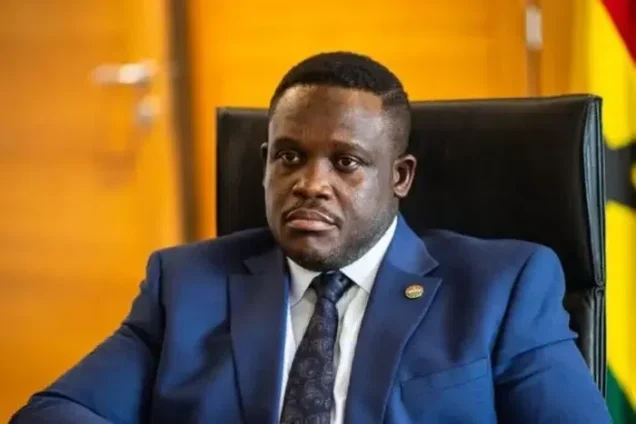
In the wake of a pre-dawn military operation by the United States in Venezuela, Minister of Communication, Digital Technology and Innovations, Samuel Nartey George, has raised questions regarding the future of global stability and the sanctity of territorial sovereignty.
The minister’s reaction follows breaking reports on January 3, 2026, that U.S. forces successfully captured Venezuelan President Nicolás Maduro in a high-stakes raid in the capital, Caracas.
The event has sent shockwaves through the diplomatic world, drawing immediate comparisons to previous Western interventions in the Middle East and North Africa.
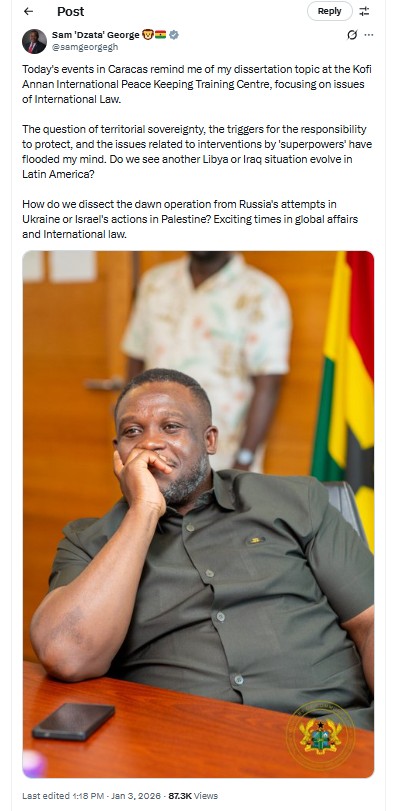
Taking to his X (formerly Twitter) account, the Ningo-Prampram legislator drew upon his academic background in peace and security studies to frame the unfolding crisis.
George, an alumnus of the Kofi Annan International Peacekeeping Training Centre (KAIPTC), noted that the military action serves as a live case study for the theories of international law he once researched.
"Today's events in Caracas remind me of my dissertation topic at the Kofi Annan International Peacekeeping Training Centre, focusing on issues of international law," George posted.
The minister indicated that the operation complicates the established norms of non-interference, stating that the “question of territorial sovereignty, the triggers for the responsibility to protect, and the issues related to interventions by 'superpowers' have flooded my mind.”
Hon. Sam George’s critique centred on whether the world is witnessing a repetitive cycle of "regime change" strategies that have historically led to long-term instability. He questioned the legal consistency of the international community's response to different global conflicts.
“Do we see another Libya or Iraq situation evolve in Latin America? How do we dissect the dawn operation from Russia's attempts in Ukraine or Israel's actions in Palestine?" he asked rhetorically.
His comparison strikes at the heart of the debate over double standard in global affairs—specifically how the world differentiates between an intervention for democratic restoration and aggression against a sovereign state.
While the capture of Maduro has been celebrated by his detractors as a victory for democracy, critics and legal scholars like George view it as a precarious moment for the United Nations Charter.
The minister concluded his thread by characterising the current era as “Exciting times in global affairs and International law”, suggesting that the precedents set in Caracas will redefine the limits of superpower influence for decades to come.
Latest Stories
-
Education is critical to Ghana’s future and development – Haruna Iddrisu
6 minutes -
Who’s Emelia Affi Agbenyo, the 43-year-old newly sworn-in Deputy EC Chair?
40 minutes -
Haruna Iddrisu calls for limits on annual university accommodation fee increases
1 hour -
Today’s front pages: Tuesday, October 13, 2026
2 hours -
Wealth Over Water: How Galamsey Is Threatening Ghana’s Water Security
3 hours -
LA 2028: Black Queens pumped up for second leg of Mauritius tie
3 hours -
LA 2028: Black Queens hold final training session ahead of second leg against Mauritius
3 hours -
Standards are not Seasonal: What the EC appointments teach both sides
4 hours -
King Mohammed VI urges private sector to create youth jobs and spread benefits of growth
4 hours -
KGL U17 Colts 2026: Greater Accra win title after penalties win over Western Region
4 hours -
UK Investment Roadshow opens in London to advance UK-Ghana growth partnership
4 hours -
Assemblies of God requires pastors to resign before entering partisan politics – Rev. Wengam
4 hours -
Ghana targets 20% annual reduction in maternal deaths – Health Minister
4 hours -
Cyber attacks in Africa grow faster than global rate, report finds
4 hours -
Ghana signs UAE deal to create 5,000 overseas jobs
4 hours