

Audio By Carbonatix
President John Dramani Mahama has called for a fundamental shift in how the world speaks about slavery, insisting that “there’s no such thing as a slave” but rather human beings who were forcibly trafficked and enslaved.
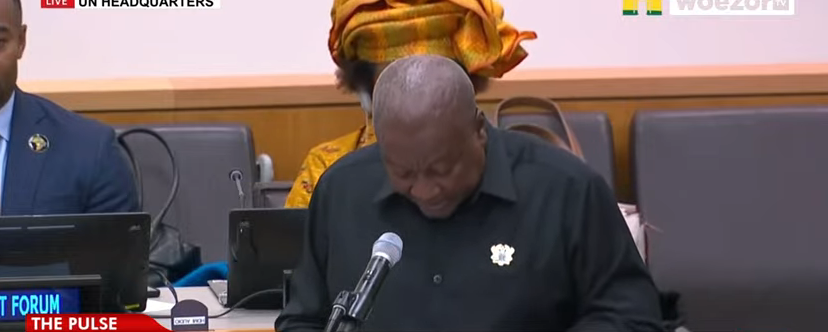
Speaking at a United Nations event at the United Nations Headquarters, Mr Mahama said language plays a powerful role in shaping consciousness and must reflect the humanity of those who suffered under the transatlantic slave trade.
“Truth begins with language,” he stated. “There were human beings who were trafficked and then enslaved by people who believed they could own those human beings as chattels.”
His remarks come as Ghana prepares to table a landmark resolution on March 25, 2026, seeking to officially declare the Transatlantic Slave Trade as the gravest crime against humanity a move expected to reignite global conversations around reparations and historical justice.
According to the President, redefining the narrative is not merely semantic but essential to restoring dignity and confronting the historical injustice that underpinned slavery.
“The entire transatlantic slavery trade was designed to deny African people their humanity,” he said on March 24, adding that the system was built on a false racial hierarchy that deemed Black people inferior.
Mr Mahama stressed that the resolution will serve as a tool for collective global acknowledgment of the atrocities suffered by millions of Africans over centuries.
“This resolution allows us as a global community to collectively bear witness to the plight of more than 12.5 million men, women, and children whose lives were stolen,” he noted.
He further described the initiative as a pathway to healing and reparative justice, not only for Ghana but for the wider African diaspora, including communities in the Caribbean and Latin America.
Providing vivid historical context, the President recounted the brutal realities of the slave trade from the capture and inhumane conditions in coastal dungeons to the deadly Middle Passage, where up to 20% of enslaved Africans perished.
He detailed how survivors were stripped of their identities, renamed, and subjected to forced labour on plantations across the Americas under harsh and often fatal conditions.
“Violence begins with language,” he emphasised, warning against the continued use of terms that diminish the humanity of victims.
The resolution, backed by the African Union and CARICOM, was first announced during the 80th UN General Assembly and seeks to establish a global legal framework for restitution and address systemic inequalities rooted in slavery.
The initiative also aligns with growing international calls for reparatory justice, as countries and institutions increasingly confront the enduring legacy of the slave trade.
Latest Stories
-
Imagination Africa, Mentors Chess Academy to host second African Genius Chess Championship at Ghud Park
47 minutes -
Nana B passport claims a diversionary tactic — Abu Jinapor
2 hours -
Pope Leo diagnosed with cancer as doctors remove lobe of lung, Vatican says
2 hours -
Legal Aid Commission takes free legal services to Techiman main lorry terminal
2 hours -
Nana B denies seeking passport favour, accuses Ablakwa of failing to account for GH¢16.4m
2 hours -
Young girls demand climate action, stronger protection against child marriage
2 hours -
Ex-gang boss sentenced to 40 years for orchestrating Tupac Shakur’s murder
2 hours -
From near-deferral to three awards: UMaT graduate’s academic journey
2 hours -
Atta Akyea denies seeking presidential pardon for Wontumi in galamsey case
3 hours -
Photos: Mahama commissions 85-bed Police Hospital ward, donates two ambulances
3 hours -
GTEC directs Ghana’s public universities to reopen by October 16 and begin lectures on October 19
3 hours -
Star Oil donates GH¢1million towards construction of new CID facility
3 hours -
Court hands Adjetey Sowah, two others lifetime bans after Amputee Football legal dispute
3 hours -
NDC appoints Julius Kwame Anthony as a Deputy Communications Director
3 hours -
Ghana repatriates 120 Nigerians rescued from suspected cybercrime centres
3 hours