


Audio By Carbonatix
Facebook has announced a breakthrough in its plan to create a device that allows people to type just by thinking.
It has funded a study that developed machine-learning algorithms capable of turning brain activity into speech
It worked on epilepsy patients who had already had recording electrodes placed on their brains to asses the origins of their seizures, ahead of surgery.
Facebook hopes it will pave the way for a "fully non-invasive, wearable device" that can process 100 words per minute.
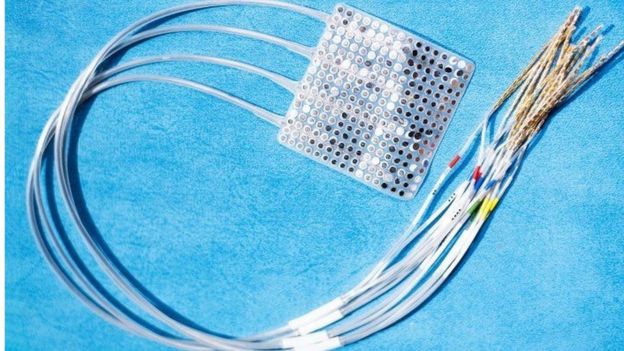 Image caption: Electrodes were temporarily placed on the surface of the brain of epilepsy patients
"Ultimately, the researchers hope to reach a real-time decoding speed of 100 words per minute with a 1,000-word vocabulary and word error rate of less than 17%," Facebook wrote on its blog.
"And by demonstrating a proof-of-concept using implanted electrodes as part of their effort to help patients with speech loss, we hope UCSF's work will inform our development of the decoding algorithms and technical specifications needed for a fully non-invasive, wearable device.
"Rather than looking down at a phone screen or breaking out a laptop, we can maintain eye contact and retrieve useful information and context without ever missing a beat."
Meanwhile, Elon Musk's Neuralink company has applied to US regulators for permission to start testing its own brain-hacking device on humans.
Some in the field believe it is time to pause to consider the ethics of such research and the possibilities it opens for the future.
"To me, the brain is the one safe place for freedom of thought, of fantasies and for dissent," neuro-ethicist Prof Nita Farahany told MIT Review.
Image caption: Electrodes were temporarily placed on the surface of the brain of epilepsy patients
"Ultimately, the researchers hope to reach a real-time decoding speed of 100 words per minute with a 1,000-word vocabulary and word error rate of less than 17%," Facebook wrote on its blog.
"And by demonstrating a proof-of-concept using implanted electrodes as part of their effort to help patients with speech loss, we hope UCSF's work will inform our development of the decoding algorithms and technical specifications needed for a fully non-invasive, wearable device.
"Rather than looking down at a phone screen or breaking out a laptop, we can maintain eye contact and retrieve useful information and context without ever missing a beat."
Meanwhile, Elon Musk's Neuralink company has applied to US regulators for permission to start testing its own brain-hacking device on humans.
Some in the field believe it is time to pause to consider the ethics of such research and the possibilities it opens for the future.
"To me, the brain is the one safe place for freedom of thought, of fantasies and for dissent," neuro-ethicist Prof Nita Farahany told MIT Review.
'Muscle twitches'
University of California San Francisco scientists asked the patients to answer out loud a list of simple multiple-choice questions ordered randomly. And the algorithms learned to identify:- the question they had been asked, 75% of the time
- their chosen answer, 61% of the time
'Safe place'
Researcher David Moses said: "It's important to keep in mind that we achieved this using a very limited vocabulary - but in future studies we hope to increase the flexibility as well as the accuracy of what we can translate from brain activity." The study is published in Nature Communications.
Image caption: Electrodes were temporarily placed on the surface of the brain of epilepsy patients
"Ultimately, the researchers hope to reach a real-time decoding speed of 100 words per minute with a 1,000-word vocabulary and word error rate of less than 17%," Facebook wrote on its blog.
"And by demonstrating a proof-of-concept using implanted electrodes as part of their effort to help patients with speech loss, we hope UCSF's work will inform our development of the decoding algorithms and technical specifications needed for a fully non-invasive, wearable device.
"Rather than looking down at a phone screen or breaking out a laptop, we can maintain eye contact and retrieve useful information and context without ever missing a beat."
Meanwhile, Elon Musk's Neuralink company has applied to US regulators for permission to start testing its own brain-hacking device on humans.
Some in the field believe it is time to pause to consider the ethics of such research and the possibilities it opens for the future.
"To me, the brain is the one safe place for freedom of thought, of fantasies and for dissent," neuro-ethicist Prof Nita Farahany told MIT Review.DISCLAIMER: The Views, Comments, Opinions, Contributions and Statements made by Readers and Contributors on this platform do not necessarily represent the views or policy of Multimedia Group Limited.
Tags:
DISCLAIMER: The Views, Comments, Opinions, Contributions and Statements made by Readers and Contributors on this platform do not necessarily represent the views or policy of Multimedia Group Limited.
Latest Stories
-
Semenyo reports to Black Stars camp after Carabao Cup win
37 minutes -
Akurugu delivers first state of Constituency address, highlights development gains in Dome-Kwabenya
5 hours -
Journalism out loud: Defending truth in a divided world
5 hours -
Heath Goldfields partners local firm, receives new mining fleet to revive Bogoso-Prestea mine
5 hours -
Korle-Bu overcrowding driven by broken referral system, not just bed shortage – Doctors
5 hours -
MC Portfolio named red carpet host for 2026 Ghana Music Awards USA
6 hours -
Oda-Akyem Swedru road develops dangerous potholes
6 hours -
U.S. Embassy explains Visa process for Ghanaians ahead of World Cup
6 hours -
Viral video on emergency care at Korle-Bu Teaching Hospital is ‘authentic’ – Emergency Medicine Residents
6 hours -
Ahmad Abdul-Samad, Rachael Quarcoo dominate 1st quarter All Ghana Badminton Championship
6 hours -
ActionAid calls for strong partnerships to advance water, gender, and climate justice
6 hours -
DVLA begins nationwide clampdown on expired DV plates from March 24
7 hours -
Ghanaian Commonwealth Youth Leader meets King Charles III, pushes for youth economic empowerment
7 hours -
Former President Akufo-Addo takes on new role in Anglican Church
8 hours -
MTN Ghana steps up sensitization on efficient and safe data usage
8 hours