

Audio By Carbonatix
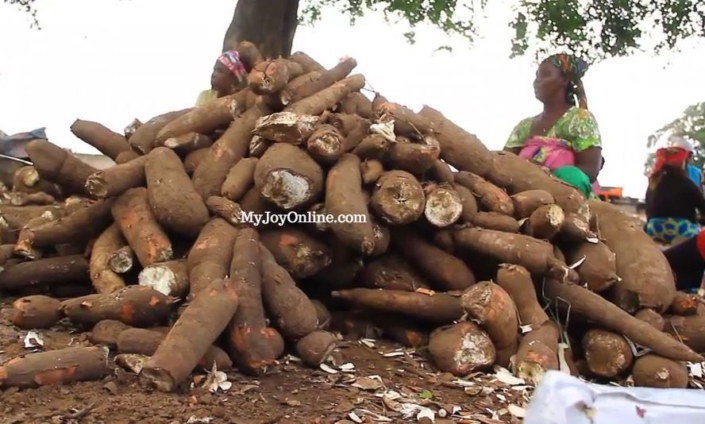
Chief Executive Officers (CEO) of Ayensu Starch Company Limited, Evans Ayim, has urged farmers to adopt new methods in the production of cassava.
He said scientists had developed improved cassava seeds and farming practices to enhance yield and ensure economic viability and encouraged farmers to take advantage of the Innovation.
Mr Ayim made the appeal at the maiden Cassava Week Celebration organised by the Biotechnology and Nuclear Agriculture Research Institute (BNARI) of the Ghana Atomic Energy Commission (GAEC).
It was under the theme: "Ghana's Golden Root for Economic Transformation".
Mr Ayim said: "Farming has moved on, today practices have advanced; these days they talk about precision agriculture. Farmers just do not go to the field and plant, instead they have to check the fertility of the soil and the exact nutrients that the soil needs, before planting, " he said.
He stated that the application of new technologies in cassava production would go a long way to stimulate economic growth and create employment opportunities for the youth.
"Globally, the starch industry for instance is worth over 97 billion US Dollars and Ghana's economy stands to benefit greatly if steps are taken to industrialise cassava," he said.
The Chief Executive Officer commended the government for supporting cassava processing factories, including the Amantin Agro processing, Caltech ventures and Twin Rock Company Limited, under the one district one factory policy.
He noted that a major problem in the cassava industry was how researchers had failed to transmit knowledge and skills to farmers, most especially in rural areas.
Mr Ayim commneded BNARI and its partners on championing the initiative, which he said sought to build a better industry to transform the livelihoods of actors in the cassava value chain.
Dr. Michael Osae, Director of Biotechnology and Nuclear Agriculture Research Institute, noted that harnessing the potential in the cassava industry could transform the economy of the country.
"Every part of the cassava crop is useful, even the peel. In South Africa, people use cassava peels in producing cement. There is a lot that can be achieved with cassava, aside from it being a staple food," he added.
Dr Osae said the Institute through the support of International Atomic Agency and other key players had funded them to develop varieties of cassava especially one that had high starch and carotenoids most needed by industries.
He urged farmers to adopt science, technology and innovation in farming, which the BNARI was working towards to get everyone involved to boost Ghana's yield in agriculture.
The Ghana Atomic Energy Commission is currently working with some farmer-based organisations and Non-Governmental Organisations to establish demonstration farms, which would transfer technologies on climate crop varieties to improve productivity in the cassava system.
Latest Stories
-
Teen defender Eric Mensah undergoes trial at Malaga CF after standout ROC Cup display
19 seconds -
Journalism out loud: Why silence is no longer an option
1 minute -
5,000 miners stranded in Ahafo-Ano North as alleged NAIMOS operatives take over site
8 minutes -
GMTFcare rollout begins at Komfo Anokye Teaching Hospital to transform patient support
15 minutes -
Leicester lose appeal against points deduction
23 minutes -
Telecel hosts Women 100 Power Connect 2026 on reciprocity in leadership
32 minutes -
Ken Ofori-Atta released from ICE detention after judicial order — Lawyer confirms
34 minutes -
Women in PR Ghana unveils Top 10 PR Women for 2025
39 minutes -
Tourism Minister advocates expansion of Vodza Regatta in Volta region to boost coastal tourism
49 minutes -
Gradual recovery signals shift in fortunes of Tema Oil Refinery
52 minutes -
Greece to ban social media for under-15s from next year
52 minutes -
Volta Chiefs condemn EOCO over alleged disregard for Court ruling in Kwamigah-Atokple case
54 minutes -
We need collective action to advance sustainability in Ghana and Africa – Deloitte Tax Partner
58 minutes -
Imperial College promotes science communication and Africa–UK innovation links
58 minutes -
Imperial College President calls for global science partnerships with Africa
1 hour