

Audio By Carbonatix
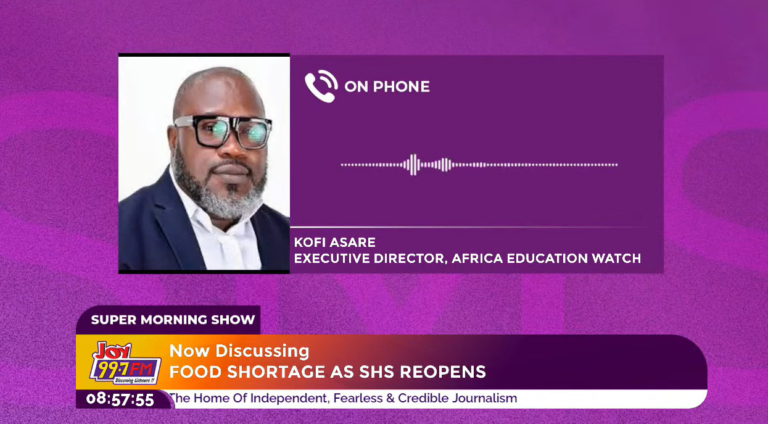
Executive Director of Africa Education Watch, Kofi Asare says even though food shortages are being recorded in some SHSs, there is enough food to supply.
Speaking on Joy FM’s Super Morning Show, he explained that "while some food items are available, there is a shortfall in essential ingredients, largely due to systemic and political challenges.”
“Rice and some other staples are sufficiently available,” he noted, “but there’s a scarcity of key ingredients due to liquidity challenges. The issue isn’t about the total absence of food, but the lack of essential items to make up a complete food basket.”
According to Mr. Asare, schools depend on food supplies from the National Food Buffer Stock Company, which delivers 18 centrally procured food items. Schools then use their subventions to purchase perishable items like fish and eggs locally. However, certain ingredients, such as bread, have become a rare commodity in many schools, forcing students to adjust.
Mr. Asare attributed these challenges to the ad hoc nature of the Free SHS feeding policy, which he said is far from being a structured system. He also highlighted the influence of political transitions on food supply chains.
“Suppliers have shown significant caution in food deliveries since September due to uncertainties surrounding political transitions,” he said. He explained that such transitions often result in delayed payments, making suppliers hesitant to continue operations.
Adding to the complexity, he pointed out that the National Democratic Congress (NDC) has pledged to abolish the current centralised food procurement system , favouring a decentralised system where schools manage their own procurement under supervision from the Ghana Education Service. This, he said, has created additional uncertainty for suppliers who fear being excluded from future contracts.
Mr. Asare concluded that addressing these issues requires solving the liquidity problem and transforming the Free SHS feeding programme from an ad hoc arrangement into a sustainable and efficient system.
The food shortage issue, he emphasised, is not new but demands a long term solution to ensure consistency in the feeding of students.
Latest Stories
-
Lekzy DeComic gears up for Easter comedy special ‘A Fool in April’
35 minutes -
Iran declares 40 days of national mourning after Ayatollah Ali Khamenei’s death
1 hour -
Family of Maamobi shooting victim makes desperate plea for Presidential intervention
2 hours -
Middle East turmoil threatens to derail Ghana’s single-digit gains
3 hours -
Free-scoring Semenyo takes burden off Haaland
3 hours -
Explainer: Why did the US attack Iran?
4 hours -
Peaky Blinders to The Bride!: 10 of the best films to watch in March
5 hours -
Crude oil price crosses $91 as Strait of Hormuz blockade chokes 22% of global supply
5 hours -
Dr. Hilla Limann Technical University records 17% admission surge; launches region’s first cosmetology laboratory
6 hours -
Over 50 students hospitalised after horror crash ends sports tournament
6 hours -
Accra–Dubai flights cancelled as Middle East tensions deepen
7 hours -
See the areas that will be affected by ECG’s planned maintenance from March 1-5
7 hours -
Kane scores twice as Bayern beat rivals Dortmund
8 hours -
Lamine Yamal hits first hat-trick in Barcelona win
8 hours -
Iran says US and Israel strikes hit school killing 108
8 hours