

Audio By Carbonatix
Officially, all lines of enquiry are still open into a wave of arson and gun attacks at French prisons.
That means police haven't ruled out the extremist left, or a foreign power such as Russia or Algeria.
But the conviction is growing that the attacks - 12 since Sunday night - can only have been the work of drugs gangs, hitting back at the government's latest crackdown.
That is certainly the belief of the government itself.
Speaking on Thursday morning, Interior Minister Bruno Retailleau said he was "certain that what we're dealing with is the drugs-yobs [in French, narco-racaille]".
"It's not they who have declared war on us. It's we who declared war on them with our new law on drugs trafficking. They know we're going to be hitting their wallets."
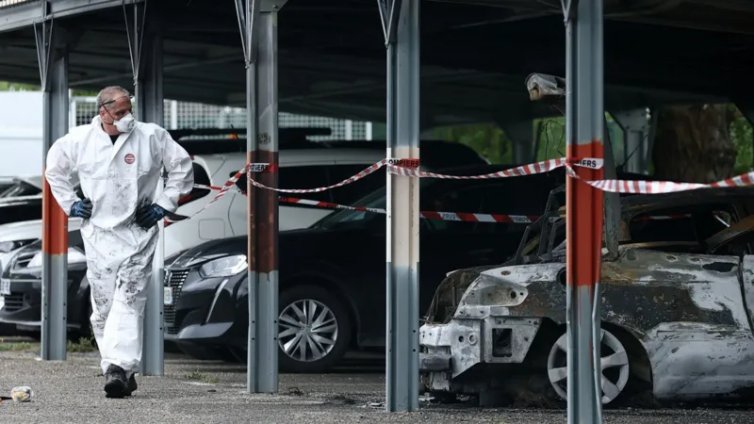
In what was obviously a co-ordinated plan over three nights, gangs set fire to cars outside prisons and a prison officer training centre. In two locations, guns were used.
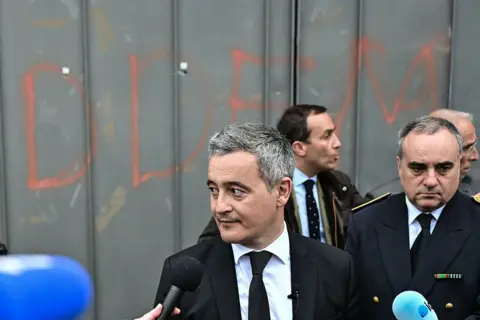
In many attacks, the perpetrators sprayed graffiti bearing the initials DDPF, which stands for Droits des Prisonniers Français - Rights for French Prison Inmates.
The group was previously unheard of, but on Tuesday it posted a video on the messaging platform Telegram showing the burning of a prison officer's car.
In French that is full of mistakes, the video's text accuses Justice Minister Gérard Darmanin of declaring "war" on prisoners.
"All we want is that human rights be respected," the text reads. "If in 2025 we can watch TV, smoke and eat our meals without being bothered in our cells, it's only because our elders fought for these fundamental rights."
Presenting themselves as defenders of human rights may not be the usual methodology of drugs gangs.
But nor does the DDPF come across as a classic far-left or anarchist organisation, which might more naturally be fighting for the cause.
For one thing, such groups tend to have intellectual underpinning which means they write grammatical and properly spelled French. Nor have far-left groups till now made prisoners' rights a particular issue.
Investigators have said that perpetrators of the attacks caught on video were dressed more like drugs-gang foot soldiers rather than far-left militants, who tend to come from a different social background.
And in one location they wrote the wrong set of initials – DDFM – suggesting that their attachment to the supposed organisation was not exactly deep.
The theory of foreign manipulation is taken seriously – especially after proven cases of Russian interference such as the spraying of Stars of David in Paris after the October 7 attacks.
Relations with Algeria are also at an all-time low at the moment.
But if the drugs gang theory is the favoured one, it is because means and motivation are both so easy to grasp.
The French government currently includes an unusual tandem: an interior and a justice minister who are not rivals; who are both on the political right; and who have pledged to fight head-on the scourge that they say is the drugs trade.
To this end Darmanin and Retailleau are currently steering a bill through parliament that they say will seriously hamper the drugs lords' ability to operate.
A dedicated branch of the prosecutors' office will be created. There will be extra powers for investigators, and a special, protected status for informers.
Even more of a threat to the drugs barons – so the government says – will be two newly converted prisons, where the 100 most powerful of them will be interned from later this year.
In these top-security jails, there will be much stricter rules governing visits and communication with the outside world. New measures will be in place to stop the infiltration of mobile telephones (of which tens of thousands are known to circulate in French jails).
The purpose is to prevent gang leaders from continuing their operations from behind bars – a security breach which has become widespread.
The case of Mohamed Amra, the drugs-lord whose escape last year led to the murder of two prison-officers near Rouen, is typical.
Prison staff who went on strike in protest told the BBC how laxity inside jails was undermining morale and presenting a growing security risk.
Amra was recaptured in Romania last month.
The French government sees in the prison attacks a sign that for once the drugs gangs feel intimidated – and that's why they're hitting back.
Of course it suits the French government to say that, because it's evidence they can present to the voters that they are indeed getting tough.
The clincher will be when they catch one of the perpetrators and get him to explain why he did it. Investigators say we should not have to wait long.
Latest Stories
-
Kwakye Ofosu rejects NPP Minority’s call for apology over anti-LGBTQ bill
2 minutes -
Music giant Universal gets $64bn takeover offer
14 minutes -
NPP criticism of anti-LGBTQ Bill ‘nothing more than political posturing’ — Kwakye Ofosu
22 minutes -
Joy FM was birthed over a bowl of fufu’ – Tommy Annan-Forson shares interesting story
27 minutes -
World Athletics to introduce standalone World Marathon Championships from 2030
32 minutes -
Africa’s voice in global journalism grows as funding, AI and misinformation shape newsrooms
34 minutes -
First Atlantic Bank holds Annual General Meeting, reports strong growth and bold outlook for 2026
36 minutes -
Ghanaian-founded fintech WeWire secures Canadian PSP license to bridge African, global payments
39 minutes -
Uganda confirms 2027 AFCON dates
48 minutes -
40 convicted in Northern Region crime crackdown
48 minutes -
‘We’re days away from parts of the world experiencing actual shortages:’ Eric Nuttall on energy
58 minutes -
‘I’m Obroni in every country’ – Coco Blasian on music, survival and making Accra home
59 minutes -
IMANI wants NIC to probe possible conflicts of interest in reinsurance arrangements
1 hour -
First Atlantic Bank strengthens balance sheet as net interest income surges 67%
1 hour -
Choplife Gaming donates to Korle Bu Radiotherapy unit for Women’s Week 2026
1 hour