

Audio By Carbonatix
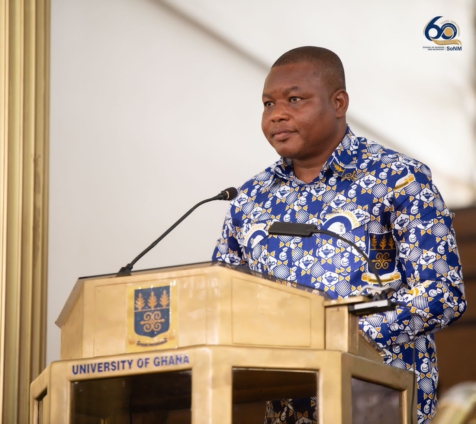
Specialist in Health Economics and Health Systems with The World Health Organization (WHO), Prof James Avoka Asamani believes Ghana has to fill the health personnel shortfall if primary healthcare objectives are to be achieved.
Prof Asamani further stated that, "what we saying is that, the number of nurses and midwives that are being trained in the country plus those we already have, assuming we are able to retain them in the country. We still have a shortfall of 66, 000 by 2030, if we want to meet the primary healthcare objectives of the country.
According to Prof Asamani, the country produces twice that number each year, with over 122,000 nurses/midwives already employed.
"In the last 20 years, we have expanded by 840%. This has been made possible through carefully planned interventions and ‘knee-jerk’ policy responses."
Quoting a recent WHO report, Prof Asamani said, Ghana, along with the other five nations (Algeria, the Democratic Republic of the Congo, Ethiopia, Nigeria, and South Africa), account for 66% of the 1.7 million nurses and midwives working in 47 countries of the WHO African Region - adding that, Ghana is undoubtedly a major producer of nurses/midwives. This accomplishment, however, has a paradox, as the disparity between training and work chances has become obvious.
The World Health Organization's (WHO) Team Lead for the Health Workforce for the African Region, a Health Economist and Health Systems specialist, also stated that the country is unable to absorb more health workers while having the potential to create.
"In the last six years, the public sector has commendably employed more than 90,000 nurses and midwives. From 2020 to 2022, we have accumulated 68,800 unemployed nurses and midwives currently searching for jobs. If we add those who will finish school in 2023, we could have more than 90,000 unemployed nurses and midwives, of whom 60% have diplomas or degrees," he said.
He said that because more than 25,000 nurses/midwives are produced each year, the phenomenon of unemployed nurses/midwives would remain in the country for some time.
"Sadly, the majority of those cannot be exported because their skills are not those being sought after in high-income countries."
Prof Asamani also addressed the labor market mismatch, which he described as not necessarily a government failure, noting that about 64% of the country's health spending is already going toward wages.
"In context, it is significantly higher than the African median of 45% and the global median of 57% - the financial strain is evident. As the Honourable Minister for Health, Hon. Kweku Agyemang-Manu, articulated at the Health Summit last week, "Over the years, we have been employing all those trained through the magnanimity of the Ministry of Finance, but now we just cannot absorb all of them."
Citing projections, he stated that if the current trend continues, there would be about 250,000 nursing/midwifery workforce by 2030, meaning that if sustainable measures are not adopted, by 2030, approximately 88% of the health budget will be dedicated to wages, spending nearly a billion dollars annually.
Prof Asamani was a special guest speaker at the 60th anniversary durbar of the University of Ghana School of Nursing and Midwifery on a theme: “Resilience in Developing Nursing and Midwifery Workforce: Embracing Technology and Promoting Excellence.”
Latest Stories
-
Nearly 2,000 displaced, schools damaged as windstorm wreaks havoc in Gushegu
17 minutes -
Ghana’s Derrick Kohn to work under Marie-Louise Eta as she becomes first woman to coach men’s Bundesliga team
21 minutes -
Accra Open Championships conclude with strong performances ahead of African Championships
28 minutes -
Ghana to begin camping with 12 athletes after Accra Open Championships – Bawa Fuseni
49 minutes -
Anthony Joshua declines showdown with Tyson Fury but admits they ‘probably’ clash next
1 hour -
Tyson Fury dominates Makhmudov, calls out Joshua next
1 hour -
I have supported highway authority financially to fix roads in my constituency – A Plus
2 hours -
US, Iran fail to reach peace agreement after marathon talks in Pakistan
3 hours -
ECG kicks off Phase Two of transformer upgrades at Lashibi; brief outages expected
3 hours -
Port crises loom as 11,000 drivers threaten four-day strike
4 hours -
A source of excellence across generations – Vice President Opoku-Agyemang lauds Mfantsipim
5 hours -
(Photos) Mfantsipim School launches historic 150th anniversary
6 hours -
Knights and Ladies of Marshall group backs Catholic Bishops’ stance on anti-LGBTQ+
6 hours -
Bright Simons: All the Filla in the Ibrahim Mahama/E&P – Gold Fields Saga
7 hours -
Monetise Idiocy In Ghana
7 hours