

Audio By Carbonatix
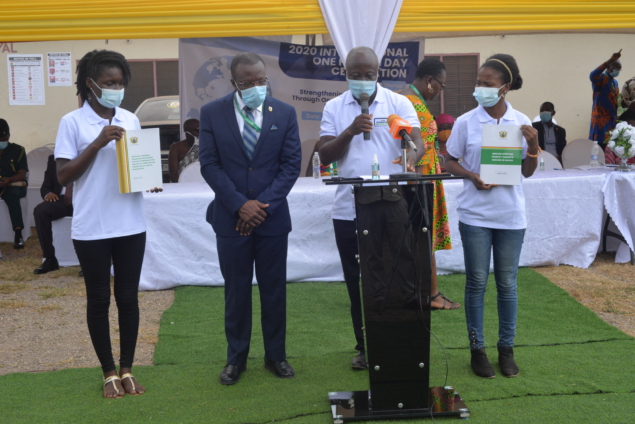
The Ghana Health Service, in partnership with the US Aid Agency, USAID, has launched two risk communication documents to improve communication and social mobilization during public health emergencies.
The first document is the National Standard Operating Procedures for Risk Communication and Social Mobilization During Public Health Emergencies.
It provides systematic guidelines on the processes to be followed for coordination and timely risk communication and social mobilization responses during the preparedness, active response and post response phases of all public health emergencies.
The second is the Message Guide for Priority Zoonotic Diseases in Ghana. This is a tool used as reference guide for designing and sharing accurate and standardized messages about the prioritized zoonotic diseases in Ghana requiring greater attention from all stakeholders.
Pro Vice-Chancellor at the KNUST, Prof Ellis Owusu-Dabo, says “the tools will propel Ghana towards achieving a number of core capacities needed to effectively detect, prevent, detect and respond to infectious disease threats as measures during the joint External Evaluation conducted by the WHO for Ghana in 2017.”
He has assured of KNUST’s preparedness to ensure effective utilization of the tools.
“KNUST will continue to engage with One Health partners to strengthen research on One Health and orient members of the University community to enhance understanding and application of these tools,” he said.
Prof. Owusu-Dabo was speaking at the 2020 International One Health day at Boadi in the Ashanti region.
The goal of this year’s One Health Day is to build the cultural will necessary for a change in how one health challenges are assessed and addressed.
The One Health Technical Working Group with support from the development partners including FAO, WHO and USAID are at the final stage of formulating the National One Health Policy.
This will formalize collaboration and coordination among the human, animal and environment sectors.
Regional Manager for the Emergency Centre for Transboundary Animal Disease West and Central Africa of the FAO, Baba Soumare pledged their commitment to continuous collaboration with KNUST.
His speech was read by Dr. Garba Ahmed, FAO country team leader.
“The school of veterinary medicine participated in the FAO training for veterinary meat inspectors and butchers on meat inspection to ensure meat safety to the public. FAO will continue to explore other areas for collaboration with KNUST,” he said.
Latest Stories
-
Drone strike hits wedding celebration in Sudan, killing at least 30 people
5 minutes -
UEW Public Lecture Series 2026: We’re preparing children for a past that no longer exists — Dr Ibn Chambas warns
11 minutes -
AMA to begin night enforcement against unscreened food vendors
12 minutes -
Nkawie Circuit Court remands 30-year-old mason over Mpasatia shop break-in
14 minutes -
Fintechs’ collaboration no longer optional – MMFL CFO
15 minutes -
KMA to prohibit other assemblies from accessing Oti landfill site over looming sanitation crisis
18 minutes -
GTA supported A Plus’ Gomoa Easter Carnival – Abeiku Aggrey
18 minutes -
GRA to tighten controls on importation of right-hand drive vehicles
36 minutes -
You can’t leave a bigger legacy than Petroleum Hub project – Western Regional Chiefs tell President Mahama
38 minutes -
Lawra MP cuts sod for GH₵11m multipurpose dining hall construction at Birifoh SHS
39 minutes -
Ghana defend African Schools Football Championship title after shootout win over Burkina Faso
43 minutes -
Ghana’s education system must evolve or risk becoming irrelevant – Patricia Obo-Nai warns
50 minutes -
Ghana Health Service responds to dead fish incident at Tema Port
1 hour -
David Vondee lauds Mahama for emergency Cabinet meeting and key resolutions
1 hour -
Universities should focus on churning out impactful graduates rather than merely adding new programmes — UEW VC
1 hour