

Audio By Carbonatix
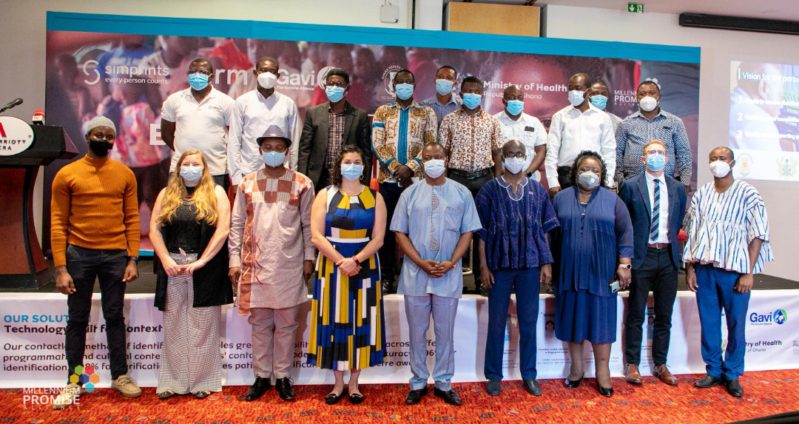
The Ghana Health Service (GHS) has partnered with Gavi and Arm to embark on a biometric-based routine immunisation program in the Eastern Region from October 2021.
This is the first national vaccination scheme in the country to use biometrics technology, provided by Simprints.
Simprints is a non-profit technology company committed to transforming the way the world fights poverty.
They build technology to radically increase transparency and effectiveness in global development, making sure that every vaccine, every dollar, every public good reaches the people who need them most.
The Gavi-Arm-Simprints strategic partnership is positioned to provide a unique, privacy-first, digital identification system that will support ongoing maternal and child healthcare programs–inclusive of routine vaccinations–as a function of the Ghana Health Service aim for universal health coverage.
The system does not require an existing formal identification document. It uses a biometric method of identification to safely create a unique ID for each individual, allowing health workers in the field to identify patients accurately, and quickly create or access their healthcare record.
The biometric data is securely collected using the health worker’s Android smartphone, while timestamps and GPS coordinates record the time and location of treatment.
Where internet connectivity is poor or non-existent, offline mode can be used to access a previously downloaded database and new patient data is uploaded when connectivity is restored.
This process is fast, eliminates the need for inefficient paper-based tracking of immunization delivery, and allows patients to be linked to their correct medical record even if they forget or lose their physical ID.
Gavi, the vaccine alliance, guides this program with its immunization expertise to administer vaccines, including for COVID-19.
Vitally, Simprints’ solution focuses on the ethical and inclusive use of digital ID, ensuring it works for diverse populations with solid privacy protocols and patient protection at its core.
The system is compatible with the digital health tools used by healthcare workers, governments, and global development practitioners around the world, and can be rapidly deployed and scaled on low-cost Android devices.
Latest Stories
-
Imprisonment should be rehabilitative, not punitive – Ghana Prisons boss at UNGA
12 minutes -
Ga Adangbe traditional priests petition Mahama over McDan aviation licence revocation
23 minutes -
Anti-LGBTQ Bill: NDC’s arrogance is worrying – Hassan Tampuli
34 minutes -
Let’s give OSP time to mature, not to scrap it – Hassan Tampuli
38 minutes -
Nigeria convicts 386 Islamist militants in mass trials
43 minutes -
Djibouti president wins election with 97.8% of vote, state media says
47 minutes -
We don’t have mandate to deduct tax from rent allowance of security services personnel – Interior Ministry clarifies
1 hour -
Ablakwa receives Presidential Special Envoy on Reparations to advance global agenda
1 hour -
Christina Koch becomes first woman to travel around the moon on Artemis II
1 hour -
Epstein survivors’ calls to meet King Charles and Queen harder to ignore as US visit approaches
2 hours -
UN Secretary-General names Ghana’s Anita Kiki Gbeho as South Sudan envoy
2 hours -
Mali withdraws recognition of Sahrawi Republic, backs Morocco’s autonomy plan
2 hours -
Gov’t distributes over 8,500 laptops to One Million Coders project
2 hours -
Julius Debrah, ‘man to beat’ as NDC’s James Agbey dismisses Musah Dankwah’s polls
2 hours -
GPRTU in Savannah Region to protest alleged eviction in Damongo
2 hours