

Audio By Carbonatix
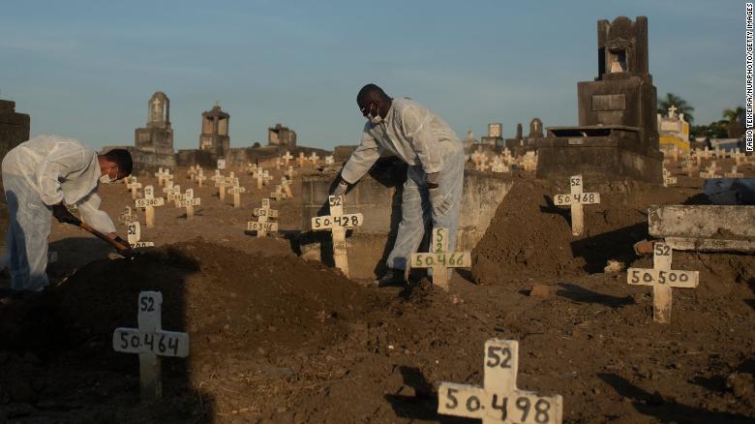
More than 4 million people around the world have died of Covid-19, according to data from Johns Hopkins University.
In total, three countries account for more than a third of all global deaths. The United States, which has the highest number of fatalities at 606,000, accounts for 15% of the global total, followed by Brazil and India.
The grim milestone, announced Wednesday, comes as new cases and deaths are dropping in the US and Europe, where significant numbers of residents have been vaccinated. But some developing countries, such as Indonesia, are still facing surging outbreaks, as authorities struggle to secure enough vaccines to protect citizens.
The Delta variant, a more transmissible and possibly more dangerous strain of coronavirus, is also contributing to an increase in cases in some countries and regions. In the US, the Delta variant now makes up more than half of all new infections, according to estimates from the US Centers for Disease Control and Prevention (CDC).
An average of 7,900 Covid-19 deaths were reported each day over the past week, according to JHU. That is 46% less than the global peak of more than 14,700 daily deaths in January, but 57% higher than the pace of about 5,000 daily deaths from this time last year.
The global death toll exceeded 1 million on September 18, 2020, 191 days after the World Health Organization declared the novel coronavirus outbreak a global pandemic. It took 115 days for the global death toll to hit 2 million, 88 days to surpass 3 million, and another 89 days to reach 4 million.
Given the difficulty in accurately tracking the spread of the virus especially in the developing world, many experts believe the global death toll is likely significantly higher than the officially reported number.
In a statement on Thursday, United Nations Secretary-General Antonio Guterres warned the pandemic is "far from over," warning of the emergence of more transmissible, more deadly variants that are more likely to undermine the effectiveness of current vaccines if the virus is allowed to continue to spread.
"Vaccines offer a ray of hope -- but most of the world is still in the shadows. The virus is outpacing vaccine distribution," he said, calling for a global plan to boost vaccine production, ensure equitable distribution and tackle vaccine hesitancy.
"To realize this plan, I am calling for an Emergency Task Force that brings together all the countries with vaccine production capacities, the World Health Organization, the global vaccine alliance GAVI and international financial institutions able to deal with the relevant pharmaceutical companies and manufacturers, and other key stakeholders," he said.
Latest Stories
-
IMANI demands review of SIGA directive steering SOEs toward SIC placements
5 minutes -
Climate change and pollution threaten livelihoods of White Volta fishermen
13 minutes -
First Atlantic Bank targets regional growth and digital expansion in 2026 outlook
16 minutes -
Bond market: Turnover surges 559.42% to GH¢2.49bn
20 minutes -
Dagomba line residents begin rebuilding after Easter Monday inferno
20 minutes -
ECG substation upgrade exercise: parts of Accra to experience power outages
24 minutes -
IMANI petitions Mahama over alleged procurement breaches in state insurance placements
29 minutes -
First Atlantic Bank posts strong 2025 results as profit surges 30.5%
32 minutes -
Maguire signs contract extension with Man United
34 minutes -
The WTO is debating trade: The world runs on investment
1 hour -
Minority questions gov’t purchase of fuel-powered buses, pushes for electric alternative
1 hour -
GFA Executive Council to decide on new Black Stars coach ahead of 2026 World Cup
1 hour -
One injured as fire destroys 14-bedroom house at Kwame Danso
1 hour -
GACL struggling despite recording profit, levy needed for expansion – Agalga
1 hour -
Kwahu Business Forum: Ghana Sports Fund calls for stronger corporate backing for sports dev’t
1 hour