

Audio By Carbonatix
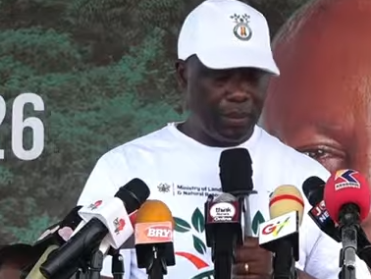
The Minister for Lands and Natural Resources, Armah Kofi Buah, has reaffirmed the government’s commitment to addressing plastic pollution and strengthening environmental sustainability measures across the country.
Speaking at the 2026 Tree for Life Reforestation Initiative held on June 5 at West Africa Senior High School under the theme “Forests and Economies,” the minister said the government’s environmental agenda extends beyond tree planting to long-term care, monitoring, and protection of planted trees.
He noted that Ghana is implementing a wide range of environmental interventions beyond reforestation, including marine and coastal conservation initiatives.
“The government continues to pursue a broad range of environmental interventions beyond reforestation. We are advancing marine and coastal conservation efforts, including the operationalisation of Ghana’s marine protected areas to safeguard marine biodiversity and support sustainable fisheries,” he said.
Mr Buah added that the country continues to roll out climate-smart policies and programmes under its Nationally Determined Contributions in line with the Paris Agreement. These include investments in renewable energy, sustainable agriculture, clean cooking solutions, improved waste management, and climate adaptation interventions for vulnerable communities.
He further stressed the government’s commitment to addressing plastic pollution and improving environmental sanitation nationwide.
“In addition, government remains committed to addressing plastic pollution and environmental sanitation challenges,” he stated.
The minister disclosed that, following an announcement by President John Dramani Mahama during the 2025 World Environment Day celebrations, processes are underway towards banning certain single-use plastics, including Styrofoam takeaway packs.
He said the implementation process is progressing steadily, alongside intensified nationwide public education on waste management, recycling, and responsible consumption.
Mr. Buah emphasised the need for a shift from awareness to action and from short-term interventions to long-term sustainability.
“Let us move beyond awareness to action. Let us move beyond planting to nurturing. Let us move beyond short-term interventions to long-term sustainability,” he said.
On behalf of the government, he expressed appreciation to development partners, traditional authorities, religious institutions, civil society organisations, the private sector, academic institutions, schools, and communities for their continued support in environmental protection efforts.
Latest Stories
-
Asos confirms hackers sent ‘unauthorised’ notification to app users
7 minutes -
White House defends Trump comment to let Iran ‘take out’ LA and San Diego
15 minutes -
US televangelist Jim Bakker, disgraced from sex scandal and fraud, dies at 86
18 minutes -
Congolese-born golfer to represent Ghana at Turkish Airlines World Cup grand final
22 minutes -
Amazon wins global rights to stream Emmys in six-year deal
24 minutes -
European Film Festival returns to Ghana after a 5-year break
28 minutes -
PTA backs teachers’ strike, threatens street protest if gov’t misses October 30 deadline
32 minutes -
Paramount takes over Warner Bros in $110bn Hollywood merger
33 minutes -
Suspend offshore gold exploration licence – NAFAG urges gov’t
33 minutes -
Investigators meet family, community over deaths of 3 children found in car trunk
42 minutes -
Teacher strike: FWSC blames new allowance demand for deadlock with teacher unions
1 hour -
Aboboyaa Company Ltd CEO donates 5 tricycles to Ghana Prisons Service
1 hour -
National Cathedral: ‘There’s no clarity as to what they want to use the site for’ – Afenyo-Markin on site’s future
1 hour -
Investigators meet family, community over deaths of 3 children found in car trunk
1 hour -
Teachers have legitimate concerns, but prolonged strike will affect pupils – Joseph Kumah
2 hours