

Audio By Carbonatix
The government of Ghana is currently working on to deploy ‘Big Data’ to rationalise the collection, processing, storing and sharing of data among government agencies.
This is expected to be the next major jump in the journey to completely digitise the Ghanaian economy.
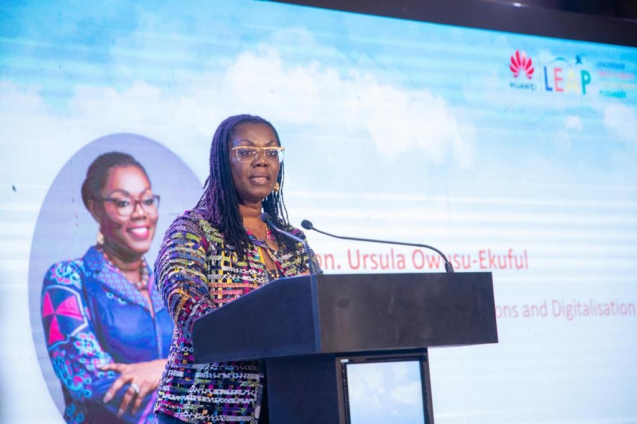
According to Minister of Communications and Digitalisation, Ursula Owusu-Ekuful, ‘Big Data’ is expected to come with the needed data analytics platform which will help make proper sense of all the data being mined across government.
It will also help government track trends across the ecosystem, make projections based on data modelling techniques that will be critical for decision making across the spectrum.
Speaking at the World Development Report by the World Bank, Mrs. Ursula-Ekuful said ‘Big Data’ architecture also takes into consideration the data generated and stored within the private sector to ensure that there is seamless sharing of data across both private and public sectors.
She explained further that the ‘Big Data’ regime is expected to bring transparency and efficiency in the way data is utilized.
“The built-in artificial intelligence component will ensure real time update of the different models for different stakeholders. Government will then be able to make policy decision based on data science and communicate effectively to citizens who would have access to the same data. This should improve on the trust relationship between government and citizenry”.
“One of the most important outlooks of this initiative is the real and accurate information to the business community from the staples of government. The business community can make targeted investments in critical, high growth sectors of the economy where return on investment is high to enable economic growth”, she added.
Some identified sectorial models for the Big Data programme include Big Data for Healthcare, Big Data for Agriculture, and Big Data for Governance, Big Data for Trade and Bid Data for Security. Other are Big Data for Education, Big Data for Finance, big Data for Disaster Management and Big Data for recreation.
Sharing of real time information is also expected to improve security across the country as the security and intelligence agencies can target scarce resources to where it is needed most based on timely and accurate data.
Ursula Owusu-Ekuful said the partnership between development partners, civil societies and government is expected to improve as there will be more reliable and uniform data across all sectors of the economy readily available in the governance process.
On the commercial side, she pointed out government is looking to model a regulated commercial framework around big data.
This will encourage institutions, both private and public, to generate more data.
The Data Exchange Hub: will provide the infrastructure, protocols and framework for data sharing across public and private sectors. It will provide the needed APIs to integrate with critical government systems to provide data input in real time, the cost of data (hits) and the use of the data that is accessed will be managed through the data governance framework to minimise data abuse and privacy issues.
Data Governance Framework: The Big Data initiatives is expected to be deployed with a data governance framework which will define data value, data exchange protocols, security channels and protocols, data governance hierarchy, data exchange dispute resolution protocols, etc.
Rural Telephony Project for Connectivity: The underlying infrastructure to ensure that government get more value out of this data ecosystem it is building. GIFEC through the rural telephony project is extending connectivity to the most rural part of the communities with shared community base stations to allow all telco providers to be able to provide services to the rural folks without the CAPEX overhead on the part of the telco providers. This will facilitate access to the data ecosystem.
Ghana Card Integration for Identity of Persons and Corporates: The ongoing integration of the Ghana Card as the identity platform for persons across the ecosystem is part of the effort to sanitise, standardise and share data across the ecosystem. The Ghana Card is providing single identity services to persons whiles RGD is expected to provide single identity to institutions and companies across the ecosystem to build trust. This government believes will help in the standardisation of data across all platforms.
Latest Stories
-
Mr President, Ghana was mentioned at the UN; why aren’t we talking about it?
46 minutes -
Accra to convene Africa’s regulators and markets on tokenisation at AVAS 2026
48 minutes -
The Paradox of Plenty — When every smartphone becomes a newsroom
1 hour -
GTA sensitises taxi drivers in ‘Know Ghana’ tourism campaign
3 hours -
Archbishop Agyinasare calls for responsible speech amid growing social media abuse
3 hours -
‘It will be inexcusable for gov’t not to honour payment of teachers’ arrears by 30th October’ – Haruna Iddrisu
3 hours -
Forbes’ World’s Best Employers 2026: No Ghanaian firm ranked among 900 companies
3 hours -
Electronic processing of teachers’ data: ‘The decision is the Controller’s’ – GES boss
3 hours -
Teachers’ Strike: Haruna Iddrisu questions paper-based processing of promoted teachers’ data
3 hours -
Savannah Region: Kunfusi bridge collapses again, leaving nearly 4,000 residents cut off
3 hours -
Teachers’ strike: GES targets Monday deadline to submit promotion data to Controller
3 hours -
Inflation to average 11.3% in 2027 – Fitch Solutions
4 hours -
‘I didn’t campaign for NDC to come and do this nonsense’ – Kpebu on EOCO’s conduct
4 hours -
Fitch Solutions maintains policy rate forecast of 14% by December 2026
4 hours -
Diaspora Nasara Caucus congratulates Mohammed Ali Suraj, new NPP executives
6 hours