

Audio By Carbonatix
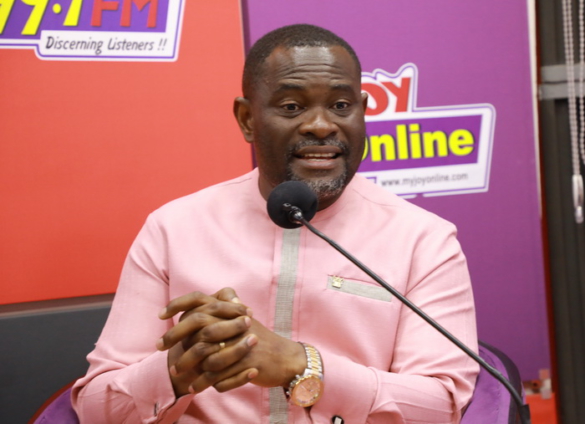
Deputy Finance Minister Dr John Ampontuah Kumah is assuring the public of government’s resort to restore public debt sustainability in order to recover the economy.
He says government intends to undertake structural reforms such as; introducing tax policy reforms, revenue administration changes and public financial management systems.
According to him, sectors which also require optimum attention include the cocoa and energy sectors, stating that the expenditure inefficiency and the issue of lack of consistency in the payment of monies to sustain electricity flow need to be addressed respectively.
“We also want to focus on certain structural deficiencies in the economy. For instance, the cocoa sector; the amount of expenditure inefficiencies in the cocoa sector have to be addressed.
“The energy sector; the Independent Power Producer (IPP) commitment and regular payment you need to do to sustain the electricity to be on – some efficiencies have to be improved,” he said on JoyNews’ Newsfile on Saturday.
He added that should the inefficiencies that have characterised government’s expenditure be addressed, arguments against its flagship programmes would become mute.
Speaking on government’s flagship programme, the minister argued that the flagship programmes are necessarily not the cause of Ghana’s fiscal issues.
He cited that government’s budget for 2023 was about ¢190 billion. Out of this, he said ¢56 billion has been apportioned for debt repayment whereas ¢45 billion is going into compensation and wages.
Another ¢35 billion has been budgeted for statutory payment obligations and about ¢16 billion for goods and services.
According to him, budgetary allocation for government’s Free S.H.S policy for 2023 was just ¢2.9 billion, an amount to educate “1.3 million of the population,” adding that there is nothing wrong with that.
Dr Kumah, therefore, speculated that people arguing that the government’s flagship programmes are incurring fiscal challenges are just being sentimental. He expressed that contrary to the perceptions, debt obligations have been responsible for the fiscal challenges. This, he said informed the government’s pursuit of an International Monetary Fund (IMF) programme.
Latest Stories
-
‘We’ve become quite experienced in negativity’ – Liverpool’s Slot
5 hours -
Legendary manager Lucescu dies days after resigning
5 hours -
One dead as train travelling 99mph collides with lorry in France
5 hours -
Airlines cut flights and hike fares as fuel prices surge
6 hours -
Kane inspires Bayern to first-leg advantage over Real Madrid at Bernabéu
6 hours -
Wireless Festival cancelled after Kanye West blocked from coming to UK
6 hours -
Wa West MP commissions five boreholes for the benefit of his constituents
6 hours -
Havertz’s late strike hands Arsenal narrow first-leg advantage over Sporting
6 hours -
Damang mine award: Minority not against Ghanaian participation; we’re asking for fair process – Konadu
6 hours -
NPA to enforce stricter registration rules for petroleum tankers
7 hours -
Manhyia South MP laments decline in hospitality operations in his constituency
7 hours -
How a simple clean charcoal innovation could benefit Ghana’s climate future
7 hours -
NPA, COMAC launch Safety Week 2026 to promote risk management in petroleum sector
7 hours -
Stakeholder engagement resolves onion trade impasse
7 hours -
Gender Ministry holds staff durbar, welcomes new Chief Director
7 hours