

Audio By Carbonatix
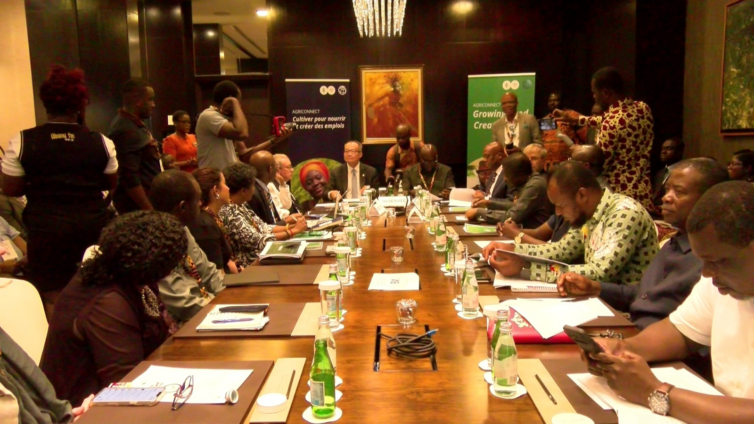
The government, with support from the World Bank Group and development partners, has launched its AgriConnect Compact.
This is a national framework to strengthen food security, create jobs, reduce food imports, and mobilise investment across priority agricultural value chains.
The Compact sets out a coordinated agenda for public and private action to raise productivity, expand value addition, improve access to markets and finance, and strengthen resilience across Ghana’s agri-food system.
It prioritises cocoa, oil palm, rice, maize, and poultry, while supporting other strategic sectors, including cashew, coconut, rubber, fisheries, and the forest economy.
In its first phase, from 2026 to 2030, the Compact aims to improve food and nutrition security for an estimated 2.99 million people and support the creation of more than 2.6 million jobs by 2035.
Financing needs for the first phase are estimated at about US$3.5 billion, with contributions expected from the Government of Ghana, development partners, and the private sector.
“Ghana’s AgriConnect Compact is a bold step toward building a more productive, resilient, and jobs-rich food system.
"By linking policy reform with investment and delivery, Ghana is creating the conditions to strengthen food security, support farmers and agribusinesses, and unlock private capital at scale,” said Guangzhe Chen, World Bank Group Vice President for Planet.
“AgriConnect is about turning Ghana’s agricultural potential into tangible results: more food on the table, more jobs for young people, and more value created here at home.
"This Compact provides a clear roadmap to modernise agriculture, support farmers, and build stronger value chains that can drive growth nationwide,” said Eric Opoku, Minister of Food and Agriculture.
“The Government remains fully committed to working with all stakeholders to translate the aspirations of this AgriConnect Compact into tangible results for our people.
"This is Ghana’s moment to feed itself, employ its youth, build competitive industries, and create wealth from its own soil“, said Thomas Nyarko Ampem, Deputy Minister of Finance.
The initiative is designed to strengthen domestic production, build resilience, and support a more competitive rural economy.
It focuses on irrigation, seed systems, mechanisation, farmer services, agro-processing, and logistics to enable more food to be grown, processed, and marketed in Ghana.
The Compact is being advanced by the Government of Ghana, with support from the World Bank Group and other partners, as part of a broader effort to accelerate agricultural transformation, crowd in private capital, and strengthen implementation.
It emphasises results, coordination, and stronger collaboration across government, development institutions, agribusinesses, and farmer organisations.
The Compact brings together policy reforms, targeted investments, and delivery mechanisms within a single national framework to position agriculture as a driver of inclusive growth, industrialisation, resilience, and long-term prosperity.
Latest Stories
-
South Tongu MP launches apprenticeship programme for 159 young people
13 minutes -
The Pusiga connection behind Gertrude Atongi’s work in New York
39 minutes -
Teachers took promotion exams in December to beat government clearance deadline – GNAT
41 minutes -
NPA launches 2026 staff welfare week with focus on teamwork and employee wellbeing
44 minutes -
Ghana, Saint Kitts and Nevis sign labour deal to strengthen protections for Ghanaian nurses
50 minutes -
Delayed promotions put teachers’ retirement benefits at risk – GNAT
53 minutes -
No ‘Bawumia candidates’ in NPP executive elections – Anthony Karbo
54 minutes -
Over 3,000 displaced as flooding overwhelms Hohoe communities
59 minutes -
Sunyani East NPP executives begin reconciliation drive ahead of 2028 polls
1 hour -
Agric Minister engages Ga Mantse on agriculture transformation agenda
1 hour -
Aayalolo expansion targets private car users, not trotro operators – Mahama Ayariga
1 hour -
KNUST, GMTF explore AI partnership to transform healthcare delivery
1 hour -
MTTD records 9,000 preventable crashes, over 900 deaths in eight months
1 hour -
UN Secretary-General expresses optimism about future, pledges support for Mahama, AU
1 hour -
Ghana’s desalination lesson: A water project must work on paper and at the tap
2 hours