

Audio By Carbonatix
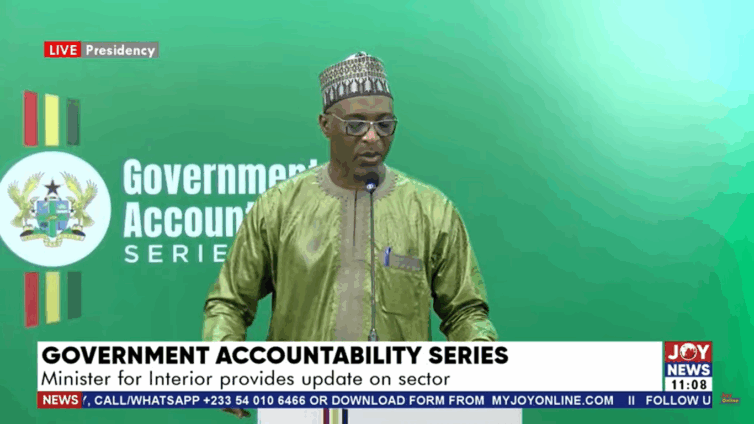
The Minister for the Interior, Mohammed Muntaka Mubarak, has announced sweeping reforms within the Ghana Prisons Service aimed at improving inmate welfare, enhancing nutrition, and equipping prisoners with employable skills for life after incarceration.
Speaking at the first session of the Government Accountability Series, Mr Mubarak highlighted the urgent need to tackle the long-standing challenges within the prison system, starting with the inadequate feeding allocation for inmates.
“As you may be aware, the feeding allocation for inmates is pegged at one Ghana cedi and 80 pesewas, an amount that is woefully inadequate and fails to meet basic nutritional needs,” he said.
To address this, the government has secured funding for a 5,000-layer poultry project and cultivated approximately 1,664 hectares of crops. According to the Minister, this agricultural initiative, supported by the Ministry of Food and Agriculture, will help improve nutrition for inmates and enhance the prisons' capacity for self-sufficiency.
Beyond nutrition, Mr Mubarak outlined plans for a 24-hour economy programme within the Prisons Service, designed to align correctional facilities with national productivity goals.
“We are determined to shift from merely warehousing prisoners to transforming prisons into centres of economic activity and rehabilitation,” he explained. “This programme will harness the productive potential of inmates, contributing meaningfully to national development.”
As part of the reform agenda, the Prisons Service has launched a digital literacy programme under the '1M Coders' initiative. The scheme targets inmates, officers, and their dependents, providing essential digital skills to open new pathways for empowerment and reintegration.
Recognising the need to strengthen human resources, the Minister highlighted a strategic partnership with the Youth Employment Agency to recruit support staff for non-custodial duties. “This collaboration is key to freeing up resources and allowing officers to focus on core custodial and rehabilitative roles,” he said.
In addition, the Minister revealed ongoing negotiations with the Ministry of Education to sign a Memorandum of Understanding (MoU) that will integrate vocational training with practical production.
“Once finalised, this MoU will enable the Prisons Service to produce 20 per cent of sanitary pads for the free sanitary initiative, 30 per cent of all school furniture, and 30 per cent of school uniforms distributed by the government,” Mr Mubarak disclosed.
He emphasised that the reforms represent a fundamental shift in Ghana’s correctional approach.
“Our goal is clear: to move beyond simply warehousing prisoners and keeping them idle. We are creating a system where inmates are actively rehabilitated and equipped to contribute to society upon release.”
Latest Stories
-
Moody’s maintains Ghana’s rating at Caa1, revises outlook to positive
32 minutes -
Zambia elevates tourism education to national priority as President Hichilema backs continental summit
1 hour -
Activa promotes credit insurance to boost SME export growth
1 hour -
ILTM Africa 2026 opens doors to inbound and outbound luxury travel in Cape Town
1 hour -
“BP Soul Travel and Tours scored the highest marks” – Sports Minister Kofi Adams endorses agency for World Cup travel
2 hours -
‘At the age of 12, I was teaching people and collecting money from them’ – Forty Under 40 Awards
3 hours -
I broke my virginity at the age of 26 after university – Richard Abbey Jnr.
4 hours -
Sacked for fees, saved by faith: The untold story of Forty Under 40 Awards founder Richard Abbey Jnr
4 hours -
GCB Bank surges GH¢0.45, ETI gains GH¢0.06 as GSE ends week higher
5 hours -
Two teens jailed 55 years for robbery
5 hours -
UDS demands apology for MPhil student wrongly branded as Tamale robber
6 hours -
“We don’t sell fish!” – Tema Shipyard CEO hits back over dead fish discovery
7 hours -
Sam George defends anti-LGBTQ+ Bill as ‘national priority’ amid debate over gov’t focus
7 hours -
Artemis II astronauts safely back on Earth after trip around moon
7 hours -
Sam George unveils massive 1,150-cell site rollout to end network woes
8 hours