


Audio By Carbonatix
For the first time since the onset of the index, inventory levels fell below the threshold of 50, at 43.2, indicating a decline in inventory levels.
All other indicators showed growth (above the 50 threshold). Inventory costs and transportation prices exhibited increasing growth, while the other indicators exhibited growth at a decreasing rate.
The rate of growth in logistics activities slowed down slightly in the third quarter of 2022. A prime reason for this slowdown is the high cost of inventory and the associated cost of warehousing and transportation prices. Inventory costs and transportation costs were both at an all-time high for the year, at 94.2 and 97.1 respectively.
Over the first three quarters of 2022, warehousing capacity and utilization as well as transportation capacity and utilization saw consistent decreases. The decline in inventory levels was also quite consistent but rather worrying as inventory levels correlate highly with logistics growth. The expectation was that inventory levels would pick up. However, that has not happened, and the downward trend continued into the third quarter. We think that this may be due to the increasing high cost of doing business in Ghana.
Researchers at the Centre for Applied Research and Innovation in Supply Chain – Africa (CARISCA) issued this report. The Logistics Managers Index (LMI) is a new tool developed by CARISCA, based at Kwame Nkrumah University of Science and Technology, for Ghanaian businesses and policymakers.
The calculated LMI for Ghana, along with the accompanying analysis of its components, provides useful insights for the government of Ghana, business decision-makers, market analysts and investors, as it offers a predictive indication of overall economic activity in the country.
The LMI report is made available quarterly at https://carisca.knust.edu.gh/LMI. Senior executives and managers of businesses in Ghana are invited to participate in the quarterly LMI surveys by visiting: https://www.surveymonkey.com/r/Q1–23–LMI
The LMI measures the growth or decline of Ghana’s logistics industry along three components: inventory, warehousing and transportation activities. The LMI for Ghana study utilizes eight metrics from the three components to capture Ghana’s logistics activities. The index measures combinations of inventory, warehouse and transportation activities and tracks the relationship between these variables to make inferences about their effects on the broader Ghanaian economy.
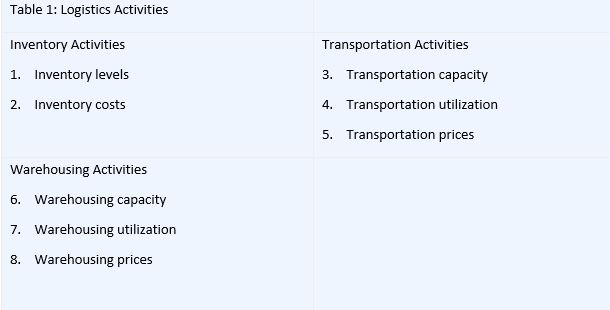
An index score is calculated for each of the eight components, and an overall index score (i.e., an LMI value) is then evaluated as a composite of these components. This LMI value is expressed as a percentage with a mid-value/threshold of 50%. An LMI value above 50% indicates a growing logistics industry, while a value less than 50% indicates a contracting logistics industry.
This approach is an effective and a reliable way to identify prevailing trends in logistics activities. Due to its predictive nature, the LMI is also a useful tool for forecasting future trends in a modern economy (Rogers et al., 2018).
ABOUT THE LOGISTICS MANAGERS INDEX FOR GHANA
The Logistics Managers Index (LMI) for Ghana is a study by the Center for Applied Research and Innovation in Supply Chain – Africa (CARISCA) at the School of Business at Kwame Nkrumah University of Science and Technology (KNUST) in Kumasi, Ghana. CARISCA is a collaboration between KNUST in Ghana and Arizona State University (ASU) in the United States, with support from the United States Agency for International Development (USAID). This study was led by Emmanuel Kweku Quansah (Ph.D.), Nathaniel Boso (Ph.D.) and Abdul Samed Muntaka (Ph.D.) of KNUST.
The Logistics Managers Index (LMI) for Ghana makes no representation other than that stated in this release regarding the individual company data-collection procedures. The data should be compared to all other economic data sources when used in decision-making.
Latest Stories
-
Ghana risks EU gas market access over methane emissions – Expert warns
15 minutes -
Salt Pond’s $200m warning: Why Ghana cannot afford to exclude Fisheries Commission from future decommissioning
16 minutes -
Venezuela frees 39 political prisoners after post-Maduro talks
53 minutes -
EU unlocks humanitarian aid for crises worldwide
56 minutes -
Tenth woman’s body found as South Africa police probe killings
1 hour -
Black woman found hanging from tree was dead before body was ‘staged’, police say
1 hour -
Final day: 3rd Republic Bank-JoyNews Habitat Fair clinic underway at Junction Mall, Nungua
1 hour -
Nor’easter brings flooding as New York and New Jersey declare emergency
1 hour -
Africa’s richest man helps fund $660m fuel pipeline between Ethiopia and Djibouti
2 hours -
Security lapses at Utah campus where Charlie Kirk was killed, review says
2 hours -
White House bars CNN from travelling with Trump on Air Force One
2 hours -
Pope praises young people’s ‘energy and commitment’ at huge open-air Mass in Paris
2 hours -
Nyankamam residents benefit from free medical screening, healthcare outreach
2 hours -
Ghana, Boeing explore setting up regional aircraft maintenance hub
2 hours -
Bangkok roads submerged as flood disaster declared
2 hours