

Audio By Carbonatix
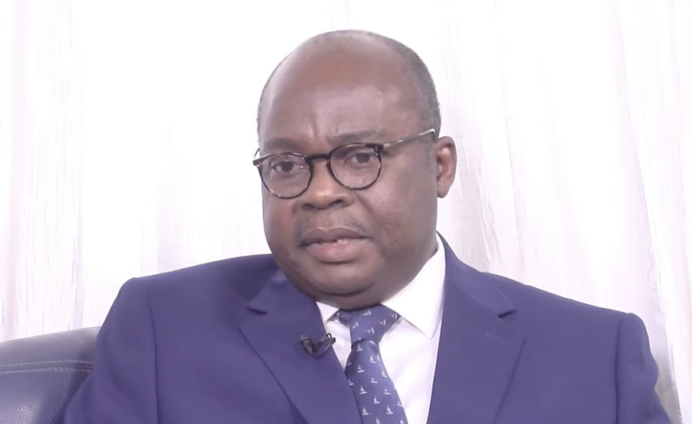
The Governor of the Bank of Ghana (BoG) opened up about the tumultuous banking sector crisis that unfolded in 2017 and the decisive actions that reshaped Ghana’s financial landscape.
With a firm stance in a revealing interview on Joy News’ PM Express Business Edition on January 2, Dr Ernest Yedu Addison, justified the revocation of banking licenses as a critical move to restore stability and confidence in the sector.
Dr Addison painted a grim picture of the banking sector he inherited in 2017. “Sometimes people forget very easily,” he said.
“Women with babies strapped to their backs were being beaten in banking halls because they couldn’t withdraw their money from microfinance institutions. The chaos was undeniable.”
According to the Governor, the sector had devolved into a near Ponzi scheme, leaving depositors without confidence in financial institutions.
“The financial system is supposed to promote savings and channel those savings into investments to support growth. But what we had was a system that had lost public trust,” he stated.
Dr Addison emphasised that the revocation of banking licenses was unavoidable.
“When I give you a bank license, I am giving you permission to take people’s money, but the money is not yours,” he explained.
The Governor detailed the widespread malpractices that plagued the sector.
“Shareholders were taking depositors’ money and using it to run their own businesses. That’s not banking,” he said.
“Some of the funds were being used for brick-and-mortar investments that weren’t liquid enough to meet withdrawal demands. It was a complete disregard for the rules of banking.”
The collapse of Capital Bank and UT Bank in August 2017 marked the beginning of the sector’s cleanup. Over time, other poorly managed institutions were removed, making way for stronger, better-governed banks.
“We cleaned up the system to allow the banking sector to play its rightful role in a market economy like ours,” Dr Addison affirmed.
The IMF’s Role and Prior Actions
Dr. Addison also revealed the International Monetary Fund’s (IMF) involvement in addressing the crisis.
“The IMF flagged the banking sector crisis as a major challenge when I took office,” he said.
Policies to address the issues had been discussed with the previous administration, but no action had been taken.
“By the time we came in, these policies had reached the point of becoming prior actions—either you implemented them, or there wouldn’t be a program for Ghana. It was as simple as that.”
Despite the controversies surrounding the cleanup, Dr. Addison expressed pride in the BoG’s achievements.
“The Bank of Ghana received an international award for the very effective cleanup of our banking system, and I think we should value that,” he said.
The Governor highlighted the transformation of the sector post-cleanup.
“Today, the banks that remain are well-capitalised and adhere to stronger corporate governance standards. They are properly managed and supervised,” he noted.
Reflecting on the challenges and successes, Dr. Addison underscored the importance of vigilance in financial regulation.
“A banking license is a special kind of instrument. It comes with responsibilities and rules that must be respected. The actions we took were justified to protect depositors and ensure the stability of the financial system,” he asserted.
The Governor’s bold decisions during the crisis ultimately set the stage for a more robust banking sector.
“It was not an easy road, but we’ve emerged stronger,” he concluded.
Latest Stories
-
Minerals Commission halts online mineral rights applications until June
7 minutes -
Serve the nation honestly, or journalists will expose you – GJA President tells public servants
19 minutes -
Ghana, Kyrgyzstan deepen relations with new agreements on cooperation and visas
23 minutes -
GAF issues appointment letters to first batch of 2025/2026 recruits
25 minutes -
Middle East tensions: policy rate cut to 14% not a risk – Dr. Asiama
28 minutes -
Justice for JoyNews’ Latif Idrisu: GJA welcomes out-of-court settlement
41 minutes -
King Charles greets Nigerian president in Windsor sunshine
51 minutes -
GJA urges Ghanaians to celebrate Heritage Month, promote national identity
51 minutes -
GJA raises alarm over alleged police intimidation of journalists
58 minutes -
Ghana pushes Safe Water Enterprises toward investment-ready growth at 2026 Beyond the Pipe Forum
1 hour -
Annoh-Dompreh claims NDC officials threatening MPs over cocoa farmer outreach
1 hour -
GJA calls for depoliticisation of security recruitment
1 hour -
Chleo-Patra Azantilow writes: Governance in action; institutional reset at the National Youth Authority
1 hour -
Be visible at work, create value – Mrs. Amissah-Arthur to Deloitte female professionals
1 hour -
I want my story to inspire youth from deprived communities – Adutwum shares reason behind presidential ambition
1 hour