

Audio By Carbonatix
Speeches rarely judge public institutions. They are judged by whether the machinery of the state begins to move again.
In Ghana’s youth development architecture, the National Youth Authority (NYA) assumes the role as the state’s principal instrument for coordinating youth policy, training, and empowerment.
Yet for many years, the institution struggled with structural inertia, resource limitations, and fragmented programmes.
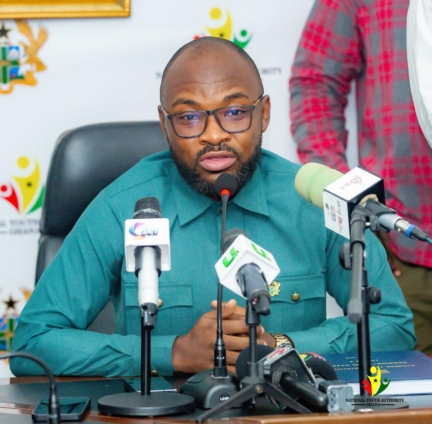
Over the past year, however, the Authority has undergone what may be described as a modest but consequential institutional reset under its current Chief Executive Officer Architect Osman Abdulai Ayariga Esq who was appointed by His Excellency John Dramani Mahama on 29th January 2025.
At a time where youth empowerment remains central to the government’s agenda, his appointment was greeted with much praise and enthusiasm considering the experience, energy and inertia he would bring in revitalizing the Youth Authority and delivering on the key manifesto promises of the National Democratic Congress in the 2024 Manifesto.
It comes as no surprise that more than a year after his appointment, an indelible mark has been created in the erstwhile tenure of his office.
The transformation has not relied on dramatic rhetoric. Instead, it appears to have been driven by a series of practical reforms; administrative, legislative, and programmatic that collectively reposition the NYA as a more functional state institution.
Achievements
Key on the agenda of the Chief Executive Officer in delivering on the mandate reposed in the new administration was the launch and implementation of the National Apprenticeship Programme.
Youth unemployment remains one of Ghana’s most persistent socio-economic challenges and the truth is that public sector jobs alone cannot absorb the country’s expanding youth population.
The apprenticeship programme as stated in the Youth Manifesto of the NDC was meant to signal a policy shift toward skills-based economic participation, integrating vocational training with practical industry engagement. It’s end goal is to contribute to building a workforce capable of responding to emerging economic sectors which I daresay is on track.
Beginning with the establishment of the working committee formed by the Ministry of Youth Development and Empowerment to draw up implementation guidelines, to the establishment of the National Secretariat on the Apprenticeship Programme, over 10,000 persons across all regions in the country have received assistance to enable various trade areas including but not limited to Craftsmanship and Artisanal Trade, Fashion and Textile Trade, ICT and Emerging Digital Crafts, Agriculture and Agro-processing, Mechanical and Electrical Trades, in just the first phase.
Applications for the second phase will roll out later in the year and the youth of Ghana are encouraged to take advantage of the opportunity.
In addition to this momentous achievement, Lawyer Osman Ayariga has supervised the completion of the new NYA Head Office Complex.
Institutional credibility is often reflected in infrastructure, and the completion of the new NYA Head Office Complex represents more than a physical structure.
It restores administrative coherence, providing a professional space for work and enhancement of operational capacity in order to pursue the youth development agenda entrusted to the Authority.
It is expected that by late March 2026, the Office Complex will be officially outdoors and will be in use to expedite the work of the Authority.
Another one of the internal reforms undertaken since Mr. Osman Ayariga assumed office has been the expansion of staffing levels and logistical support within the Authority.
As of 2026, the Chief Officer of the NYA saw to the retooling of all Regional Offices of the NYA with the provision of key operational tools, including desktop computers, printers, and other stationary in order to address longstanding capacity gaps. In public administration terms, this reflects a move toward strengthening the Authority’s bureaucratic backbone whilst equipping staff with up-to-date stationery to support various deliverables.
This effort has been enhanced with the provision of operational vehicles for all Regional Directors of the Authority and Coordinators for the National Apprenticeship Programme to enhance mobility and monitoring capacity.
One of the less publicised yet significant administrative actions has been the settlement of outstanding transfer grants owed to regional and partner institutions.
As of the time the CEO assumed office, the National Youth Authority owed three (3) years in arears of payment grants and with decisiveness, ordered for approval to be given in order for them to be paid.
The Authority has also initiated discussions with the Fair Wages and Salaries Commission to review allowances for staff of the National Youth Authority.
It is the sure expectation that these discussions will yield success so that there will be a structured framework for remuneration.
A major structural gap in the youth governance framework has been the absence of a working Legislative Instrument (LI) to operationalize the National Youth Authority Act, 2016 (Act 939).
With renewed dedication, Mr. Osman Ayariga sought to resolve this gap by initiating the process to develop a Legislative Instrument for the consideration of Parliament in order to provide a procedural architecture through which the mandate of the NYA is translated into administrative rules.
Perhaps the most institutionally strategic initiative has been the establishment of the Ghana Youth Federation (GYF).
The Federation functions as a national coordinating platform for youth-led and youth-focused organizations, bringing together registered groups under a unified framework for national development.
By creating this structure, the Authority has effectively begun to consolidate what has historically been a fragmented youth sector.
The Road Ahead
Of course, institutional reform is rarely completed in a single year. Youth unemployment remains high, and expectations within the youth sector continue to grow.
Programmes such as the National Apprenticeship Programme must scale rapidly if they are to produce measurable economic outcomes.
Yet the past year suggests that the National Youth Authority is gradually reasserting its relevance within Ghana’s development landscape. Public institutions often decline quietly. Their revival, by contrast, tends to occur through steady administrative decisions that rarely capture headlines.
The work and achievements of Mr. Osman Abdulai Ayariga Esq at the National Youth Authority may represent precisely such a process.
Latest Stories
-
Power restoration fault suspected in Kumasi Central Market fire
42 minutes -
The 7-foot giant of Ngleshie Amanfro: Seven-foot Ghanaian Ephraim Saawa dreams of joining the national basketball team
1 hour -
Government promises support for Kumasi Central Market fire victims
1 hour -
Vibes The Movie: Big Ghun’s Ghanaian film earns five nominations at 2026 REFFA
2 hours -
MamaCare CEO warns unresolved conflicts among health workers could undermine maternal and neonatal care
2 hours -
Health professionals urged to translate medical knowledge into practice to save mothers
2 hours -
Conflicts among care providers linked to maternal, neonatal deaths – Expert
4 hours -
GIS marks 10th TIME conference, champions improved teaching practices
4 hours -
BRICS Or Balance? What Ghana’s bid really means
5 hours -
GPRTU wants full TRAFFITECH-GH implementation to start in 2027
5 hours -
Mahama announces plans to import electric wheelchairs for PWDs
5 hours -
KGL U17 Colts 2026: Western beat Prempeh Elite Academy to set up final final with Greater Accra Region
5 hours -
Late Solanke strike salvages 10-man Spurs draw at Man United
5 hours -
Gender Ministry to monitor welfare of Nana Akua Addo’s children amid domestic violence case
6 hours -
Benedict Okyere Yeboah: Ghana’s football problem goes beyond sacking a coach
6 hours