

Audio By Carbonatix
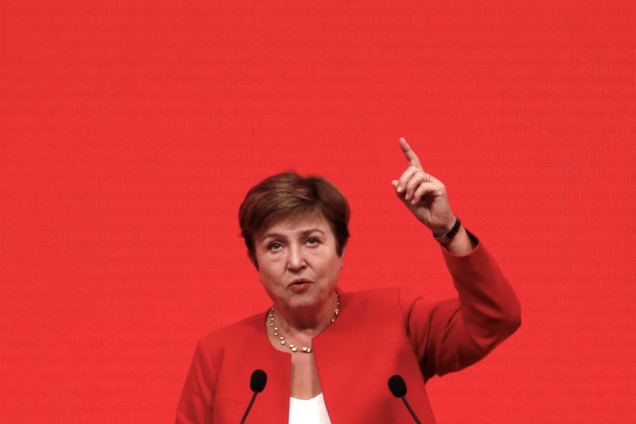
The Managing Director of the International Monetary Fund (IMF), Kristalina Georgieva, is urging central banks to keep an eagle eye on the data, including higher inflation expectations.
According to her, strong regulation and supervision remain essential to keep banks safe, adding, rising risks from nonbanks must be monitored and contained.
Speaking ahead of the World Bank/IMF Spring Meetings, which open today in Washington, USA, Madam Georgieva said that to protect price stability, monetary policy must remain agile and credible, supported by a strong commitment to central bank independence.
Her speech is also coming amid the US tariff war with the global economy.
According to her, emerging market economies should preserve exchange rate flexibility as a shock absorber, urging policymakers to look to the IMF’s Integrated Policy Framework for insights on how and when temporary measures may be warranted.
“Tighter budget constraints will entail difficult choices everywhere, but nowhere more so than in low-income countries. Here, weak revenues necessitate stronger efforts for domestic resource mobilization, but also call for support from international partners—both to improve capacity for reforms and to secure crucial financial assistance”, she.
She pointed out that countries with unsustainable public debt should move proactively to restore sustainability, including in some cases by taking the difficult decision to seek debt restructuring.
“I am very pleased to mention that the Global Sovereign Debt Roundtable will soon publish a playbook for country authorities considering debt restructuring—to help decision-making”, she alluded.
Policy Tradeoffs
She mentioned that policy tradeoffs can be eased by lifting growth potential.
“The U.S. economy has seen strong productivity growth while others have slipped behind. How can they catch up? Through ambitious reforms in banking, capital markets, competition policy, intellectual property rights, and AI preparedness, all of which can contribute to higher growth”, she added.
In many cases, Madam Geogieva said the state can and should do much more to reduce obstacles to private enterprise and innovation—in other words, eliminate self-inflicted injuries.
Macroeconomic Adjustment
She continued that the IMF will help countries manage macroeconomic adjustment and advance reforms.
Currently, 48 countries are relying on the Fund’s balance of payments support, including Argentina.
“As a second hugely important priority, countries should renew their focus on internal and external macroeconomic imbalances”, she pointed out.
Latest Stories
-
We can tackle multiple priorities – Sam George defends Anti-LGBTQ Bill push
28 minutes -
Statement: Ghana Chamber of Mines’ Response to Claims in Joe Jackson’s “Ananse Stories about the Economy of Ghana”
29 minutes -
GES opens 2026 teacher recruitment for licensed B.Ed graduates
31 minutes -
Ghana must value skilled trades, build resilient learners — Ibn Chambas
39 minutes -
Ghana must rethink education around relevance, resilience and responsibility — Ibn Chambas
42 minutes -
Prince Harry faces defamation lawsuit from charity he co-founded
44 minutes -
South Korea deploys thermal cameras to track escaped zoo wolf
46 minutes -
Calls for royal meeting with Epstein survivors grow ahead of US visit
49 minutes -
Ibn Chambas advocates blend of technology and human values in education
51 minutes -
UMA improves healthcare access in Asutifi North with GH₵700k ‘Kim Taylor Legacy’ Walkway
56 minutes -
Scholarships Authority and Fanaka University offer sponsorship for procurement and supply chain studies
59 minutes -
Bisa Kdei drops new single ‘Go N Look’ featuring Medikal
1 hour -
Benin facing rising terrorism in north as French military presence faces growing criticism
1 hour -
UEW Public Lecture Series 2026: Education debate ‘about the soul of Ghana’s future’ — Dr Ibn Chambas
1 hour -
EU fingerprint and photo travel rules come into force from today
2 hours