

Audio By Carbonatix
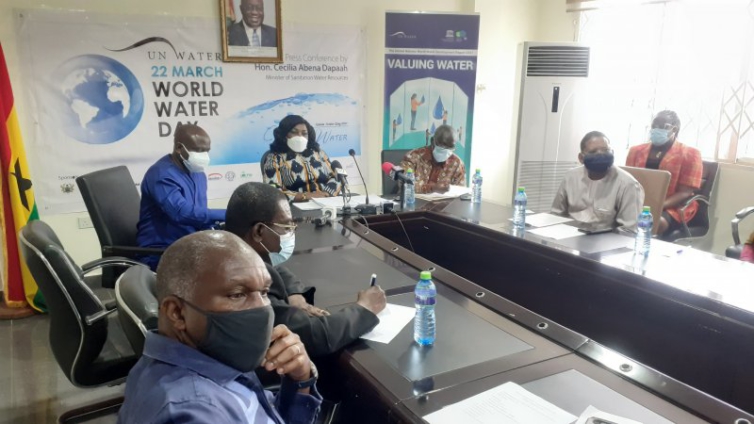
Minister of Sanitation and Water Resources, Mrs Cecilia Abena Daapah, has called for a collaborative intervention to protect and conserve the country’s water bodies.
She said government’s policy response to safeguard the water bodies was a shared responsibility, urging all and sundry to support the enforcement of existing laws and other appropriate regulatory and management actions on water preservation.
The Minister made the call on Monday in Accra at a press briefing to mark World Water Day which falls on March 22, to raise awareness on the importance of freshwater on the theme: “Valuing Water”.
The theme offers the opportunity to create a broader understanding of how water was valued by different people in different contexts and to support the achievement of the Sustainable Development Goal six-“Water and Sanitation for All by 2030”.
She said Ghana had made strides in the provision of basic drinking water services to the citizenry, stressing that the population with access to improved water sources increased from 78 per cent in 2017 to 81 per cent in 2019.
Also, the population with safely managed drinking water sources increased from 27 per cent in 2017 to 36 per cent in 2019, which is in sync with the government’s agenda of bringing water to the doorsteps of the people.
She announced that an amount of $ 1.04 billion was being invested in about 14 ongoing urban water supply projects and six major rural water supply projects in the country, targeting about 4.87 million people to be served when completed.
The Minister said the result was being seen in the gradual decline of basic access to drinking water sources from 51 per cent in 2017 to 45 per cent in 2019.
She said government aimed at investing in building climate resilient water infrastructure systems to reduce wastage in freshwater use; shift towards environmentally sustainable policies that took account of interconnection among ecological systems and reduce pollution.
She noted that water was under extreme threat from a growing population and increasing demands of agriculture and industry, adding that there was the need to value water to avoid mismanaging the finite and irreplaceable resource.
Mrs Daapah said the illegal mining had affected the quality of water bodies especially within the southwestern river system, including the Tano, Bia, and Ankobra river basins as well as the Pra basin and its Offin and Birim tributaries.
The proportion of rivers with fairly good ambient water quality at the end of 2016 was 36 per cent, the proportion increased to 53 per cent at the end of 2018, which was attributed to the fight against illegal mining.
The proportion further improved to 57.8 per cent in 2019, but reversed to 56.6 per cent at the end of 2020, she said.
Latest Stories
-
Telecel Foundation supports safer pregnancies with ultrasound outreach in Naaha
2 minutes -
AU’s 10-year reparations agenda is essential to address historic injustices – Spio-Garbrah
24 minutes -
Ghana can’t remain vulnerable to global economic disruptions— Dr Tutu-Boahene
38 minutes -
‘No nepotism’ – Former NSA Board Chairman demands world-class coach after Otto Addo exit
42 minutes -
Volta Region seen as top choice for luxury weekend breaks — V. L. K. Djokoto
51 minutes -
Halt small-scale mining for one year to fight galamsey – Hopeson Adorye
56 minutes -
President Mahama orders full probe into ‘Big Push’ procurement exposé
1 hour -
Weija-Gbawe MP calls for commissioning of Weija paediatric hospital
2 hours -
Ghanaians dying in Russia–Ukraine war: The danger is real
2 hours -
Player ratings: Oppong earns high marks as Sibo and Adjetey draw low scores in Germany defeat
2 hours -
Pres. Mahama pledges action on 1.2m out-of-school children after School for Life raises concern
2 hours -
Suhum MP vows NPP will probe Gold-for-Reserves in 2029
2 hours -
Ghana to host Zimbabwe’s President Mnangagwa on three-day state visit
2 hours -
Ghana pushes for stronger West African blue economy partnership at Liberia fisheries investment conference
2 hours -
Ghana hosts high-level African climate strategy meeting ahead of COP31 and COP32
2 hours