

Audio By Carbonatix
Professor Nana Ama Browne Klutse, Acting Chief Executive Officer, Environmental Protection Authority (EPA), says restoring a water body polluted by illegal mining activities could cost Ghana no less than $300 million.
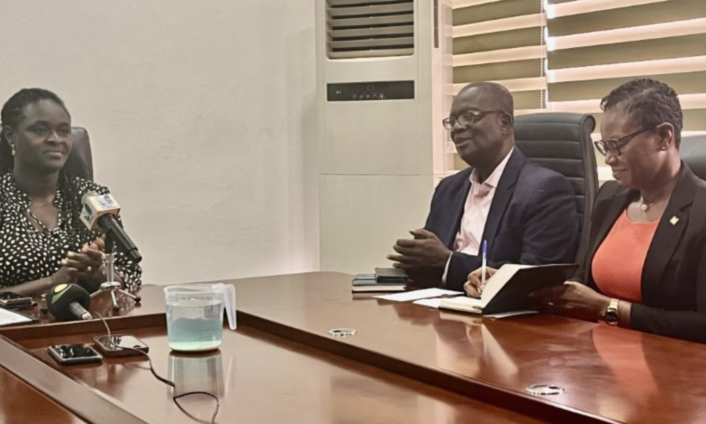
She disclosed this when a team from Knutsford University and the Climate Communications Network called on her in Accra on Wednesday.
The meeting was to congratulate Prof. Klutse on her appointment and to discuss areas of collaboration, including climate change education.
Prof. Klutse said the EPA had received proposals from ten companies expressing readiness to restore polluted water bodies to their original state.
She stated that the authority was assessing the bids based on technology, application methods, potential environmental impacts, and cost.
“We want to be careful to do the due diligence of each and every application that has come,” she said.
Illegal mining, commonly known as ‘Galamsey,’ has severely degraded forests and polluted vital water sources.
The water sector in Ghana faces significant challenges, particularly from illegal mining activities that contaminate freshwater sources, making them unsafe for drinking and agriculture.
Pollution levels in major rivers within the Southwestern Basin are critically high, with turbidity levels far exceeding permissible limits.
Turbidity levels from galamsey activities have been recorded as high as 14,000 nephelometric turbidity units (NTU), far above the five NTU limit set by the Ghana Standard Authority for drinking water.
Restoring the affected water bodies would involve desilting sediment and clearing heavy metals, such as mercury, to make the water safe for drinking, domestic use, and aquatic life.
Prof. Klutse said the proposals included financial arrangements, with one option being for Ghana to pay 100 percent using its carbon credits, or share the cost with development partners.
“The plan is to settle on the technologies and start at the same time. We will then go ahead to protect the water bodies with armed guards.
“This is to prevent a situation when the water is cleaned and then we get them polluted again,” she said.
Prof. Klutse said the government would employ water guards in communities “who stand by the river bodies, all along the river bodies to protect the water bodies.”
“People can go to fetch as it is clean and then use it like we usually do. But not to allow mining activity or any other pollution of the river,” she said.
Asked about measures to end mining in forest areas, Prof. Klutse explained that under the Environmental Protection Act, 2025 (Act 1124), no company had been granted a mining permit to mine in any forest area.
She hinted that parliament had started a process to enact a new law banning mining in forest areas.
Mr. Frank Adjei-Ntekor, Acting Registrar at Knutsford University, said the university was ready to collaborate with the EPA to run educational training for journalists to help them disseminate accurate and credible information on environmental issues.
Latest Stories
-
FABAG commends Ato Forson’s over removal of 20% excise duty on locally manufactured fruit juices
6 minutes -
HIV stigma discourages testing, prevention and treatment in Ghana – Ghana AIDS Commission
9 minutes -
Blocking cocaine probe lends weight to claims of political protection for traffickers – Assin South MP
12 minutes -
NPP Vice Chair race: I may be the youngest, but most experienced – Nana B
14 minutes -
Last UK and US troops leave Iraq as anti-Islamic State mission ends
14 minutes -
Don’t stay home idle, embrace entrepreneurship while awaiting posting – Unemployed nurses urged
26 minutes -
Aayalolo buses not speeding on contra-flow lanes – GAPTE assures commuters
29 minutes -
Effia MP calls for Kurt Okraku’s removal, overhaul of Ghana football structure
30 minutes -
CAS hearing on AFCON final appeal by Senegalese Football Federation set for October 8
30 minutes -
STC fares to go up by up to 8% this week – Deputy MD
32 minutes -
Photos: Accra-Kumasi bypasses get new lease of life as contractors return to site
32 minutes -
Man allegedly swallows five SIM cards to conceal evidence after arrest
32 minutes -
After three finals, Ayikuma Methodist Basic School finally lifts National Juniors Challenge trophy
32 minutes -
Black Stars management ignored players’ health conditions ahead of Gambia game – Ernest Thompson alleges
34 minutes -
Ghana is 5th largest crypto market in sub-Saharan Africa; annual transactions around $21bn
34 minutes