

Audio By Carbonatix
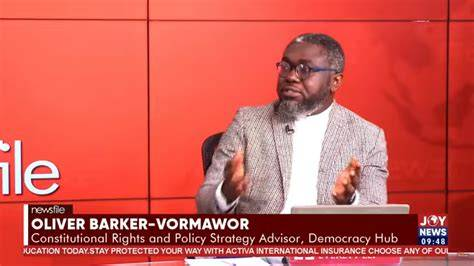
Private legal practitioner and activist Oliver Barker-Vormawor has pushed back against public claims surrounding controversial Anti-LGBTQ+ legislation, arguing that the reintroduced bill differs significantly from the version previously passed by Parliament and submitted for presidential assent.
In a Facebook post shared on Monday, June 1, Barker-Vormawor also challenged assertions by Member of Parliament for Assin South, Rev. John Ntim Fordjour, that the latest version of the bill contained 31 amendments and represented a weakened form of the earlier legislation.
According to him, that interpretation is “not true in substance,” insisting instead that a technical legal review conducted by his firm, Merton & Everett LLP, found extensive structural and substantive modifications that go beyond simple numerical comparisons.
Barker-Vormawor stated that his firm analysed the reintroduced legislation in March 2026 after it was brought back to Parliament by its sponsors.
He said the comparative assessment revealed at least 27 clearly identifiable textual and structural changes, with a broader counting approach suggesting as many as 64 modifications.
He argued that the narrative that the bill was simply reintroduced without significant alteration is inaccurate, adding that the drafting changes materially affect the structure, definitions, and enforcement framework of the legislation.
Among the key differences he highlighted was the restructuring of the legislative instrument from 20 sections in the 2024 Act to 19 clauses in the reintroduced version.
He also pointed to the inclusion of an expanded explanatory memorandum running approximately 19 pages, which outlines legislative history, constitutional justifications, and international law arguments, as well as detailed clause-by-clause explanations.
Barker-Vormawor further noted the deletion of a standalone offence relating to the “subversion of family values,” along with its associated penalties, and the removal of a broadly worded criminal offence that previously captured aiding or facilitating such conduct.
The legal practitioner explained that several offence-creating provisions were reformulated from direct criminal wording into prohibition-style drafting, using phrases such as “a person shall not,” while largely maintaining the original penalties.
He cited provisions relating to procurement, detention, brothel-related offences, gross indecency, void marriages, and funding or sponsorship activities as examples of this structural shift.
While he noted that penalties in many cases remained unchanged, he argued that the change in drafting style reflects a significant legal restructuring of how offences are framed and enforced.
A substantial portion of Barker-Vormawor’s analysis focused on expanded definitions and newly introduced identity categories within the bill.
He noted the inclusion of “queer” within the list of recognised identities under the legislation, as well as newly defined terms such as “intersex,” “non-binary,” and “pansexual.”
He also pointed to the introduction of catch-all provisions criminalising conduct or identity expressions considered contrary to binary gender classifications, which he argued significantly broaden the scope of potential liability.
Additionally, he raised concerns that the formal definition of “intersex” combined with certain operative clauses could create legal vulnerabilities for individuals who do not undergo surgical correction, depending on how the law is interpreted and enforced.
Barker-Vormawor’s intervention directly challenges political interpretations of the bill, particularly claims that the reintroduced version is materially weaker than the earlier legislation.
Instead, he argues that the bill reflects a complex mixture of deletions, structural rewrites, and definitional expansions that cannot be accurately reduced to a simple count of amendments.
Latest Stories
-
Amb. Edward Boateng congratulates Boadu, Kodua on election wins
24 minutes -
John Boadu pledges to rebuild NPP from grassroots and restore ‘winning machinery’
26 minutes -
Ashaiman Assembly deploys monitoring system to curb dumping in storm drain
39 minutes -
John Boadu must rebuild, unite NPP for 2028 – Edward Boateng
40 minutes -
Executive intimidation of opposition undermines separation of powers – Prof Oquaye
44 minutes -
I have no issue with John Boadu; we’ll work together – Justin Kodua
2 hours -
Adom FM Y2K Jam delivers a night of music, fashion and nostalgia
3 hours -
Lawrence Kobena Nsarko Otoo, Esq
4 hours -
Bel-Aqua intensifies mental well-being campaign ahead of 15th anniversary
4 hours -
From banking to party finances: Alfred Kwadwo Thompson elected NPP Treasurer
4 hours -
George Christian Papa Mends
4 hours -
Ali Suraj elected NPP NASARA Coordinator
4 hours -
Mustapha Hamid misses out on NPP Vice Chairmanship by 31 votes despite early poll lead
4 hours -
Kojo Bamba, Henry Nana Boakye and Nana Akomea elected NPP Vice Chairmen
5 hours -
From Delta Force to NPP First Vice Chairman – Kojo Bamba’s political journey
5 hours