

Audio By Carbonatix
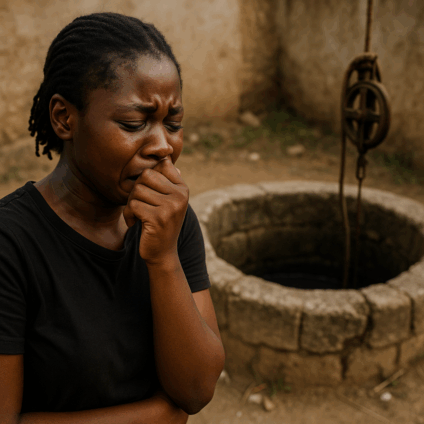
A chilling confession has emerged in the tragic death of a four-year-old boy, whose body was retrieved from a well at Karlo in the Suaman District of the Western North Region.
Akua Afriyie, the 23-year-old mother, has reportedly admitted to police that she intentionally dumped her son in the well to satisfy a condition set by a man she hoped to marry.
Adom TV's Western North Regional Correspondent, Augustine Boah, reported that the harrowing incident occurred on Saturday, July 19, 2025, and was promptly reported by Mr. Eric Armah, the Assemblyman for the Karlo Electoral Area.
According to Mr. Armah, the young mother, upon interrogation by police, confessed that the unnamed man allegedly told her he would only marry her if she did not have a child.
Driven by a desperate desire to secure this new relationship, Afriyie tragically decided to take her son's life.
Upon receiving the report, police swiftly dispatched a team to the scene.
The body of the child was successfully retrieved from the well and has since been transported to the mortuary of a local hospital for preservation and autopsy, which will officially determine the cause of death.
This deeply disturbing case brings to the forefront the devastating issue of child abandonment and murder, often tragically linked to complex social and economic pressures as well as harmful beliefs.
While the specific motive cited by the mother points to a desperate attempt to secure a romantic relationship, such acts of extreme violence against children are a stark reminder of vulnerabilities within society.
In Ghana, child protection laws are enshrined in statutes like the Children's Act of 1998, which aims to protect children from all forms of abuse and neglect.
Infanticide and child murder carry severe penalties under Ghanaian law, reflecting the gravity with which the state views such offenses.
Child abandonment, though less frequently fatal, remains a concern, often influenced by factors such as extreme poverty, lack of support systems for single mothers, societal stigma associated with out-of-wedlock births, and in some tragic instances, a misguided belief that a child poses a barrier to personal advancement or social acceptance.
While statistics on direct child murder for such specific reasons are rare, broader data from UNICEF and the Ghana Statistical Service highlight that a significant percentage of Ghanaian children face various forms of deprivation and vulnerability, underscoring the need for robust social welfare programs and community support.
Latest Stories
-
Ghana must value skilled trades, build resilient learners — Ibn Chambas
6 minutes -
Ghana must rethink education around relevance, resilience and responsibility — Ibn Chambas
9 minutes -
Prince Harry faces defamation lawsuit from charity he co-founded
11 minutes -
South Korea deploys thermal cameras to track escaped zoo wolf
12 minutes -
Calls for royal meeting with Epstein survivors grow ahead of US visit
16 minutes -
Ibn Chambas advocates blend of technology and human values in education
17 minutes -
UMA improves healthcare access in Asutifi North with GH₵700k ‘Kim Taylor Legacy’ Walkway
22 minutes -
Scholarships Authority and Fanaka University offer sponsorship for procurement and supply chain studies
25 minutes -
Bisa Kdei drops new single ‘Go N Look’ featuring Medikal
32 minutes -
Benin facing rising terrorism in north as French military presence faces growing criticism
33 minutes -
UEW Public Lecture Series 2026: Education debate ‘about the soul of Ghana’s future’ — Dr Ibn Chambas
34 minutes -
EU fingerprint and photo travel rules come into force from today
1 hour -
Anti-LGBTQ+ Bill: Ghanaians demand expedited passage, not dialogue – Ntim Fordjour to Mahama
1 hour -
EU airline industry warns of fuel shortages if Strait of Hormuz stays closed
1 hour -
White House staff told not to place bets on prediction markets
1 hour