

Audio By Carbonatix
“I have slaughtered a ram every year starting from 1976 but this year I can't, I just can't.”
Like many other Muslims in Nigeria, 78-year-old Mallam Kabiru Tudun Wada is not celebrating Eid al-Adha as he normally would because of the cost-of-living crisis.
Muslims around the world traditionally slaughter a ram or another animal on Eid al-Adha, in memory of the prophet Ibrahim's willingness to sacrifice his own son when God ordered him to.
The meat is used to prepare a huge feast for the entire family, while friends and neighbours visit each other and eat the food each family has prepared.
Clerics also recommend that some of the meat is distributed to the poor and needy.
“In years gone by I could afford at least one ram but things have never been tighter,” Mr Wada told the BBC in the city of Kano, the largest city in northern Nigeria, where the vast majority of people are Muslim.
Nigeria is currently experiencing its worst economic crisis in a generation, leading to widespread hardship and anger.
Annual inflation - the average rate at which prices go up - is now over 30%, the highest figure in nearly three decades. The cost of food has risen even more - by 50%.
An average ram now sells for 100,000 naira (£50; $63) which is beyond the reach of many.
Another Nigerian, Mallam Auwal Yakasai, 66, said the only way he could afford to slaughter an animal for Eid this year was to find a friend and share the cost.
“We got a camel so the two of us can slaughter together.
“Things are so tight for many people and for some, an arrangement like this is the only way they can make the sacrifice.”
Muslim cleric Idris Garba Sokoto told the BBC that slaughtering a ram, goat or camel on Eid is one of the most beloved deeds a Muslim can perform for Allah.
“Islam traces the origin of the animal slaughtering on Eid to the prophet Ibrahim, who had a dream and was about to sacrifice his son before God intervened with a ram which he slaughtered instead. Since then it has become a religious practice.”
“For cows and camels, up to seven persons can put money together, buy and slaughter together - Islam permits that,” the cleric said.
Why are there two Eids and what is the difference?
But for many Muslims, and other Nigerians, basic food is their top priority at the moment - not an animal which some consider a luxury.
Shamsu Mohammed, 54, said that even if someone gave him the money to buy an animal, he would be more inclined to buy cheaper food to stock up his home.
“Slaughtering is not compulsory, as Islam says it is for those who have the means. For those who can't afford it, it’s not necessary.”
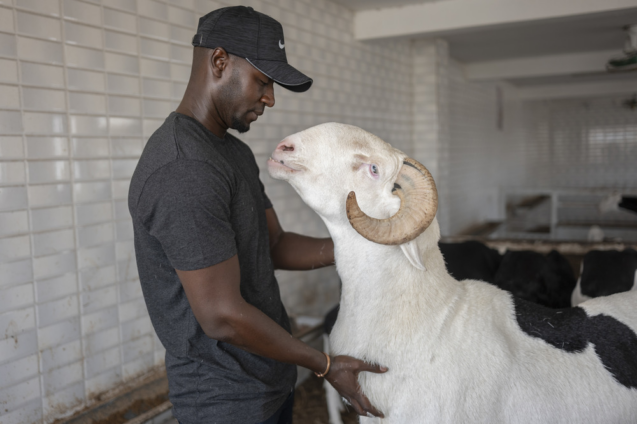
Ahead of Eid, the ram markets are normally full of people choosing which animal to buy and take home to their family. Normally, people take great pride in choosing the biggest and most impressive animal.
But this year is very different.
Ibrahim Balarabe Wambai makes his living selling rams and his whole year is normally geared around Eid.
He says the market is very different this year.
"Last year I sold 15 rams but this year, I have sold only seven."
The Nigerian government say it is doing all it could to turn the economy around.
Around 15 million poor households are receiving a cash transfer of 25,000 naira ($16; £13) a month but these days that doesn't go very far.
As millions of Nigerian Muslims return from visiting the mosques, the prayer on the lips of many will be that things improve so that by next year, they can not only slaughter an animals but buy new clothes as well.
Latest Stories
-
Ghana explores centre of excellence for hearing, communication and cochlear implant care
41 minutes -
Schizophrenia-related disorders lead mental health cases recorded in Ghana
1 hour -
Dutch authorities enlist Ghana in hunt for fugitive drug lord Bolle Jos
1 hour -
Ghana housing finance conference adopts communiqué to improve affordable housing access
6 hours -
Special Initiatives Minister urges Wa Technical Institute to enrol more girls as EU-backed solar training lab opens
6 hours -
In the matter of my first year at the Bar
6 hours -
ActionAid Ghana calls for an end to child marriage, greater investment in girls’ rights
7 hours -
Newsfile to tackle World Cup visa scandal, beach demolitions, education strikes, BRICS bid
7 hours -
UK-Ghana Trade & Investment Summit: Trade Resource Centre to help businesses maximise UK-Ghana trade opportunities
7 hours -
Embassy of Denmark celebrates World Maritime Day
7 hours -
Linking LEAP to productive inclusion could cut extreme poverty by 2030 – UNICEF
8 hours -
Trade Ministry backs use of creative arts to rehabilitate prison inmates
9 hours -
Negotiations with government to continue despite strike suspension – GNAT
9 hours -
‘Ghana cannot afford to waste public resources; every cedi has a job’ – Ato Forson
9 hours -
Ghana expects economic boost as World Assemblies of God Congress brings 10,000 delegates to Accra
9 hours