

Audio By Carbonatix
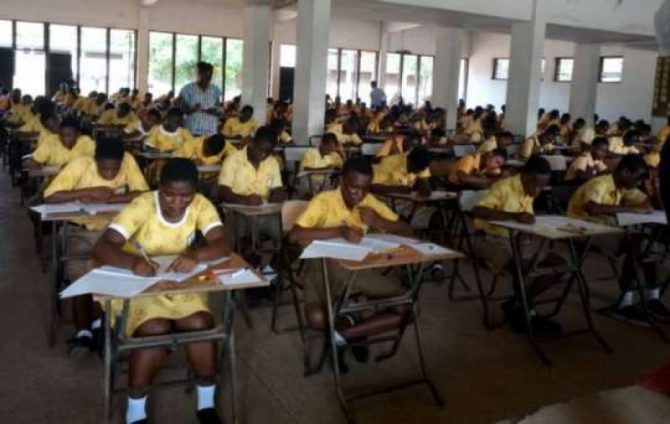
A total of 470,768 primary pupils are expected to participate in the 2021 National Standardised Test today.
The national test will enable the Ministry of Education generate data on the performance of pupils in English Language and Mathematics.
According to the Education Ministry, the NST will help to build a strong educational system in the country by enhancing the learning outcomes of pupils while reducing the issue of learning poverty.
The test is not meant to grade pupils in primary four but to improve teaching and learning in the basic schools across the country.
Currently, the national test will be conducted in only public schools; however, there could be a consideration for enrolling private schools in subsequent ones.
Spokesperson for the Ministry, Kwasi Kwarteng, said in an interview on Prime Morning that the conduct of the test will aid in highlighting learning gaps to shape future educational policies.
“It’s nothing new, apparently because if you look at it we have a similar test already in our system. The BECE, for instance, gives us a test of a national significance and so at the end of the day, it’s an assessment regime where you have to test students and then know the policy response in terms of resource allocation interventions that you are giving to such students.”
“If you look at the test regime, based on the Education Strategic Plan and the assessment framework we’ve drawn at the Ministry, you realize that the test is supposed to be conducted among students in Class 2, Class 4 and Class 6; it is the commencement that starts with Class Four. So when students write in Class Two, by the time they get to Class Three, you’d be able to generate the data and know the learning gaps and then profess whatever interventions that you are able to come up with,” he added.
The NST falls within the ‘Education Strategic Plan’ which started in 2018 and is expected to end in 2030.
The first edition of the national assessment will be administered by the West African Examinations Council (WAEC) and the Ghana Education Service (GES).
It will address the challenge of many school-going children who have limited knowledge in numeracy and literacy, thereby helping to meet the United Nations Sustainable Development Goal 14, the Ministry had added.
There would be 2,850 examination centres with 200 pupils per centre. 15,391 schools will be participating.
Latest Stories
-
NPP behind every monumental agenda in Ghana – Miracles Aboagye
9 minutes -
Ho Airport not a misplaced priority — GACL Board Chair
11 minutes -
Nationwide sensitisation of haulage truck drivers ahead of Axle Load Enforcement
11 minutes -
Vice President backs community tourism at Vodza Regatta 2026
14 minutes -
Tree Crops Development Authority says media reports on rubber exports are misleading, demands apology
21 minutes -
Kotoko suffer shock 2-1 defeat to Samartex in Kumasi
31 minutes -
Scrap sanitation levy amid fuel price hikes — Miracles Aboagye
32 minutes -
Rapper Offset injured in shooting near Florida casino, officials say
40 minutes -
Sporting CP vs Arsenal Champions League preview: Where to watch, predicted line-ups, form, coaches’ thoughts
55 minutes -
Real Madrid vs Bayern München Champions League preview: Where to watch, predicted line-ups, form, coaches’ thoughts
1 hour -
CIB Ghana Post-MPC policy seminar urges action to turn macroeconomic stability into jobs
1 hour -
Maguire signs one-year contract at Man Utd
1 hour -
GACL chairman says airport levy to fund projects, completion targeted within 24 months
1 hour -
Sugar sacks now used to bag cocoa under Mahama government – Annoh-Dompreh raises concerns
1 hour -
President Mahama will sign LGBTQ Bill when it reaches him — NDC’s Wonder Madilo
1 hour