

Audio By Carbonatix
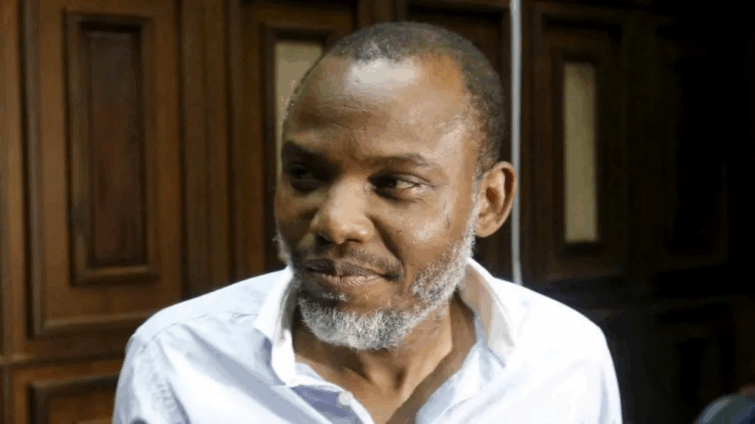
A court in Nigeria has found separatist leader Nnamdi Kanu guilty of terrorism 10 years after he was first arrested.
The court said it was satisfied that Kanu had made a series of broadcasts to incite violence and killings, as part of his campaign for a separate state in south-east Nigeria, known as Biafra.
Kanu has so far been convicted on six of the seven charges he faced, with the judge continuing to deliver his ruling.
Once a relatively obscure figure, Kanu's popularity surged in 2009 when he started Radio Biafra, a station that called for an independent state for the Igbo people broadcast to Nigeria from London.
Though he grew up in south-eastern Nigeria, where he attended the University of Nsukka, Kanu moved to the UK before graduating and acquired British nationality.
In 2014, he set up the Indigenous People Of Biafra (Ipob), a movement demanding independence.
Ipob was banned as a terrorist organisation in 2017. Its armed wing - the Eastern Security Network - has been accused of killings and other acts of violence in recent years.
Delivering his judgement, Judge James Omotosho said: "Mr Kanu knew what he was doing, he was bent on carrying out these threats without consideration to his own people.
"From the incontroverted evidence, it is clear that the defendant carried out preparatory act of terrorism.
"He had the duty to explain himself but failed to do so."
In court ahead of the verdict, Kanu insisted that proceedings could not continue because he had not yet filed his final written address, accusing the judge of bias and not understanding the law.
The judgement was delivered after Kanu had been forcibly removed from the courtroom for unruly behaviour.
He was first arrested in October 2015 but he jumped bail in 2017 and left the country after a military raid on his home. The court later revoked his bail in March 2019 and he was re-arrested in 2021 in Kenya.
The calls for Biafran independence date back many years.
In 1967 Igbo leaders declared a Biafran state, but after a brutal civil war, which led to the deaths of up to a million people, the secessionist rebellion was defeated.
Latest Stories
-
Ghanaian food storyteller Bibiana Gyasi launches children’s book to strengthen cultural literacy
15 minutes -
EPA emerges among Ghana’s most compliant public institutions – PFM League Table
33 minutes -
44 Ghanaians rescued from “QNET” scheme in Nigeria
46 minutes -
Kasoa bank fraud: Suspects nabbed months after unauthorised withdrawals
2 hours -
‘Deal with your own’ – Miracles Aboagye tells Mahama on galamsey
2 hours -
Signage works at Accra International Airport fully completed
2 hours -
Applauding gov’t for galamsey admission is hypocritical – Miracles Aboagye
4 hours -
TUC calls on Mahama to take stronger action against galamsey in forests and rivers
4 hours -
Mahama launches $30m World Cup fundraising campaign
4 hours -
Stop the imposition – James Agbey warns NDC ahead of post-Mahama power struggle
4 hours -
Public sector productivity crisis undermining economy – Senyo Hosi warns
4 hours -
Achimota Golf Club hosts Lady Captain’s Prize 2026 today
5 hours -
Mahama was right, Ghana’s economy is showing signs of resilience – Edem Agbana
5 hours -
Blaming public sector wages for economic strain is misleading – TUC
5 hours -
We don’t have resilence; gov’t must be modest about its successes – Senyo Hosi
6 hours