

Audio By Carbonatix
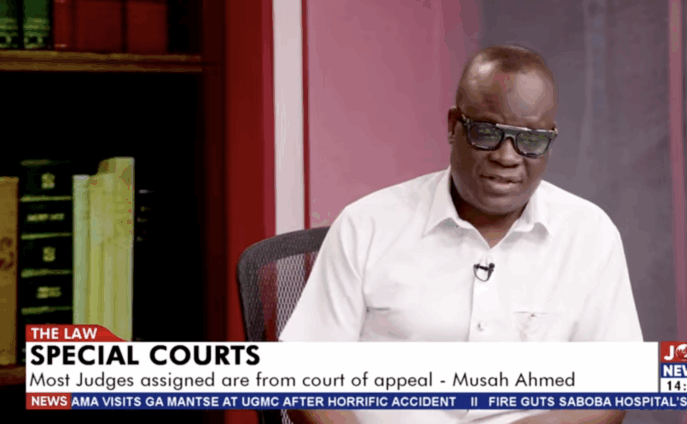
Judicial Secretary, Musah Ahmed, says the judiciary has put in place a comprehensive system designed to tackle the long-standing problem of case delays — one that combines the newly established Specialised High Court Division with afternoon courts to significantly reduce the workload on individual judges.
Ahmed made the remarks on The Law on Joy News, providing the most detailed explanation yet of how the reforms introduced by Chief Justice Paul Baffoe-Bonnie will work in practice.
"The system we are creating has taken care of all those delays," Ahmed said. "We have put in place now a new system which seeks to transform the system where one particular judge is given different subject matters to try, for which reason he's touching on various subjects before him, which could lead to inefficiency and delays."
At the heart of the new approach is a simple but significant shift: reducing the number of cases before any single judge. Ahmed explained that afternoon courts will play a key role in this, with cases redistributed from morning sessions to afternoon court judges to ease the burden on their counterparts handling the morning docket — including those sitting in the specialised courts.
"What we are doing now is to reduce the number of cases before a particular judge. This then calls for the establishment of the afternoon courts so that we will push a number of those cases to the afternoon court judges to try them," he said.
The old model, Ahmed argued, was a recipe for slowness. A judge juggling different subject matters across unrelated cases — from land disputes to financial crimes to cybersecurity — could not reasonably be expected to deliver swift, focused decisions. The new model flips that logic entirely.
Under the reformed system, judges in the Specialised High Court Division are assigned cases within a defined subject area.
"These are assigned specific cases; they effectively deal with them as a subject, and then they dispose of them with dispatch," Ahmed explained.
The Specialised High Court Division, formally established through a Chief Justice circular on February 5, 2026, covers corruption and public accountability, natural resources and galamsey, state asset recovery, and organised crime and security.
Complementing this, the Chief Justice ordered that High Court offices remain open from 8:00 am to 6:30 pm on weekdays — creating the operational window needed to run both morning and afternoon court sessions effectively.
The reforms come amid years of public frustration over how long it takes Ghanaian courts to resolve high-profile cases, particularly those involving corruption and galamsey. Cases that have dragged on for years with little movement have eroded public trust in the justice system, making the pressure on the judiciary to act both immense and urgent.
The Judicial Service is also revising the Rules of Court, expected to come into force by March 2026, alongside technological innovations to further enhance the delivery of justice.
Latest Stories
-
National Peace Council urges investment in youth to sustain Ghana’s peace
3 minutes -
Afenyo-Markin urges youth to speak up against injustice
14 minutes -
CAF annuls Edo Queens victory, orders WAFU B final to resume from extra time
37 minutes -
Interior Minister urges traditional authorities to enforce anti-bushfire bye-laws
38 minutes -
3rd Republic Bank-JoyNews Habitat Fair Clinic ends on a high note after three days of strong patronage
40 minutes -
Ten climbers missing after avalanche hits Himalayan base camp
1 hour -
NPP had more permanent fuel relief measures than current GH¢2 diesel cut – Amin Adam
2 hours -
Photos from the 3rd Republic Bank-JoyNews Habitat Fair Clinic
2 hours -
Ethiopia’s army promises restraint amid fears of new civil war
2 hours -
Amin Adam calls for review of fuel taxes as diesel prices remain above GH¢18
2 hours -
World Vision Ghana, Ahafo districts sign MoU for universal WASH coverage
3 hours -
When the gold engine stutters: What Ghana’s Cedi and reserves are telling us about the new economic architecture
3 hours -
Two reportedly die after being trapped in mining pit at Juaboso
3 hours -
Petrosol cleans up Wa Municipal Hospital, to donate medical equipment
3 hours -
‘If NPP was ‘insensitive’ over fuel prices, NDC must accept same description now’ — Amin Adam
4 hours