

Audio By Carbonatix
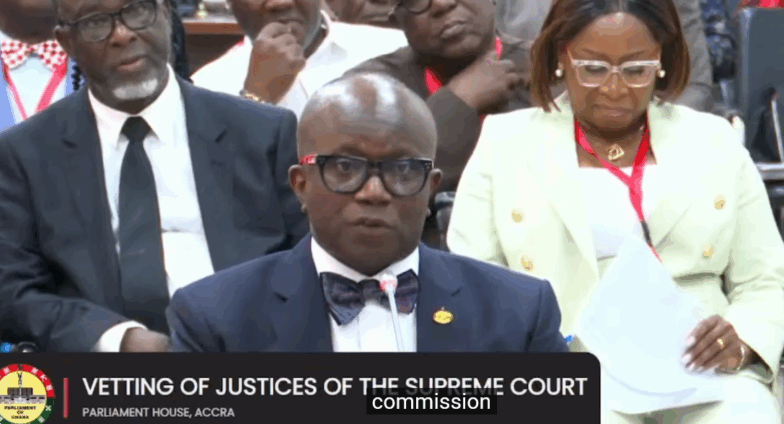
Supreme Court nominee, Justice Eric Kyei Baffour Ackaah-Boafo, says the country’s justice system must not tolerate arrests that are not supported by proper investigations and credible evidence.
Appearing before the Appointments Committee of Parliament on Friday, June 20, Justice Ackaah-Boafo was responding to questions on his previously stated legal opinion criticising the police for arrests made solely on the basis of association or unverified claims by co-accused persons.
“My view is that there is a need to have proper investigations and not a co-arrestee's say-so be the basis for prosecution,” he stated.
Referring to a case in which he gave a concurring opinion, he explained: "Apart from those who were arrested with him, saying that he was part of us, there wasn’t any investigation that was conducted to link the individual. These statements were actually not repeated in court apart from a caution statement.”
Justice Ackaah-Boafo stressed that arbitrary arrests, especially those not backed by credible evidence, undermine public trust in law enforcement and the justice system.
Asked how the judiciary can prevent arrests used to settle personal scores or suppress dissent, he said, “The only way the judiciary can confront this is when presented with a compendium of evidence, assess it and say that there was no basis for this arrest and no basis for the prosecution. If ultimately there’s no evidence, there’s no evidence.”
On institutional reforms needed to prevent abuse of police powers, the nominee urged the Attorney General’s Department and prosecutorial services to develop clearer ethical and operational guidelines for investigators.
“These guidelines ought to come from the Ministry of Attorney General and the prosecutorial services. In other jurisdictions, no matter the charge, if a matter has been unduly delayed, it could be stayed. Should someone stand trial for five years without calling any evidence? These are conversations that we can have,” he added.
Justice Ackaah-Boafo also acknowledged that until a case is formally filed in court, the judiciary’s power to intervene in investigative excesses is limited, but emphasized the need for broader legal reforms to uphold justice and human rights.
Latest Stories
-
US, Iran fail to reach peace agreement after marathon talks in Pakistan
12 minutes -
ECG kicks off Phase Two of transformer upgrades at Lashibi; brief outages expected
46 minutes -
Port crises loom as 11,000 drivers threaten four-day strike
2 hours -
A source of excellence across generations – Vice President Opoku-Agyemang lauds Mfantsipim
2 hours -
(Photos) Mfantsipim School launches historic 150th anniversary
3 hours -
Knights and Ladies of Marshall group backs Catholic Bishops’ stance on anti-LGBTQ+
4 hours -
Bright Simons writes: All the Filla in the Ibrahim Mahama/E&P – Gold Fields Saga
4 hours -
Monetise Idiocy In Ghana
4 hours -
The Ghanaian prophet and the mysterious death of his scottish wife Charmain Speirs
5 hours -
Nearly 400 sentenced in Nigeria for links to militant Islamists
5 hours -
Ghana’s recovery supported by gold strength despite global oil price pressures – Standard Bank Research
6 hours -
Methodist Church hails Mfantsipim@150; calls for “fresh consecration” to excellence
6 hours -
‘Excellence is our inheritance’ – Nana Sam Brew-Butler hails Mfantsipim’s 150-year reign in leadership
6 hours -
Kwaku Azar writes: A-G vs OSP
6 hours -
Mfantsipim–Adisadel rivalry built excellence, not division – Sam Jonah
7 hours