

Audio By Carbonatix
The Minority Leader, Alexander Afenyo-Markin, has questioned claims by the Finance Minister, Dr Cassiel Ato Forson, that the recent appreciation of the cedi is unprecedented, insisting that the previous New Patriotic Party (NPP) administration had already stabilised the local currency before leaving office.
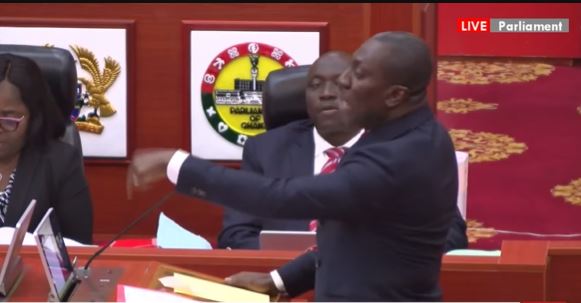
Speaking on the floor of Parliament on Thursday, July 31, during the debate on the 2025 Mid-Year Budget Review, Mr. Afenyo-Markin said while the cedi’s current performance is commendable, the context behind its recent gains must be properly understood.
“Mr. Speaker, the Mid-Year Review makes much of the Ghanaian Cedi’s performance, with the Minister jubilantly declaring ‘cedi no apicki’. He even claims the recent appreciation has never happened in the history of the country,” the Minority Leader said.
“Let’s analyse this carefully. Yes, in early 2025, the cedi strengthened against major currencies, a positive development, we admit. But what are the underlying causes, and is this sustainable?”
Mr. Afenyo-Markin stated that the Finance Minister’s Mid-Year Budget Review presentation failed to acknowledge the global economic challenges that led to the Cedi’s steep depreciation in 2022.
He noted that during that year, the Cedi was among the worst-performing currencies in the world, having lost over half its value at one point. However, he argued that the situation was not unique to Ghana.
“In 2022, virtually all emerging economies saw their currencies fall sharply against a surging US dollar,” he said.
“Aggressive interest rate hikes by the US Federal Reserve strengthened the dollar, while the Russia-Ukraine conflict drove up oil and commodity prices, draining foreign reserves in countries like ours.”
The Effutu legislature further explained that Ghana suffered a temporary loss of investor confidence before securing a deal with the International Monetary Fund (IMF), which compounded the Cedi’s troubles.
Despite those setbacks, Mr. Afenyo-Markin maintained that the NPP government was able to stabilise the Cedi by the end of 2023.
He cited policy initiatives such as the IMF agreement, debt restructuring efforts, and the Gold-for-Oil programme as contributing factors.
“After reaching its weakest point in late 2022, the Cedi’s slide was arrested and partially reversed,” he said.
“By the end of 2024, the depreciation had slowed dramatically, only 19% year-on-year against the dollar. That was a marked improvement from the earlier free-fall.”
He added that the governing NDC administration, led by President John Mahama, inherited a recovering currency rather than a collapsing one.
“So when the new government took over the reins of affairs in January 2025, they inherited a stabilising currency, not a perpetually dwindling one,” Mr. Afenyo-Markin stated.
Latest Stories
-
Prioritise public education on legal aid to support vulnerable persons – Presbyterian University VC
3 minutes -
Kurt Okraku commiserates with Berekum Chelsea after fatal armed robbery attack
4 minutes -
78% of NDC delegates worried about jobs, but majority remain optimistic – Global InfoAnalytics poll
8 minutes -
Traceability is the new currency of global cocoa Trade
12 minutes -
Asiedu Nketia holds lead in NDC race but Ato Forson closing gap fast – Poll
25 minutes -
Collaboration across sectors key to tackling MoMo fraud — MobileMoney Ltd CEO
27 minutes -
President Mahama commends Catholic Church for role in Ghana’s development
31 minutes -
Canadian PM Carney on verge of Liberal majority gov’t as votes cast in three by-elections
33 minutes -
UK could adopt EU single market rules under new legislation
34 minutes -
Ghana Shippers’ Authority CEO to meet association of Port Transport Drivers over intended strike
34 minutes -
MTN Ashantifest musical concert lives up to bill
40 minutes -
Ninani Group launches D. A. Twum Jnr. Fellowship to address skills gap in creative industry
52 minutes -
Independent assessment by Lands and Mines Watch backs Heath Goldfields for mining operations
53 minutes -
Leaders must be held accountable for their words – Lom-Nuku Ahlijah
1 hour -
Multimedia Group Limited unveils innovative programming for World Cup 2026
1 hour