

Audio By Carbonatix
The New Patriotic Party (NPP) has challenged the sustainability of the government's recent economic gains, arguing that the improvements being touted ahead of the 2026 Mid-Year Budget Review are heavily dependent on temporary factors rather than durable policy reforms.
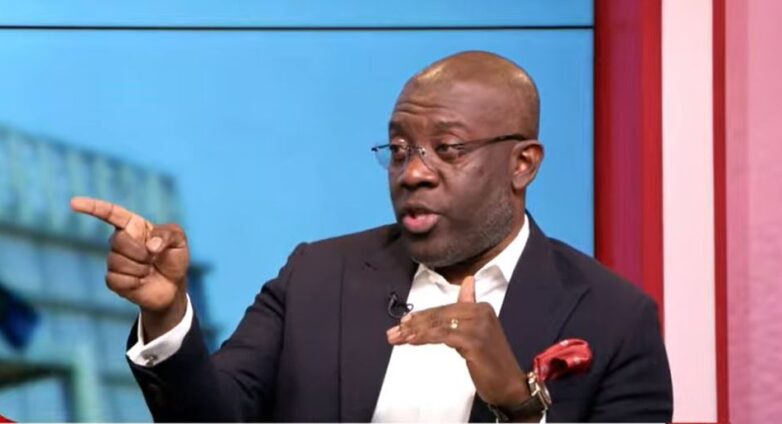
Addressing a press conference on Wednesday, Chairman of the NPP Policy Co-ordination Committee, Kojo Oppong Nkrumah, said the government's fiscal and macroeconomic performance should be subjected to what he described as a "durability test" to determine whether the current gains can be sustained once the conditions supporting them change.
He argued that Ghana's continued engagement with the International Monetary Fund (IMF) under a new Policy Coordination Instrument (PCI), expected to be approved after the Mid-Year Budget Review, demonstrates that the country still requires external oversight despite no longer seeking additional IMF financing.
"The choice to remain under Fund supervision without Fund money is an admission that an external anchor is still needed," he said, adding that the IMF itself has identified state-owned enterprises, contingent liabilities, quasi-fiscal activities and Ghana's dependence on high gold prices as key risks to the economy.
Gold, not policy
Mr Oppong Nkrumah also questioned the government's narrative on economic growth, arguing that the reported 6.4 percent first-quarter growth was driven primarily by record gold prices and increased mining activity rather than broad-based economic reforms.
He noted that industrial growth accelerated from 1.9 percent to 6.9 percent within a quarter largely because of the mining sector, while export earnings reached a record US$31.1 billion on the back of historically high gold prices.
"If gold returned to its five-year average price, what would growth be? What would the trade surplus be? What would the primary balance be? Where will they get the foreign exchange to continue supporting the market?" he asked.
He called on the Finance Minister to publish a sensitivity analysis showing how Ghana's economy would perform under lower gold prices.
Inflation and exchange rate risks
The former Information Minister further argued that inflationary pressures were beginning to re-emerge despite recent declines in headline inflation.
According to him, inflation has recorded three consecutive monthly increases, reaching 5.3 percent in June, driven partly by higher global fuel prices following tensions in the Middle East.
He also pointed to the depreciation of the cedi this year, warning that exchange rate gains which contributed to the decline in Ghana's debt-to-GDP ratio could easily be reversed.
"What the currency gave, the currency can take back," he cautioned.
Debt concerns
Mr Oppong Nkrumah questioned inconsistencies in Ghana's debt figures, noting that while the Bank of Ghana reports debt at about 45.1 percent of GDP as of May 2026, IMF projections suggest the ratio could rise to 53 percent by the end of the year.
He argued that the government's recent borrowing raises concerns about meeting medium-term debt sustainability targets and called on the Finance Minister to publish a comprehensive debt sustainability analysis during Thursday's review.
"The government should convince Ghanaians that all the work and sacrifice made to reduce the debt burden has not been in vain," he said.
Spending cuts and revenue concerns
The NPP also maintained that the government's fiscal surplus was achieved through significant spending cuts rather than improved revenue performance.
Citing Bank of Ghana data, Mr Oppong Nkrumah said first-quarter expenditure was 21.2 percent below target, with capital expenditure falling nearly 42 percent below projections.
He said foreign-financed projects, spending on goods and services, and grants to sectors including health, education and local government all fell substantially short of budgeted levels.
According to him, the only expenditure category that remained largely protected was the public sector wage bill.
He further argued that revenue mobilisation remains weak, with first-quarter revenue falling 4.5 percent below programme targets and oil revenues declining sharply compared with previous years.
"Fiscal space created by under-execution is not fiscal space. It is deferral," he said.
Bank of Ghana losses
Mr Oppong Nkrumah also described the Bank of Ghana's financial position as a "fiscal time bomb", citing significant reported losses and negative equity.
He argued that future recapitalisation of the central bank would place additional pressure on public finances and reduce resources available for infrastructure and social services.
He further welcomed the Bank of Ghana's decision to stop pre-financing gold purchases for GoldBod, insisting the Minority had long warned that the arrangement exposed the state to significant financial risks.
"For months, the Minority warned that this financing was an unbudgeted, quasi-fiscal operation exposing the state to loss. We were dismissed. Now the financing has stopped, but the losses have already been booked," he said.
The NPP's comments come a day before Finance Minister Dr Cassiel Ato Forson presents the 2026 Mid-Year Budget Review, where the government is expected to outline the state of the economy, fiscal performance and plans for the remainder of the year.
Latest Stories
-
Total revenue & grants stood at GH¢144.5bn in July 2026, slightly below target – BoG
12 minutes -
Ghana Sports Fund urges sports federations to submit credible proposals and measurable targets
16 minutes -
Musk says US government may be behind slowdown of Ukraine drone speeds
33 minutes -
Picking Chief Justices nearing retirement could give Mahama immense power – Bentil
43 minutes -
Netflix to shed 1,000 jobs in steepest cuts since 2022
1 hour -
Burnham had two hospitality dinners with Man City chairman, deleted records show
1 hour -
Semenyo ‘froze’ after alleged racist abuse, court told
1 hour -
‘Shameless’ – Mourinho critical of Vinicius Jr ban timing
2 hours -
Loyalty can outweigh competence in Chief Justice selection – Bentil
2 hours -
Man City suffer as PSG masterclass sets up Champions League win
2 hours -
Customer Service Africa CEO urges business leaders to observe staff and customer interactions
2 hours -
On night of mayhem for Liverpool, Barcola arrives in style
2 hours -
Muzic Mensah finds healing and renewed love in new single ‘WayƐ Late’
2 hours -
FIFA to offer extra £2.6bn for football development
3 hours -
Government backing is no EPA permit – Authority warns GoldBod, ministries
3 hours