

Audio By Carbonatix
In policy and public debates on environmental health, “evidence” is often demanded but then judged inconsistently by the seniority of the source, how recent the study is, or whether findings align with prior beliefs. What matters more is methodological rigour and transparency about limits.
This commentary draws on a 2024 Scientific Reports paper describing Pure Earth’s Rapid Market Screening across 25 low- and middle-income countries, including Ghana[1], where researchers systematically purchased common consumer products from markets and tested them on-site using portable XRF, with laboratory confirmation on a subset. The study’s core contribution is pragmatic, as it demonstrates how rapid, field-based screening can identify plausible lead exposure sources in everyday items, particularly foodware, ceramics, and paints, thereby creating actionable signals for regulators and public health programmes.
The cooking pots that feed Ghanaian families every day may also be quietly poisoning them. This research examining aluminum cookware from 25 lower-and middle-income countries, including Ghana, shows that many common pots, especially those made from recycled scrap metal, contain enough lead to raise blood lead levels in children and women of child‑bearing age, as well as in boys and men.
Ghana’s aluminum pots under the microscope
Ghana was one of the 25 countries where researchers bought aluminum cookware directly from local markets as part of Pure Earth’s Rapid Market Screening programme. Pure Earth is an environmental health organisation that partners with governments to prevent and mitigate exposure to toxic pollutants with the goal of advancing public health and economic growth. In total, they screened 518 metal foodware items across all countries, predominantly aluminum pots, and then selected 100 uncoated aluminum pots representing every country in the survey, including Ghana for detailed leaching tests.
While the paper does not publish a separate numeric average for Ghana alone, Ghanaian cooking pots are explicitly part of the dataset in which total lead ranged from about 4 ppm to almost 16,000 ppm, with an overall average around 1,600 ppm and a median of 450 ppm. Only about 22% of the tested pots across countries had less than 100 ppm lead, meaning that most of the aluminum cookware on sale, including items from Ghanaian markets, contained measurable lead in the metal. Given Ghana’s active informal scrap‑metal sector and artisanal metalworking, the pathway described by the authors, aluminum pots cast from mixed scrap that may include engine parts, radiators, computer components, and old cookware is highly relevant to local production.
From a Ghanaian public health perspective, this matters because the country already faces documented burdens of lead exposure from used lead‑acid batteries, informal recycling, contaminated soil around smelters, and lead in some paints and cosmetics. Adding contaminated cookware to this list suggests that many Ghanaian households may be exposed from multiple directions at once.
What the study found about leaching
A common question asked is: If there is lead and so what? Does it get into our food and into our bodies? To understand how much of the lead in the metal actually reaches food, the researchers boiled a 4% acetic acid solution which is comparable in acidity to vinegar or tomato‑based stews in each cooking pot for two hours and then measured lead and aluminum in the liquid. This approach was applied to all 100 selected pots, including those purchased in Ghana. Across the combined sample results showed that:
- Leachable lead ranged from below detection to 2,900 micrograms per litre (µg/L), with an average of about 100 µg/L and a median of 14 µg/L.
- About 55% of pots produced leachate above the WHO guideline of 10 µg/L for lead in drinking water, meaning that more than half of the tested cookware, some of it from Ghana, released lead at levels that would trigger concern if they were found in tap water.
- Roughly 18% of pots leached at least 100 µg/L and about 11% fell in the 200–300 µg/L range.
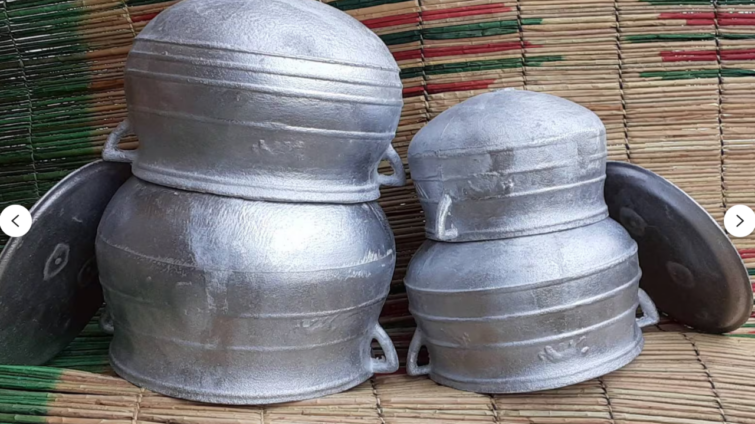
The study also distinguished between pots formed from rolled aluminum (wrought) and those manufactured by pouring molten scrap into moulds (cast). For the same total lead content, cast pots released about seven times more lead than wrought pots under the test conditions. This is important for us in Ghana where cast local pots are widely sold in markets, often recognisable by their thicker walls, seams, rougher surfaces, and more irregular finishes.
In a country where many low-and middle‑income households, and even high income households rely on these cheaper, locally cast pots, the risk is not abstract and the fact is that certain common pot types are structurally more prone to leaching lead into our banku, TZ, palm‑nut soup, tomato sauces, and waakye[2].
From Ghanaian kitchens to Ghanaian blood
To translate pot chemistry into human risk, the authors used the US EPA’s All Ages Lead Model (AALM) to estimate blood lead levels in young children and women aged 25–30, assuming daily consumption of 250 millilitres or grams of food cooked in contaminated pots at the measured leachate levels. Although these simulations are not Ghana‑specific, they apply directly to Ghana’s demographic reality, where many children eat cooked foods from aluminum pots at least once or twice a day.
The model showed that:
- At the highest observed leaching level ( about3,000 µg/L), predicted blood lead levels ranged from about 32 to 46 µg/dL—clearly toxic concentrations associated with cognitive impairment and cardiovascular harm.
- Leachate in the 200–300 µg/L range, present in about one tenth of all tested pots, was sufficient to raise modelled blood lead above 5 µg/dL, the threshold at which WHO recommends investigating exposure sources.
- Even 100 µg/L leaching, seen in about 18% of pots, produced modelled blood lead levels of roughly 1.6–2.8 µg/dL.
For Ghana, where national blood lead surveillance is limited and many exposures are likely under‑recognised, these modelled numbers are a strong signal. A Ghanaian child in a household using a highly contaminated cast pot could, in principle, reach blood lead levels in the tens of micrograms per decilitre from cookware alone, before adding whatever they absorb from soil, dust, water, and other products.
At the same time, the study emphasises that its vinegar‑boil test is deliberately conservative and may overestimate the average lead content of a typical Ghanaian meal, which often involves water‑based cooking of staples such as rice, yam, gari, and banku. Highly acidic foods like tomato‑rich stews, hibiscus drinks, some fermented dishes are likely to leach more lead than neutral foods. The reality in Ghanaian kitchens will depend on a complex mix of diet, cooking practices, and pot materials.
Why Ghana’s pots behave the way they do
Microstructural analysis helps explain why some pots leach so much more lead than others. Wrought pots, typically imported or industrially fabricated, showed a smoother layered structure with finely dispersed lead inclusions and less severe pitting after acid exposure. Cast pots, similar to those produced by many informal foundries in Ghana had rough, deeply pitted surfaces with dendritic microstructures and lead‑rich regions in interdendritic spaces.
Under hot, acidic conditions resembling Ghanaian tomato stew or palm‑nut soup, these rough, lead‑rich zones are preferentially attacked, releasing lead into the food. Repeated boiling tests suggest that lead leaching from a given pot often drops sharply after the first few very aggressive boils, but does not disappear, because deeper inclusions are still exposed over time through pitting and abrasion.
The study also found that adding moderate salt increased aluminum leaching and slightly reduced lead leaching in most pots, although some extremely contaminated cast pots actually disintegrated and released 40–60 times more lead. In a Ghanaian context, where salt is routinely added to stews and soups, this mixed picture suggests that while ordinary salting does not automatically worsen lead leaching, certain unstable, high‑lead alloys could behave unpredictably when exposed to salty, acidic foods.
Policy implications for Ghana
For Ghanaian regulators, this study is both a warning and a roadmap. The warning is that aluminum cookware on sale in Ghanaian markets is part of a documented global pattern: in many countries, including Ghana, a majority of tested pots contain significant lead, and a meaningful fraction leach enough to affect blood lead levels. The roadmap is the proposal to use a 100 ppm total lead cut‑off, measured by portable XRF, as a practical threshold for safer cookware. In the study, only one of 20 pots below this threshold produced leachate above 10 µg/L, and only modestly so.
For Ghana, concrete actions could include:
- Set and enforce a national maximum lead standard for aluminum cookware, aligned with or stricter than 100 ppm, and incorporating this into Ghana Standards Authority regulations and Food and Drugs Authority oversight.
- Deploy portable XRF devices at ports, major markets, and informal foundry hubs to screen both imported and locally produced aluminum pots, focusing initially on high‑volume items and obviously cast products.
- Work with local metalworkers’ associations in places like Suame, Ashaiman, and clusters adjacent to Agbogbloshie to improve feedstock selection, discourage use of high‑lead scrap, and gradually shift production toward certified low‑lead rolled stock.
- Integrate cookware into broader lead‑poisoning prevention strategies, alongside legacy paint, contaminated soil, batteries, and consumer products identified by Pure Earth’s Rapid Market Screening.
Because Ghana’s health system already grapples with under diagnosed neurodevelopmental disorders and cardiovascular risk, preventing additional lead intake via cookware is a cost‑effective way to protect children’s brains and adults’ hearts.
Practical guidance for Ghanaian households
An existential question question arises:. What can we do? While structural solutions must come from the government and industry, households can take some interim steps, without panic and within real budget constraints. The study’s findings support several practical messages for Ghana:
- When possible, prefer smoother, lighter‑looking aluminum pots that appear stamped or spun (wrought) over very rough, thick, obviously cast pots, especially for cooking children’s meals.
- Avoid prolonged boiling of strongly acidic disheslike heavily tomato‑based stews or long‑simmered palm‑nut soupsin obviously cast aluminum, especially when cooking for pregnant women and young children.
- Use alternative materials where affordable and safe, such as stainless steel or enamelled ware, for the most acidic and long‑cooked dishes.
However, it would be unfair and unrealistic to frame this as an individual “choice” problem. Many Ghanaian families cannot simply replace their pots. The real task is to clean up the supply so that when a trader in Tamale, Wa, Makola or Kejetia sells an aluminum pot, it is both affordable and safe, and when a mother in Savelugu or Techiman chooses a pot, she does not also unknowingly choose a toxin.
This study makes one thing clear: if Ghana is serious about protecting children’s brains and adults’ hearts from lead poisoning , it must look not only at soil, paint, and batteries, but also into the aluminum pots simmering quietly on firewood and charcoal stoves in amost every household in Ghana.
[1] Sargsyan, A., Nash, E., Binkhorst, G. et al. Rapid Market Screening to assess lead concentrations in consumer products across 25 low- and middle-income countries. Sci Rep 14, 9713 (2024). https://doi.org/10.1038/s41598-024-59519-0
[2] Waakye is a popular local rice and beans dish common across all regions in Ghana.
Latest Stories
-
Three arrested over Obrachire student assault
4 minutes -
Only operational landfill in Eastern Greater Accra set to overflow within a month
10 minutes -
COCOBOD Deputy CEO welcomes probe amid conflict of interest allegations
35 minutes -
152 bales of suspected cannabis intercepted in Western Region, three arrested
37 minutes -
Cats and dogs are family, not meat – ICS demands a total ban
45 minutes -
Gov’t may consider tax cut if revenue leakages are sealed – Deputy Finance Minister
53 minutes -
Devastating Zabzugu Market fire leaves traders with huge losses
54 minutes -
Samini’s ORIGIN8A surges to no. 1 on Ghana Shazam chart, hits over 1 million streams on Audiomack
1 hour -
Chad shuts border with Sudan after cross-border incursion kills its troops
1 hour -
Poison in our cooking pots: study links Ghana’s aluminium cookware to lead exposure: A policy commentary
1 hour -
TCDA celebrates success of first Ghana Tree Crops Investments Summit with Thanksgiving Service
1 hour -
Richmond Eduku: Unlike before, Central Bank’s financing of government’s deficit has been curtailed
2 hours -
Support youth to venture into farming – Gov’t urged
2 hours -
Nsarkoh criticises NPP, NDC over inequality and galamsey failures
2 hours -
KATH Orthopaedic Unit raises alarm over surge in road accident cases
2 hours