

Audio By Carbonatix
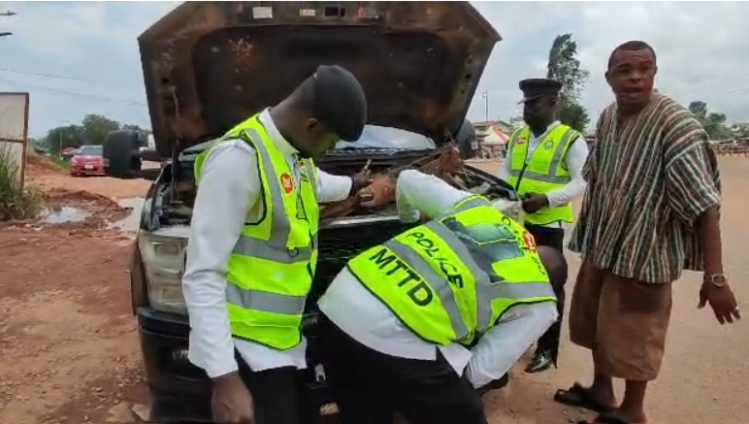
The Motor Traffic and Transport Department (MTTD) of the Ghana Police Service has intensified its enforcement of road traffic regulations, impounding about 700 vehicles during a special operation in the Western Region aimed at eliminating the unlawful use of sirens, beacon lights and strobe lights.
The exercise, conducted in Takoradi and Tarkwa, also led to the removal of numerous unauthorised emergency warning devices from vehicles, including beacon and strobe lights, while seven illegally installed sirens were confiscated.
The operation forms part of a nationwide campaign by the Ghana Police Service to enforce Regulations 65 and 74 of the Road Traffic Regulations, 2012 (L.I. 2180), which restrict the use of emergency warning equipment to authorised state officials and recognised emergency service institutions.
Law enforcement
Speaking to journalists after the exercise, the Director of Education, Research and Training at the MTTD, Assistant Commissioner of Police (ACP) Alexander Kwaku Obeng, said the operation had become necessary because of the growing disregard for the law by some motorists.
He explained that the increasing use of sirens and emergency lights by unauthorised persons not only violated the law but also endangered other road users.
According to him, only the president, specified state officials and approved emergency service organisations are permitted to use sirens, beacon lights and strobe lights in the discharge of their official duties.
Public warning
ACP Obeng cautioned members of the public against fitting their vehicles with prohibited emergency equipment, stressing that the practice creates confusion on the roads and compromises public safety.
He specifically warned chiefs, politicians, pastors, business executives and other vehicle owners to comply with the regulations or risk sanctions.
The senior police officer noted that motorists who unlawfully use emergency lights and sirens often intimidate other road users and contribute to reckless driving behaviour, increasing the risk of road traffic crashes.
ACP Obeng indicated that the enforcement exercise would not be a one-off operation but would continue on a daily basis in the Western Region as part of broader nationwide efforts to improve compliance with road traffic laws.
"Henceforth, you will see the police in Takoradi and in Tarkwa embark on this exercise on daily basis but remember this exercise is also being conducted across the country," he added.
The police have in recent months stepped up enforcement of traffic regulations to improve road safety, reduce indiscipline on the roads and ensure that emergency warning devices are used only for their intended purposes.
Authorities have urged motorists to familiarise themselves with the provisions of the Road Traffic Regulations and refrain from making unauthorised modifications to their vehicles that contravene the law.
Latest Stories
-
Power restoration fault suspected in Kumasi Central Market fire
40 minutes -
The 7-foot giant of Ngleshie Amanfro: Seven-foot Ghanaian Ephraim Saawa dreams of joining the national basketball team
1 hour -
Government promises support for Kumasi Central Market fire victims
1 hour -
Vibes The Movie: Big Ghun’s Ghanaian film earns five nominations at 2026 REFFA
2 hours -
MamaCare CEO warns unresolved conflicts among health workers could undermine maternal and neonatal care
2 hours -
Health professionals urged to translate medical knowledge into practice to save mothers
2 hours -
Conflicts among care providers linked to maternal, neonatal deaths – Expert
4 hours -
GIS marks 10th TIME conference, champions improved teaching practices
4 hours -
BRICS Or Balance? What Ghana’s bid really means
5 hours -
GPRTU wants full TRAFFITECH-GH implementation to start in 2027
5 hours -
Mahama announces plans to import electric wheelchairs for PWDs
5 hours -
KGL U17 Colts 2026: Western beat Prempeh Elite Academy to set up final final with Greater Accra Region
5 hours -
Late Solanke strike salvages 10-man Spurs draw at Man United
5 hours -
Gender Ministry to monitor welfare of Nana Akua Addo’s children amid domestic violence case
6 hours -
Benedict Okyere Yeboah: Ghana’s football problem goes beyond sacking a coach
6 hours