

Audio By Carbonatix
It has emerged that the Prof. Yaa Baidu-Ntiamoah Emoluments Committee commented on the significant inequity between salaries paid to regular Public Servants and Article 71 Office Holders in the country.
In a report sighted by myjoyonline.com, the Committee indicated that as of 2016, ordinary public sector workers earned about six per cent of the monthly average salary of Article 71 Office Holders.
Article 71 Office Holders include the President, the Vice-President, the Speaker of Parliament, the Chief Justice and Justices of the Supreme Court.
The rest are; Members of Parliament (MPs), Ministers of State, political appointees, and public servants with salaries charged to the Consolidated Fund but enjoying special constitutional privileges.
On the other hand, per the Public Services Commission Act, 1994 (Act 482), public sector workers are persons who work in; the Civil Service; Judicial Service; Audit Service; the Audit Service; Education Service; the Prisons Service; Parliamentary Service; the Health Service; Statistical Service; National Fire Service; Customs, Excise and Preventive Service; Internal Revenue Service; Police Service and Immigration Service among others.
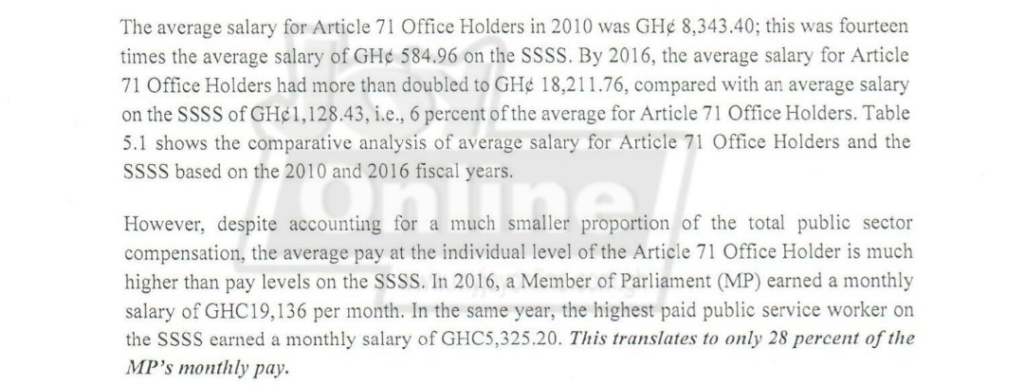
“Despite accounting for a much smaller proportion of the total public sector compensation, the average pay at the individual level of the Article 71 Office Holder is much higher than pay levels on the Single Spine Salary Structure (SSSS). In 2016, a Member of Parliament (MP) earned a monthly salary of GH₵19,136 per month.
"In the same year, the highest-paid public service worker on the SSSS, earned a monthly salary of GH₵5,325.20. This translates to only 28 percent of the MP's monthly pay," parts of the report read.
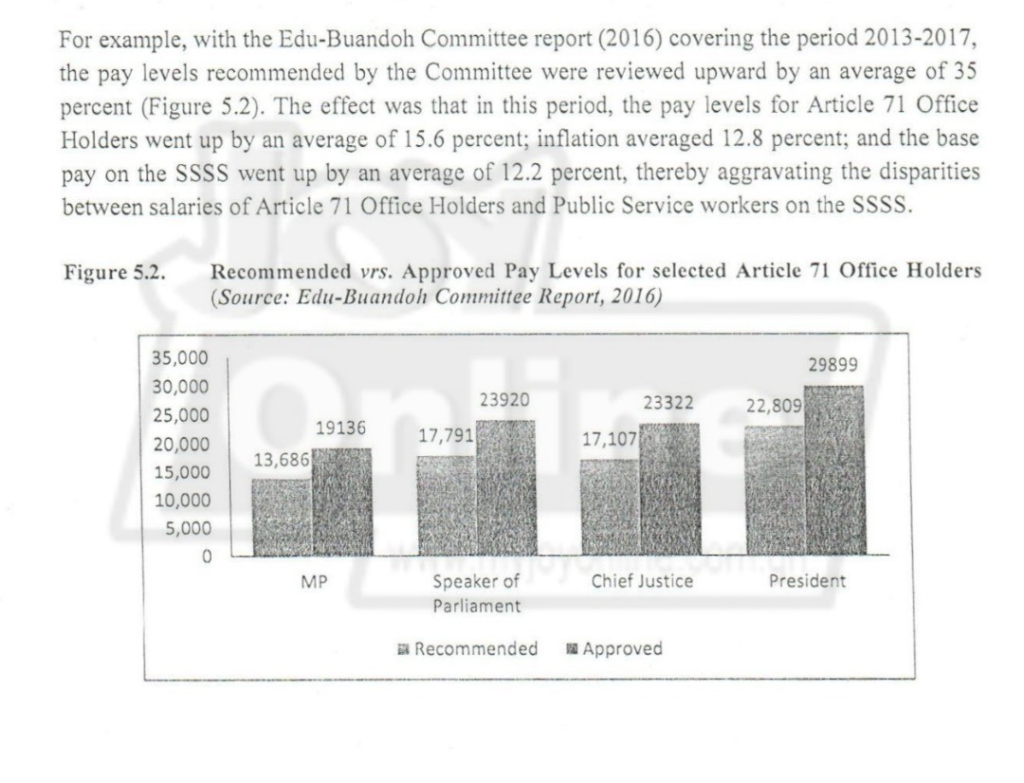
The Emoluments Committee further raised concerns over Parliament and former President Mahama’s decision to vary the previous Emolument Committee’s report to give each Office Holder about GH₵7,000 salary raise per month.
The Committee also noted the salary disparity between Chief Executive Officers of some state agencies and the President. They observed that these CEOs earn higher salaries than the President.
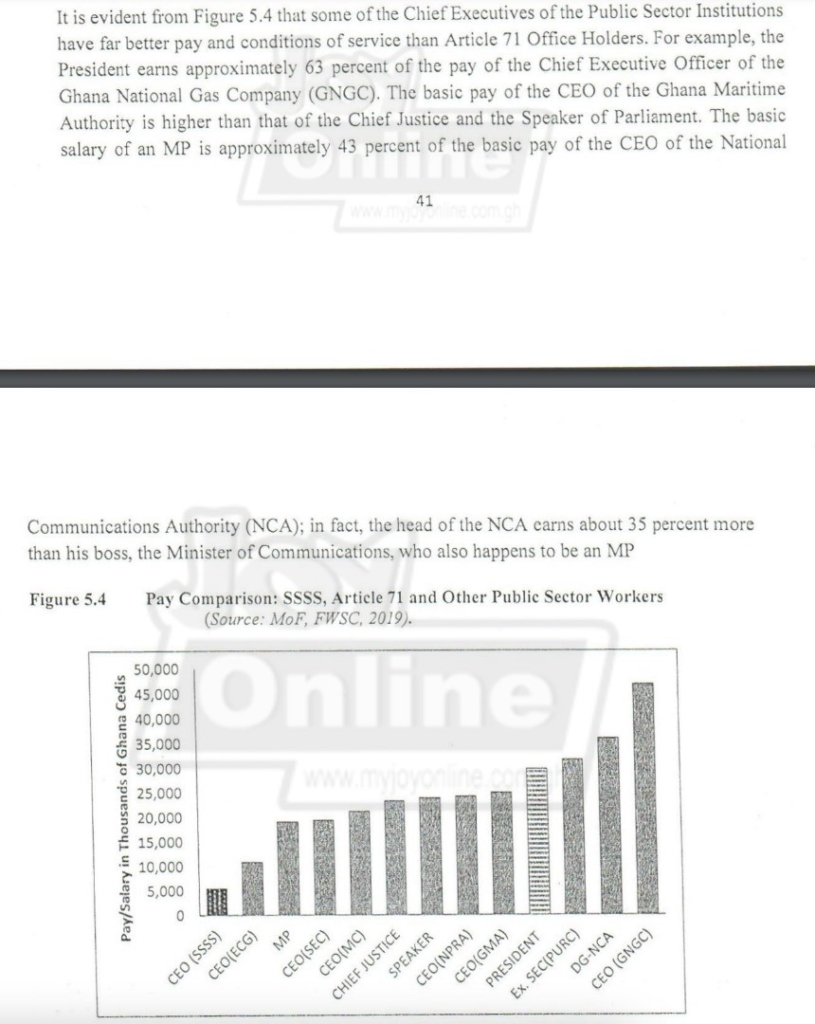
Citing some examples, the Committee said, "the President earns approximately 63 percent of the pay of the Chief Executive Officer of the Ghana National Gas Company (GNGC). The basic pay of the CEO of the Ghana Maritime Authority is higher than that of the Chief Justice and the Speaker of Parliament.
"The basic salary of an MP is approximately 43 percent of the basic pay of the CEO of the National Communications Authority (NCA); in fact, the head of the NCA earns about 35 percent more than his boss, the Minister of Communications, who also happens to be an MP."
Latest Stories
-
Who gave Gbande the EOCO remote control?
3 minutes -
Ghana begins review of 1999 National Land Policy, targets new framework by 2027
42 minutes -
Tiptoe Lane’s tech takeover: The story behind Ghana’s booming informal phone market
2 hours -
Abanga vows to use social media to counter NDC messaging ahead of 2028 elections
2 hours -
Okai Mintah seeks Sabah Zita Benson’s support for NDC National Youth Organiser bid
2 hours -
Okai Mintah vows to strengthen NDC campaign machinery ahead of 2028
2 hours -
Mother of four and Jasikan teacher among new Telecel M’ahitti Promo winners
2 hours -
International Youth Shakers Conclave 2026 set to bring global young leaders to London
2 hours -
Gov’t is committed to addressing teachers’ conditions of service, deprived-area allowance – Education Minister
3 hours -
GoldBod’s structure encouraging galamsey – Afenyo-Markin
3 hours -
Tullow starts selling Jubilee, TEN crude to Ghanaian refineries
3 hours -
Local Government Service authorises rationalisation, redistribution of staff
3 hours -
PURC assures consumers of working to ensure quality services in Northern Region
3 hours -
Ghana develops US$4.28bn water financing framework
3 hours -
Christian Council calls for protection of mission schools’ religious identity
3 hours